
This guide covers homeowners insurance in the United States. Policy language and specific exclusions vary by insurer, and some state regulations add further nuance, so review your own policy’s exact wording alongside this general overview.
Two homes can end up with nearly identical water-stained ceilings, and one homeowner gets a check while the other gets a denial letter. The difference almost always comes down to a single word buried in the policy: sudden. Understanding what that word actually means to an insurer, before you’re standing in a flooded room deciding what to do next, changes how you handle the situation and what you can reasonably expect to be covered.
The Line That Determines Everything: Sudden vs. Gradual
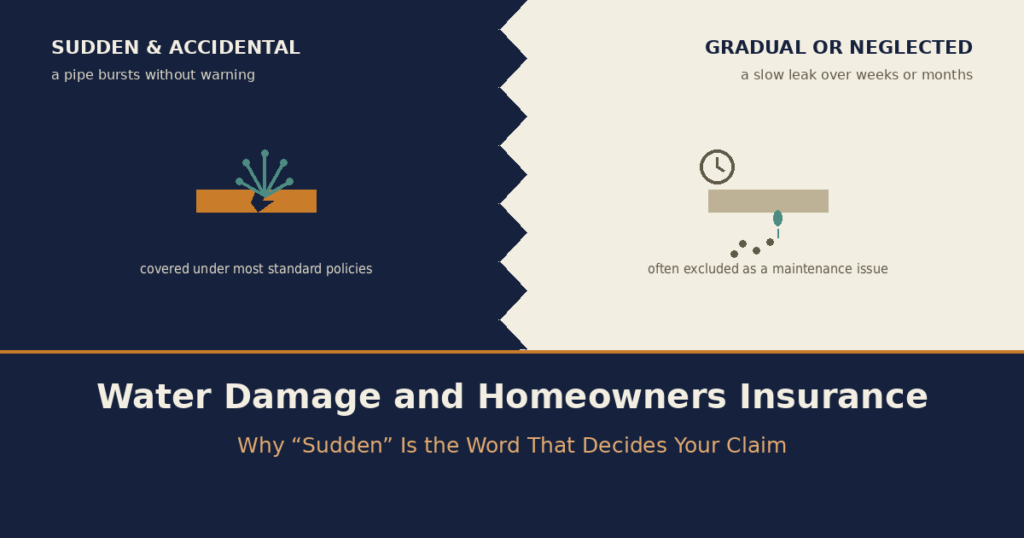
Standard homeowners policies cover water damage that’s sudden and accidental. They exclude damage that develops gradually, from wear, or from deferred maintenance. That single distinction drives more water damage claim disputes than any other factor.
A pipe that bursts because of a sudden freeze is sudden and accidental. A pipe that’s been slowly leaking behind a wall for months, eventually causing mold and rot, is gradual, and insurers treat that very differently, even though the visible damage might look similar by the time you discover it.
The logic behind this split: insurers consider gradual damage preventable through ordinary maintenance. A slow drip under a sink that goes unaddressed for months was something a homeowner reasonably could have caught and fixed before it caused real damage. A pipe bursting without warning wasn’t.
What’s Actually Covered
Common sudden, covered events include a pipe bursting from freezing temperatures, a washing machine supply hose failing unexpectedly, a water heater rupturing without warning, and storm-driven water entering through a roof that a covered peril, like wind or hail, damaged first.
When one of these events is covered, your policy typically responds through a combination of dwelling coverage for structural damage, personal property coverage for damaged belongings, and sometimes liability coverage if the water damage affects a neighboring unit or property. Many policies also cover mold remediation connected to a covered water event, provided it’s caught and addressed quickly, since delayed reporting can complicate or reduce that portion of a claim.
What’s Excluded, and Why It Trips People Up
Gradual leaks and seepage. Continuous or repeated leakage over time, the classic slow drip under a sink or a corroding pipe fitting behind a wall, falls outside standard coverage almost universally. Insurers commonly describe this using language like “continuous or repeated seepage or leakage over a period of time.”
The failed item itself. Even when the resulting water damage is covered, the appliance or pipe that caused it usually isn’t. If your dishwasher fails and floods your kitchen, your policy may pay to repair the damaged floor, but not to replace the dishwasher.
Flooding. This is a separate, frequently misunderstood category. Flood damage, meaning water entering from outside sources like heavy rain, storm surge, or rising rivers, isn’t covered by a standard homeowners policy at all. It requires a completely separate flood insurance policy, regardless of how the water actually entered your home.
Sewer backup. Water or sewage backing up through drains or sewer lines is typically excluded unless you’ve specifically added a sewer backup endorsement to your policy. This is a common and worthwhile add-on, but it doesn’t come standard.
Deferred maintenance and roof age. A roof leak is covered if it results from a sudden, covered peril like wind, hail, or falling debris. It generally isn’t covered if it developed from an aging roof or one that wasn’t properly maintained, and some insurers apply an outright age cutoff, commonly somewhere around 15 to 20 years, beyond which roof-related water damage may face additional scrutiny or exclusion.
Why Documentation Matters More Than You’d Expect
Because the sudden-versus-gradual distinction is genuinely disputable, and because adjusters rely heavily on physical evidence to make that call, how you document a water event matters as much as the event itself.
A clean pipe break from a pressure surge or a hard freeze tends to look different, physically, from a pipe that failed due to slow internal corrosion, and adjusters are trained to look for that difference. If you can, avoid disposing of the failed component before your insurer has a chance to inspect it, since it can be your strongest evidence that the failure was sudden rather than gradual. A plumber’s written report describing exactly how the failure occurred adds real weight to a claim, particularly in a disputed case.
Timing matters too. Reporting a leak promptly, and following your insurer’s guidance on immediate repairs, supports your case. Delaying repairs after you’ve noticed damage, especially after a storm has already compromised your roof, can itself become grounds for a reduced or denied claim, since insurers reasonably expect homeowners to prevent additional damage once they’re aware of a problem.
A Practical Example
Imagine a washing machine supply hose fails without warning overnight, flooding a laundry room and the hallway outside it. This is a sudden, unpredictable event. The homeowner reports it immediately, and their insurer covers the resulting damage to the flooring, drywall, and affected personal property, though not the cost of the hose itself.
Now imagine a different scenario: a small leak under a bathroom sink goes unnoticed for several months, slowly saturating the subfloor and cabinet base until visible damage finally appears. When the homeowner files a claim, the adjuster’s inspection reveals gradual moisture staining and corrosion consistent with a long-term leak, not a sudden failure. This claim is likely to be denied, or only partially covered, precisely because the damage pattern points to something that could have been caught and fixed much earlier.
Same category of damage, fundamentally different outcome, because of how and when the water actually got there.
Common Mistakes to Avoid
- Assuming any water damage is automatically covered. The cause and timeline matter more than the damage itself.
- Confusing water damage coverage with flood insurance. They’re entirely separate products, and no amount of “the water came from outside” reasoning changes that a standard policy excludes flooding specifically.
- Skipping the sewer backup endorsement. It’s optional, inexpensive relative to the risk, and commonly overlooked until a backup actually happens.
- Delaying repairs or reporting. Both can weaken an otherwise valid claim, and mold can begin developing within just one to two days on wet materials, adding urgency beyond the insurance question alone.
Final Thoughts
Whether water damage is covered rarely comes down to how bad it looks. It comes down to how it started, and whether that origin was sudden and accidental or something that built up gradually enough to have been prevented. Understanding that distinction before an incident happens, keeping up with routine maintenance, and documenting any sudden failure promptly and thoroughly are what put you in the strongest position if you ever need to file this kind of claim.
Disclaimer: This article is for general informational purposes only and does not constitute financial, legal, or insurance advice. Coverage terms, exclusions, and endorsement options vary by insurer, policy, and state, and can change over time. Review your policy documents carefully and contact your insurance provider or a licensed insurance professional for advice about your specific situation.
Sources
- Washington State Office of the Insurance Commissioner — “Leaks, water damage and mold,” insurance.wa.gov
- U.S. News & World Report — “Does Homeowners Insurance Cover Water Damage?,” usnews.com
- MoneyGeek — “Does Homeowners Insurance Cover Water Damage?,” moneygeek.com