This guide covers life insurance in the United States. Policy structures, cash value performance, and costs vary by insurer and individual policy, so review specific policy illustrations carefully before buying.
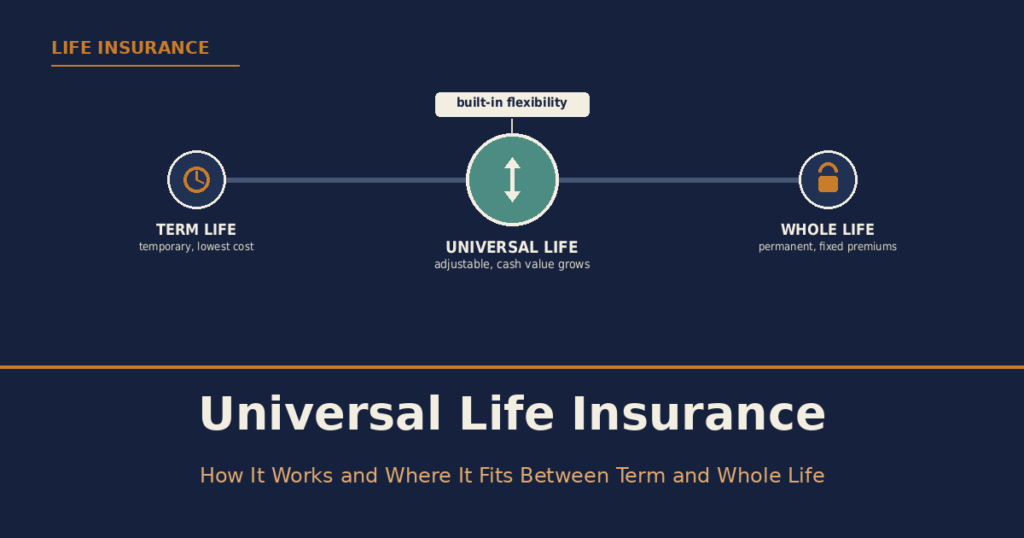
Universal life insurance gets pitched as the flexible middle ground between term and whole life, and in some ways it is. It’s also the type of policy most likely to surprise a policyholder years in, when a cash value that looked healthy on paper turns out not to be, and a policy that seemed secure suddenly needs a much larger premium to stay in force. Understanding how the flexibility actually works is what separates a policy that serves you well from one that quietly runs into trouble.
What Makes It Different From Whole Life
Both universal life and whole life are permanent policies, meaning they’re designed to last your entire life rather than a fixed term, and both build cash value you can access while you’re alive. The difference is in how much is fixed versus adjustable.
Whole life bundles everything into one fixed premium and shows you a single number. The insurer guarantees the cash value growth rate and the premium never changes. Universal life itemizes the same underlying costs separately, and lets you see, and to some extent control, each piece: how much you pay, how large your death benefit is, and how your cash value grows.
That transparency is also where the complexity comes from. Whole life asks little of the policyholder beyond paying the premium. Universal life asks you to actually understand and monitor how the policy is performing.
The Three Adjustable Pieces
Flexible Premiums
Within limits set by the policy and IRS guidelines, you can pay more in years when money is available and less, sometimes down to a set minimum, when it isn’t. This is the feature most often cited as universal life’s biggest advantage over whole life, particularly for people with variable income.
Adjustable Death Benefit
You can typically increase or decrease your coverage amount as your needs change, though increasing coverage usually requires new underwriting, sometimes including a medical exam, since it represents new risk for the insurer.
Cash Value That Moves With a Crediting Rate
Unlike whole life’s guaranteed growth rate, universal life’s cash value grows based on a crediting rate that can be tied to current interest rates, a market index, or in some variable universal life products, to actual investment choices you make within the policy. This means growth isn’t fixed the way it is with whole life, and it can underperform the projections shown when you first bought the policy.
The Mechanism That Causes the Most Problems
Every month, the insurer deducts a cost of insurance charge from your cash value, essentially the price of the actual death benefit coverage that month. This charge is based on your age and the policy’s “net amount at risk,” meaning the death benefit minus your current cash value, and it rises as you get older.
Here’s where the flexibility becomes a real risk rather than just a convenience. If you pay only the minimum premium for an extended period, especially in a lower-interest environment where your cash value grows more slowly than projected, the cost of insurance can eventually outpace what your cash value can cover. When that happens, the insurer may require a substantially higher premium to keep the policy active, or the policy can lapse entirely, potentially with little or no warning if you’re not reviewing your annual statements.
This isn’t a hypothetical concern. Many universal life policies sold decades ago were illustrated using higher interest rate assumptions than what actually materialized in the years since, leaving some policyholders with cash values that depleted far faster than the original projections showed. It’s a documented pattern in the industry, and it’s the single most important reason universal life policies need active monitoring rather than a “buy and forget” approach.
A Practical Example
Imagine someone buys a universal life policy at 40, initially paying more than the required minimum to build cash value early, then dropping to close to the minimum premium in their 50s as other financial priorities compete for their money.
For a while, this works fine, since the accumulated cash value covers the growing cost of insurance charges. But by their late 60s, the cost of insurance has risen substantially with age, and years of minimum funding mean the cash value hasn’t kept pace. The insurer notifies them that their current premium is no longer sufficient to keep the policy in force, and maintaining the same death benefit now requires a significantly higher payment than they’ve been used to.
Had this policyholder reviewed their annual statements against the original illustration and adjusted their funding earlier, this outcome was often avoidable. That’s the core trade-off with universal life: the flexibility is real, but it puts more of the ongoing responsibility on the policyholder than whole life does.
Who Universal Life Tends to Suit
This type of policy tends to work best for people who’ve already maxed out other tax-advantaged accounts, like a 401(k), IRA, and HSA, and want another avenue for tax-deferred growth as part of a broader financial plan. It can also suit business owners using life insurance for buy-sell agreements or key-person coverage, and people who specifically want a permanent death benefit with more control over premium timing than whole life allows.
For most people whose primary goal is straightforward income replacement during their working years, term life insurance typically provides substantially more coverage per premium dollar, without the ongoing monitoring universal life requires.
Common Mistakes to Avoid
- Paying only the minimum premium without understanding the long-term consequence. This is the single most common path to an unexpected lapse or premium increase later in the policy’s life.
- Assuming the original illustration is a guarantee. Illustrated growth rates are projections, not promises, and actual performance can fall meaningfully short, particularly during periods of lower interest rates.
- Never reviewing annual statements against the original projections. Universal life specifically requires this kind of ongoing check, unlike whole life, which largely runs on its own once funded.
- Treating withdrawals as tax-free the same way the death benefit is. Withdrawals beyond what you’ve paid into the policy are generally taxed as income, a distinction that surprises some policyholders.
Final Thoughts
Universal life insurance offers real flexibility that whole life doesn’t: adjustable premiums, an adjustable death benefit, and visibility into the policy’s actual costs. That same flexibility shifts real responsibility onto the policyholder, since underfunding the policy for too long can quietly erode the cash value and threaten the coverage itself. For the right buyer, usually someone with fluctuating income, a specific tax-planning goal, or the discipline to actively monitor the policy over decades, it can be a genuinely useful tool. For someone who just wants predictable, lifelong coverage without ongoing management, whole life or, for many people, term life remains the simpler fit.
Disclaimer: This article is for general informational purposes only and does not constitute financial, legal, or tax advice. Policy structures, crediting rates, costs of insurance, and performance vary by insurer and individual policy, and past performance shown in any illustration is not a guarantee of future results. Consult a licensed insurance agent or fee-only financial advisor for advice about your specific situation.
Sources
- Guardian Life — “Universal Life Insurance: What it is, How it works,” guardianlife.com
- MoneyGeek — “What Is Universal Life Insurance?,” moneygeek.com
- eMedicare — “Universal Life Insurance Explained,” emedicare.com