This guide covers life insurance in the United States. Rules around cash value, taxation, and free-look periods can vary by state, so check your policy documents for the specifics that apply to you.
Life insurance shopping usually starts with one confusing moment. You ask for a quote, and the price for “term” and the price for “whole life” look like they belong to two different products entirely. In a sense, they do. Both pay a death benefit to your family. Beyond that, they work in very different ways, and the right one depends on what problem you’re actually trying to solve.
What Term Life Insurance Actually Is
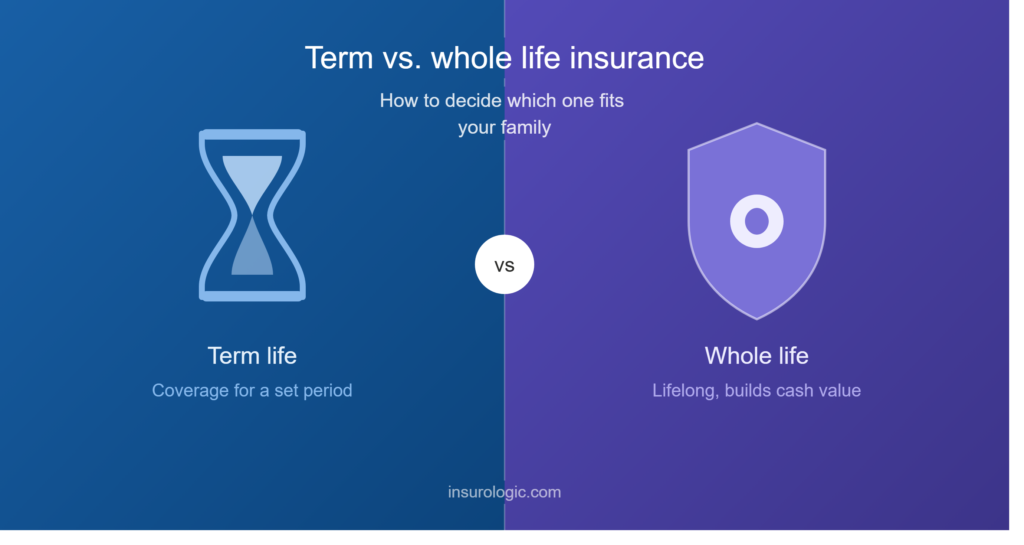
Term life insurance covers you for a set number of years, usually 10, 20, or 30. If you die during that window, your beneficiaries receive the death benefit. If you outlive the term, the coverage simply ends. You don’t get any money back.
That structure is exactly why term is inexpensive. You’re paying for pure risk protection during a defined stretch of time, with no savings component attached. Most term policies use level premiums, meaning your payment stays the same for the entire term.
Term life fits a specific kind of need well: covering the years when your family would struggle financially without your income. A 20-year term policy taken out when your kids are young can line up neatly with the years before they’re financially independent. A term matched to your mortgage can cover the payoff period on your loan.
The Trade-Off With Term
If you outlive your policy, coverage ends. Some policies let you renew or convert to permanent coverage, but pricing at that point is usually based on your age when you renew, not your original age. That can make renewal expensive, especially later in life.
What Whole Life Insurance Actually Is
Whole life insurance is a form of permanent coverage. It lasts your entire life, as long as you keep paying premiums, and it includes a cash value component that grows over time on a tax-deferred basis. Some policies also pay dividends, though dividends aren’t guaranteed and vary by insurer.
The cash value is not the same as the death benefit. It’s a separate savings-like balance inside the policy. You can typically borrow against it or withdraw from it while you’re alive, though doing so can reduce the death benefit if the loan isn’t repaid.
Because whole life combines lifelong coverage with this savings feature, it costs substantially more than term for the same death benefit. Depending on age, health, and the specific policy, whole life premiums commonly run several times higher than term premiums for equivalent coverage, and the gap tends to widen the older you are when you buy.
Where Whole Life Tends to Make Sense
Whole life is often considered for goals that don’t have a clear end date. Estate planning, leaving a guaranteed inheritance, covering final expenses, or providing for a dependent who will need lifelong support are common reasons people choose it over term. It can also appeal to people who’ve already maxed out other tax-advantaged savings and want a low-risk, guaranteed-growth component as part of a broader financial plan.
Comparing the Two Directly
| Term life | Whole life | |
|---|---|---|
| Coverage length | Fixed period (10–30 years) | Lifetime, while premiums are paid |
| Cost | Lower | Substantially higher for the same death benefit |
| Cash value | None | Builds over time, tax-deferred |
| Complexity | Simple | More moving parts to understand |
| Best fit | Temporary needs, income replacement | Permanent needs, estate planning |
A Practical Example
Imagine two people, both 35 and in good health, each buying $500,000 in coverage.
The first buys a 20-year term policy. Their premium is relatively low and stays fixed for 20 years. If they die during that period, their family receives $500,000. If they’re still alive at year 21, the policy ends, and they’ve paid for pure protection during the years their coverage mattered most.
The second buys a whole life policy for the same death benefit. Their premium is significantly higher and continues for as long as they keep the policy active. In exchange, part of every payment builds cash value they can access later, and the coverage doesn’t expire as long as premiums are paid.
Neither approach is inherently better. The term buyer paid far less for coverage during the years they needed it most, but has nothing to show for it if they outlive the term. The whole life buyer pays more, but keeps coverage for life and builds a cash value they can tap into.
A Common Strategy Worth Knowing About
Some financial commentators describe an approach often summarized as “buy term and invest the difference.” The idea is to buy a lower-cost term policy for the coverage you need, then invest the money you would have spent on whole life premiums separately, such as in a retirement account.
This isn’t universally the better approach. It requires the discipline to actually invest that difference consistently, and it assumes market-based returns will outperform a whole life policy’s guaranteed cash value growth over your time horizon. For some households, the guaranteed nature of whole life’s cash value is worth the lower expected return. This is exactly the kind of trade-off worth discussing with a licensed financial professional who can look at your full situation.
Common Mistakes to Avoid
- Buying whole life you can’t sustain long-term. A lapsed policy means losing the coverage and often losing the cash value you’ve built, which is a costly outcome.
- Assuming term is wasted money if you don’t die during the term. You’re paying for risk protection during a specific window, similar to how you’d view car or home insurance.
- Not matching your term length to your actual need. A term that ends before your mortgage is paid off or before your kids are financially independent can leave a real gap.
- Treating whole life’s cash value as a high-growth investment. Its internal growth rate is typically modest compared to market-based investing, and it functions more as a guaranteed, low-risk component than a wealth-building engine.
What to Actually Do Next
A commonly cited starting point is coverage worth roughly 10 to 12 times your annual income, though your actual number depends on debts, dependents, and existing savings. From there, the term-versus-whole-life decision usually comes down to two questions: how long do you actually need the coverage, and how much can you comfortably commit to paying for it over time. A licensed insurance agent or a fee-only financial planner can run these numbers against your specific situation, including any tax considerations tied to cash value or estate planning.
Final Thoughts
Term and whole life insurance solve different problems. Term is generally the more affordable way to protect your family’s income during a defined stretch of years. Whole life costs more, but it offers permanent coverage and a savings component that some households value for estate planning or lifelong dependents. There’s no universally right answer, only the one that matches your actual timeline, budget, and goals.
Disclaimer: This article is for general informational purposes only and does not constitute financial, legal, or insurance advice. Coverage options, premiums, cash value growth, and tax treatment vary by insurer, policy, state, and individual circumstances, and can change over time. Review your policy documents carefully and contact a licensed insurance agent or a financial professional for advice about your specific situation.
Sources
- NerdWallet — “Term Life vs. Whole Life Insurance,” nerdwallet.com
- Fidelity — “Term vs. whole life insurance: What’s the difference?,” fidelity.com
- Guardian Life — “Term vs. whole life insurance: What’s the difference?,” guardianlife.com
- National Association of Insurance Commissioners (NAIC) — naic.org