This guide covers life insurance in the United States. Conversion rules, deadlines, and available permanent products vary significantly by insurer and by policy, so review your specific contract or ask your insurer directly before relying on the details below.
Most people buy term life insurance and never think about it again until the policy is close to expiring. Buried in many of those policies, though, is a feature worth knowing about well before that point: the right to convert some or all of the coverage into a permanent policy, without a new medical exam, regardless of what’s happened to your health since you first bought it.
What Conversion Actually Is
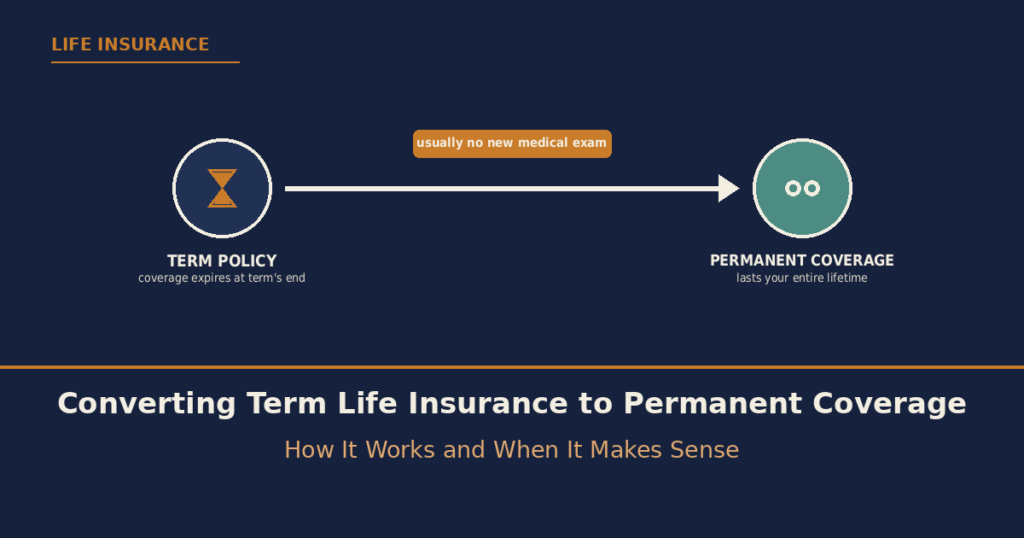
A term conversion lets you exchange some or all of a term policy’s death benefit for a permanent policy, typically whole life or universal life, from the same insurer. The defining feature is that it generally requires no new evidence of insurability: no medical exam, no new health questionnaire, no underwriting review of your current condition.
That detail matters more than it might first appear. If your health has changed since you bought your original term policy, even significantly, a conversion can secure permanent coverage you might not qualify for, or would qualify for only at a much higher cost, if you applied for a brand-new policy today.
Not Every Policy Offers This, and the Window Is Limited
Most term policies sold today include a conversion provision, but it isn’t universal, and the terms vary considerably by insurer. Confirming whether your specific policy is convertible, and under what conditions, is something to check in your policy documents or with your insurer directly rather than assume.
Conversion windows are also time-limited. A common structure ties the conversion deadline to either the end of the policy’s level premium period or a maximum attained age, often somewhere in the range of 65 to 75, whichever comes first. Some insurers allow conversion for the entire term length; others restrict it to an earlier window, sometimes just the first several years of a longer term policy. Missing this deadline means losing the guaranteed right to convert, and you’d need to apply for new coverage through ordinary underwriting instead.
Two Different Ways Insurers Price a Conversion
This is the detail that varies most between insurers, and it’s worth understanding clearly, since the two approaches can produce meaningfully different costs.
Attained age conversion prices the new permanent policy based on your age at the time you actually convert. This generally results in a higher ongoing premium than an original age conversion would, but it doesn’t require any lump sum payment at the time of conversion.
Original age, or issue age, conversion prices the new policy as though you’d purchased it back when you first bought your original term policy. This produces a lower ongoing premium, but it typically requires paying a lump sum at conversion, covering the difference between what you actually paid in term premiums and what you would have paid had you held the permanent policy since the original issue date, often with interest included.
Not every insurer offers both options. Some only provide attained age conversion; others offer a choice between the two. Which option makes more financial sense depends on how much lump sum you’d be asked to pay versus how much the higher ongoing premium would cost over time, a comparison worth running with an agent rather than guessing.
What You Can Actually Convert To
Insurers generally limit conversion to specific permanent products they currently offer, commonly whole life or universal life, and the exact lineup varies by company. You typically can’t convert to another term policy, and most insurers won’t let you increase your coverage amount during conversion, though converting to a lower death benefit than your original term policy is usually allowed if that fits your needs or budget better.
A Practical Example
Imagine someone who bought a 20-year term policy at 35 and is later diagnosed with a health condition at 50 that would make new coverage difficult or expensive to obtain. If their policy’s conversion window is still open, they can convert some or all of their remaining death benefit to a permanent policy without any new health questions, locking in coverage their current health might otherwise put out of reach.
Now imagine their insurer offers both attained age and original age conversion. Under attained age conversion, their new permanent premium reflects their current age of 50, with no lump sum due. Under original age conversion, their premium would be priced as if they’d bought the permanent policy at 35, but they’d owe a lump sum covering the gap between their actual term payments and what those years of permanent premiums would have cost. Depending on how large that lump sum is and how long they expect to keep the policy, one option could clearly outperform the other financially, which is exactly the kind of comparison worth running with a financial professional before deciding.
Why People Convert
A few common situations make conversion worth considering. A health change since the original policy was issued is the most common reason, since conversion sidesteps new underwriting entirely. A desire for permanent, lifelong coverage, rather than a policy that eventually expires, is another. Some people also convert specifically to access a permanent policy’s cash value component as part of a broader financial or estate planning strategy, particularly later in life when a permanent policy’s savings feature becomes more relevant to their goals.
Common Mistakes to Avoid
- Not knowing your policy’s conversion deadline until it’s already passed. This is consistently described as one of the most underused, and most missed, features in term life insurance.
- Assuming your policy is convertible without checking. Not every term policy includes this provision, and terms vary enough between insurers that it’s worth confirming directly.
- Choosing attained age or original age conversion without comparing the actual numbers. The better option depends on your specific lump sum cost versus the ongoing premium difference, not a general rule that favors one over the other.
- Waiting until health has declined further to explore conversion. The value of this option is highest precisely when new medical underwriting would work against you, which makes it worth understanding well before that becomes urgent.
Final Thoughts
Term conversion is a feature many policyholders don’t even know they have, and it’s worth checking your own policy for it, particularly if your health circumstances have changed since you first bought coverage. Understanding your specific conversion deadline, which permanent products are available to you, and whether your insurer prices conversion by attained age or original age, are the details that determine whether this option ends up being valuable or irrelevant when you actually need it.
Disclaimer: This article is for general informational purposes only and does not constitute financial, legal, or insurance advice. Conversion provisions, deadlines, available permanent products, and pricing structures vary significantly by insurer and policy, and can change over time. Review your policy documents and consult a licensed insurance agent or financial advisor for advice about your specific situation.
Sources
- Thrivent — “Life Insurance Conversion: How Term to Permanent Conversion Works,” thrivent.com
- MoneyGeek — “What is Convertible Term Life Insurance?,” moneygeek.com
- AccuQuote — “How Term Life Conversion Works,” accuquote.com
- Midland National — “How term life insurance conversion works,” midlandnational.com