
This guide covers homeowners, condo, and renters insurance in the United States. Sublimits, floater terms, and pricing vary by insurer, so confirm the specifics of your own policy before assuming a figure here applies to you.
Most people assume their homeowners or renters policy simply covers their belongings, full stop. For everyday items, that’s roughly true. For jewelry, fine art, and other high-value possessions, it usually isn’t, and the gap can be far larger than most people realize until they’re filing a claim.
The Sublimit Problem Hiding in Your Policy
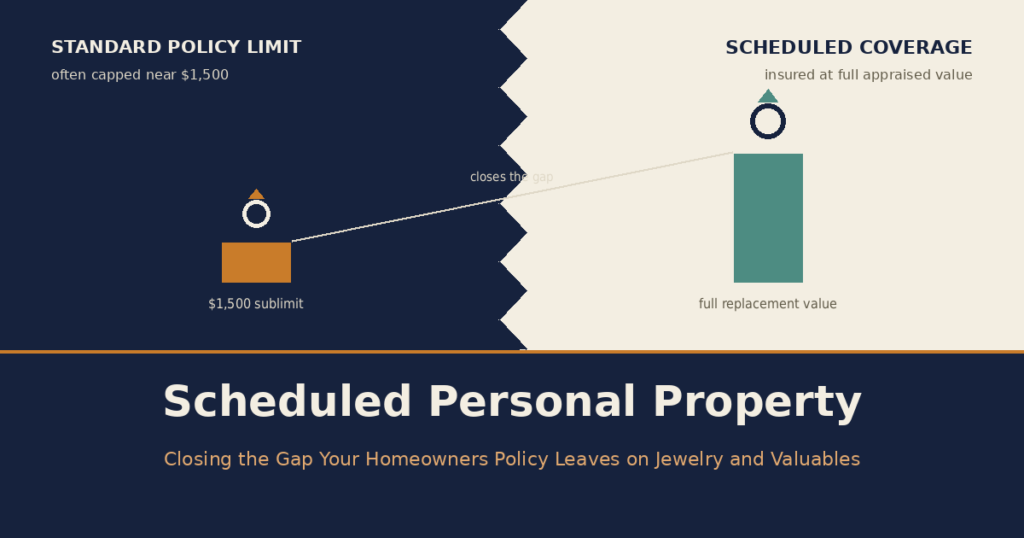
Standard homeowners, condo, and renters policies do cover personal property, but certain categories carry sharply reduced coverage caps, called sublimits, regardless of what those items are actually worth. Jewelry is the most common example. A typical policy might cap jewelry coverage somewhere around $1,000 to $2,500 total, no matter how much jewelry you actually own or what any individual piece is worth.
That means a single $10,000 engagement ring, insured only under a standard policy, might be covered for a small fraction of its value if it’s lost or stolen. The remaining loss would be entirely out of pocket. Firearms, fine art, silverware, and collectibles typically carry similar sublimits, each capped well below what a serious collection or a handful of valuable pieces would actually be worth to replace.
What Scheduled Personal Property Coverage Actually Does
A scheduled personal property endorsement, sometimes called a personal articles floater or, more formally, inland marine coverage, lets you list specific high-value items individually, each insured for its own appraised or agreed value. Once an item is scheduled, that sublimit no longer applies to it. If your $10,000 ring is scheduled at that value, a covered loss pays the full $10,000, not the standard policy’s sharply lower jewelry cap.
Beyond removing the sublimit, scheduled coverage typically comes with real advantages a standard policy doesn’t offer.
No deductible, usually. Most scheduled item claims are paid without a deductible applying, unlike a standard homeowners claim.
Broader coverage for how the loss happens. Standard policies generally only cover named perils like theft or fire. Scheduled coverage commonly extends to accidental loss too, the classic example being a ring that slips off in a sink drain or falls out of a pocket, situations a standard policy typically wouldn’t cover at all.
Coverage that travels with you. Scheduled items are generally covered worldwide, not just at your home address, which matters if you travel with jewelry or transport valuable items for any reason.
What You’ll Need to Get an Item Scheduled
Insurers generally want documentation establishing the item’s value before they’ll schedule it: a recent appraisal, a purchase receipt, or in some cases photographs alongside other supporting documentation. For jewelry and fine art especially, a professional appraisal is the standard way to establish the value your coverage, and your future claim payout, will be based on.
That appraised value isn’t necessarily permanent. Jewelry and art values can shift over time with market conditions, so periodically updating your appraisal, commonly suggested every two to five years depending on the source and item type, keeps your scheduled coverage aligned with what the item would actually cost to replace today.
Scheduled vs. Blanket Coverage
Scheduling isn’t the only way to expand coverage beyond a standard sublimit. Some insurers also offer blanket coverage, a higher overall limit for a category like jewelry as a whole, without requiring an appraisal for each individual piece.
Blanket coverage tends to work well for a collection of moderate-value items where no single piece justifies an individual appraisal, while scheduling makes more sense for your highest-value individual pieces, where full appraised-value protection matters most. Many people reasonably use both together: scheduling their most valuable items individually while relying on a blanket limit, or simply their standard policy’s sublimit, for lower-value pieces.
A Practical Example
Imagine someone with a $12,000 engagement ring and a modest collection of other jewelry worth around $3,000 combined, all covered only under a standard homeowners policy with a $1,500 jewelry sublimit.
If the ring is lost, this policy would pay only up to that $1,500 sublimit, regardless of the ring’s actual value, leaving a loss of well over $10,000 uncovered.
Now imagine the same person scheduled the ring individually at its $12,000 appraised value, while adding blanket coverage for the remaining jewelry. If the ring is lost, the scheduled endorsement pays the full $12,000, likely without a deductible, and the remaining jewelry stays covered under the blanket limit for whatever befalls it separately.
Common Mistakes to Avoid
- Assuming standard coverage is enough because “it’s homeowners insurance.” Sublimits on jewelry, art, and similar categories are standard practice across insurers, not a gap unique to any one policy.
- Not updating appraisals over time. A scheduled value that hasn’t been reappraised in years may no longer reflect what the item would actually cost to replace today.
- Scheduling only some items in a collection. If you own several valuable pieces, review the full set rather than assuming one appraisal covers everything you’d want protected.
- Forgetting to notify your insurer about new valuable items. A newly purchased or inherited piece isn’t automatically covered at full value until you’ve actually had it scheduled or added to a blanket limit.
Final Thoughts
The gap between what a standard policy covers and what your valuables are actually worth is one of the more common, and more fixable, blind spots in home insurance. Scheduling your highest-value items, and keeping their appraisals current, closes that gap directly, and it’s often a relatively affordable addition compared to the exposure it removes. Reviewing your jewelry, art, and other valuables against your policy’s actual sublimits is worth doing before you assume you’re covered, not after a loss reveals you weren’t.
Disclaimer: This article is for general informational purposes only and does not constitute financial, legal, or insurance advice. Sublimits, scheduling requirements, appraisal standards, and costs vary by insurer and policy type, and can change over time. Review your policy documents and contact your insurance provider or a licensed insurance professional for advice about your specific situation.
Sources
- U.S. News & World Report — “What Is Scheduled Personal Property Coverage?,” usnews.com
- Insurance.com — “What is scheduled personal property coverage?,” insurance.com
- Bankrate — “Scheduled personal property,” bankrate.com