This guide covers business insurance in the United States. Coverage terms, required limits, and costs vary by industry and insurer, so confirm specifics with a licensed commercial insurance agent.
A common assumption trips up a lot of retailers and resellers: if you didn’t manufacture a product, you can’t be held responsible when it hurts someone. Under most state product liability laws, that’s not how it works. Manufacturers, distributors, and retailers can all be named in the same lawsuit, regardless of who actually made the defective item.
What Product Liability Insurance Actually Covers
Product liability insurance covers bodily injury and property damage caused by a product your business manufactures, distributes, or sells. Coverage generally responds to three broad categories of defect claims: manufacturing defects, where something went wrong in how a specific unit was made; design defects, where the product’s underlying design itself is inherently dangerous; and failure-to-warn claims, where a product lacked adequate instructions or warning labels for a foreseeable risk.
Coverage typically includes the cost of a third party’s bodily injury or property damage, along with legal defense costs and court costs if a claim goes to trial, regardless of whether the claim is ultimately found to have merit.
Why the Entire Supply Chain Can Be Liable
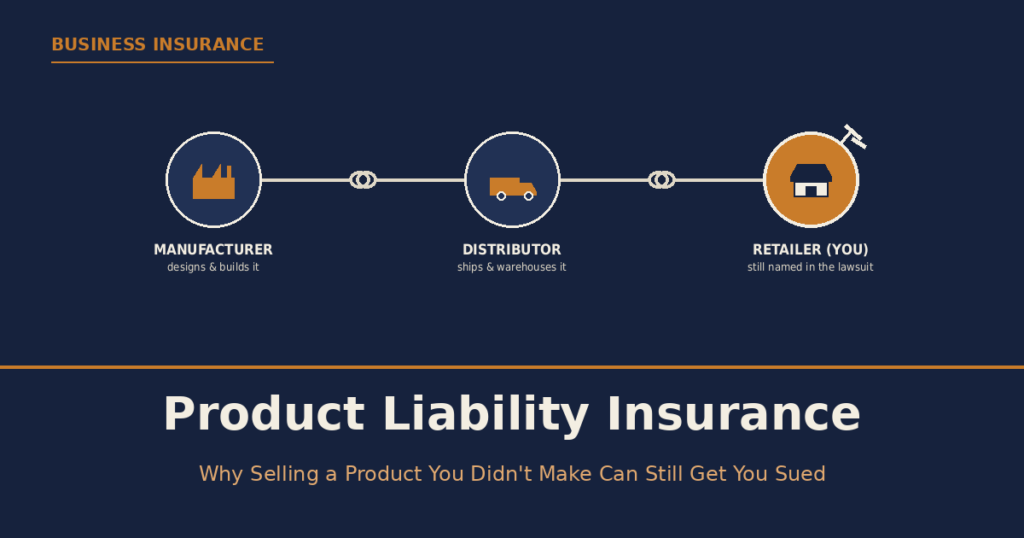
Many state laws hold every party in the chain of commerce potentially responsible for a defective product, from the company that designed and manufactured it, to the distributor, to the retailer that ultimately sold it to the customer. Under strict liability principles that apply in product cases in most states, a plaintiff generally doesn’t need to prove negligence, only that the product was defective and that the defect caused their injury.
This matters enormously for retailers, distributors, and importers who never touched the manufacturing process. If a customer can’t locate or successfully pursue the original manufacturer, perhaps because it’s a foreign company, has gone out of business, or is otherwise hard to reach, the retailer or distributor further down the chain can become the practical target of the lawsuit instead.
Online sellers face this same exposure. Marketplace platforms increasingly require sellers to carry product liability coverage as a condition of doing business on their platform, and dropshippers and resellers carry real liability exposure even though they never physically handle the product themselves.
What Standard Coverage Doesn’t Include
Product liability insurance covers harm the product causes to others. It generally doesn’t cover the cost of the product itself failing or needing replacement, and it doesn’t cover the cost of transporting the product. If a defective component fails and simply needs to be replaced with no resulting injury, that replacement cost typically isn’t a product liability claim at all.
Recall costs are a separate and commonly misunderstood exclusion. Standard product liability coverage generally doesn’t pay for the costs of notifying customers, retrieving products from the market, or replacing recalled inventory. Businesses facing meaningful recall exposure, particularly in categories like food, children’s products, or supplements, may want to ask specifically about product recall coverage as a separate endorsement.
Coverage also generally excludes claims tied to known defects. Selling a product you already knew was dangerous, rather than a defect that wasn’t reasonably foreseeable, can void coverage entirely, since insurance is built around unforeseen risk rather than knowingly shipping a hazardous product.
Who Actually Needs This Coverage
Any business that manufactures, distributes, wholesales, or retails a physical product carries some degree of this exposure. Certain categories face meaningfully elevated risk and warrant particular attention: food and beverage producers, children’s product manufacturers and retailers, consumer electronics brands, supplement and health product companies, and toy or sporting goods makers all appear consistently as higher-risk categories across industry guidance.
For most small businesses, product liability coverage is included as part of a broader general liability policy, often under a component called “products and completed operations” coverage, rather than sold as a fully separate policy. Standalone product liability coverage becomes more relevant in three situations: your specific product category is excluded from standard general liability forms, which is common for items like firearms, certain chemicals, or supplements making health claims; your sales volume is high enough that standard limits may not be adequate; or a contract, such as a large retailer’s vendor agreement, specifically requires standalone coverage.
How Much Coverage Is Typically Appropriate
Industry sources commonly describe $1 million per occurrence and $2 million in aggregate coverage as a standard baseline limit, though the appropriate amount for your specific business depends on your product category, sales volume, and any contractual requirements from retailers or platforms you sell through.
What It Actually Costs
Since product liability coverage is usually bundled into a general liability policy rather than priced entirely separately, cost figures across sources vary depending on exactly what’s being measured. Some sources cite an average small business cost somewhere in the range of $50 to $100 a month, translating to roughly $600 to $1,200 a year, for standard-risk retail or small manufacturing exposures at typical limits. Higher-risk categories, including manufacturers in general and certain product types specifically, can see meaningfully higher premiums, with some manufacturing-specific sources describing general liability costs alone in the range of $500 to $1,500 a year before factoring in product-specific risk. Given how much these figures vary by product category, sales volume, and claims history, getting a specific quote for your business and product type is the only reliable way to know your actual cost.
A Practical Example
Imagine a small retailer that sells imported kitchen gadgets, none of which they manufacture themselves. A customer is injured when one of these products malfunctions, and the manufacturer, based overseas, is difficult to locate and pursue directly. Under many states’ product liability laws, the retailer can still be named in the resulting lawsuit, simply for having sold the defective item, regardless of having no role in its design or manufacturing.
With product liability coverage in place, the retailer’s insurer covers the legal defense costs and any resulting settlement or judgment, up to the policy’s limit. Without it, the retailer would face this claim, and its legal costs, entirely out of pocket, potentially for a defect they had no ability to detect or prevent.
Common Mistakes to Avoid
- Assuming you’re protected because you didn’t manufacture the product. Retailers and distributors are frequently named in product liability claims regardless of their role in production.
- Not asking about recall coverage if your product category is recall-prone. Standard coverage generally excludes these costs, and they can be substantial.
- Underestimating coverage limits based on old sales volume. As your revenue and distribution grow, your realistic exposure grows with it, and your coverage should be reviewed accordingly.
- Assuming a marketplace platform’s own coverage protects you. Sellers are frequently required to carry their own coverage as a condition of using a platform, not covered under the platform’s own policy.
Final Thoughts
Product liability exposure follows a product through its entire path to the customer, not just its point of manufacture, which is exactly why retailers, distributors, and importers carry real risk even when they never touched the design or production process. Confirming whether your existing general liability policy adequately covers your specific product category, or whether you need standalone coverage, is worth a direct conversation with a commercial insurance agent familiar with your industry.
Disclaimer: This article is for general informational purposes only and does not constitute financial, legal, or insurance advice. Coverage terms, required limits, exclusions, and costs vary by industry, product category, and insurer, and can change over time. Contact a licensed commercial insurance agent or broker for advice about your specific business.
Sources
- Forbes Advisor — “Product Liability Insurance: Coverage & Costs,” forbes.com
- U.S. Chamber of Commerce (CO—) — “Product Liability Insurance: What Small Businesses Need,” uschamber.com
- Insureon — “Product Liability Insurance Cost,” insureon.com