This guide covers federal surprise medical billing protections in the United States. State laws add further protections in some areas, particularly ground ambulance billing, so check your specific state’s rules alongside the federal law described here.
A surprise medical bill used to be one of the most common ways an unavoidable emergency turned into a lasting financial problem. You’d get care at an in-network hospital, and days later, discover the anesthesiologist or radiologist who treated you wasn’t actually in your network, leaving you responsible for the difference. The No Surprises Act, in effect since January 1, 2022, closed much of that gap. It didn’t close all of it, and knowing exactly where the remaining holes are matters as much as knowing what’s protected.
What Balance Billing Actually Means
Balance billing happens when an out-of-network provider bills you for the difference between what they charged and what your insurer paid. Before this law, that difference could be substantial, and patients often had no idea a specific provider involved in their care was out-of-network until the bill arrived.
The No Surprises Act doesn’t eliminate out-of-network billing entirely. It specifically prohibits balance billing in certain defined situations, while leaving other situations, deliberately or through gaps in the law, still exposed.
What’s Actually Protected
Emergency Care, Regardless of Network Status
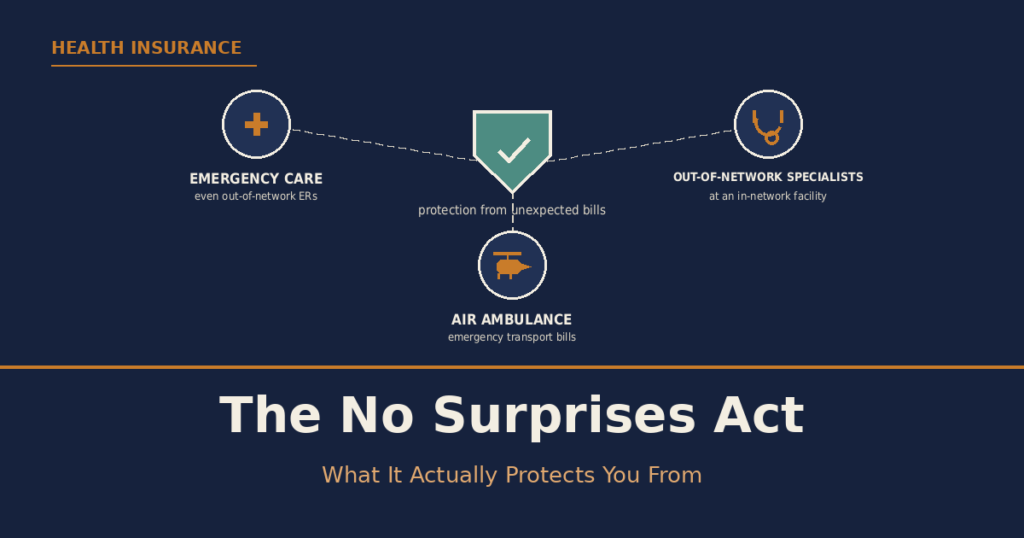
If you receive emergency care, the law protects you from balance billing even if the emergency facility or the treating physicians turn out to be out-of-network. This applies even without prior authorization, since emergencies don’t allow time for network verification. Your cost-sharing is limited to what you’d owe for in-network care, and that amount counts toward your in-network deductible and out-of-pocket maximum, not a separate, higher out-of-network one.
Post-stabilization care generally remains protected too, until you’re stable enough to provide informed written consent to continue out-of-network care voluntarily.
Out-of-Network Providers at In-Network Facilities
This is the scenario that catches the most people off guard: you deliberately choose an in-network hospital or surgical center, but a specific provider involved in your care, an anesthesiologist, a radiologist, an assisting surgeon, turns out to be out-of-network. The law protects you here too. You owe only your in-network cost-sharing amount, regardless of that individual provider’s network status.
Air Ambulance Transport
Out-of-network air ambulance services are covered by the federal law. Your cost-sharing can’t exceed what you’d owe for in-network air transport, and the company can’t bill you for the remaining difference.
The Biggest Gap: Ground Ambulance
Here’s the exception that surprises the most people: ground ambulance transport is explicitly excluded from the federal No Surprises Act. If you’re transported by an out-of-network ground ambulance, current federal law still allows that provider to balance bill you for the full difference.
This gap matters more than it might sound, since a large share of ground ambulance trips generate an out-of-network charge in practice. Some states have stepped in with their own ground ambulance billing protections, and as of 2026, roughly 22 states have enacted some form of this protection, though the details, and which plans they actually cover, vary. These state protections generally apply to state-regulated, fully insured plans. Self-funded employer plans, which cover a large share of privately insured workers, are governed by federal ERISA rules and are generally exempt from state-level protections in this area, leaving a meaningful group of patients still exposed even in states with their own ambulance billing laws.
Checking your specific state’s rules, and understanding whether your employer plan is fully insured or self-funded, is the only way to know where you actually stand on this specific gap.
Other Situations Where Balance Billing Can Still Happen
Beyond ground ambulances, a few other situations remain outside the law’s protection.
Scheduled, voluntary out-of-network care. If you knowingly and voluntarily choose an out-of-network provider for non-emergency care, and that provider gives you a written notice explaining that No Surprises Act protections don’t apply, along with a consent form you sign, they can legally balance bill you. This is sometimes called the notice-and-consent exception, and it exists specifically for situations where you’re making an informed, voluntary choice rather than being surprised.
Care outside the law’s covered plan types. The law’s protections generally apply to group health plans, employer coverage, Marketplace plans, and individually purchased insurance. If you’re uninsured or paying out of pocket, a related but separate provision requires providers to give you a Good Faith Estimate of expected costs before treatment, and you have the right to dispute a final bill that comes in $400 or more above that estimate.
A Practical Example
Imagine someone who goes to an in-network emergency room after a serious accident. The treating physician turns out to be an out-of-network contractor, something the patient had no way of knowing or controlling in the moment. Under the No Surprises Act, this patient owes only their normal in-network cost-sharing, not a balance bill for the physician’s full out-of-network charge.
Now imagine the same person is transported to that hospital by a ground ambulance that happens to be out-of-network. For that specific portion of the bill, federal protection doesn’t apply. Whether they’re protected from a balance bill for the ambulance ride depends entirely on whether their state has its own ground ambulance law, and whether their specific health plan is fully insured or self-funded.
Same overall incident, two different bills, and two different levels of legal protection, purely based on which part of the care is involved.
What to Do If You Get a Bill You Believe Violates the Law
If you receive a bill that appears to violate your protections under the No Surprises Act, you can dispute it. The federal government operates a No Surprises Help Desk through the Centers for Medicare & Medicaid Services specifically for this purpose, and providers found in violation can face civil monetary penalties. Filing a complaint with your state insurance commissioner is also worth doing, particularly for state-regulated plans where state-level enforcement may apply alongside federal protections.
Common Mistakes to Avoid
- Assuming all ambulance transport is covered the same way. Air ambulance is protected federally. Ground ambulance generally isn’t, unless your specific state has stepped in.
- Signing a consent form without understanding what it waives. The notice-and-consent exception is a real, legal way to lose your balance billing protection for scheduled out-of-network care, so read what you’re signing carefully.
- Not requesting a Good Faith Estimate as an uninsured or self-pay patient. This is a separate right under the same law, and it gives you a basis to dispute an unexpectedly high final bill.
- Assuming a self-funded employer plan gets the same state protections as a fully insured one. This distinction specifically affects ground ambulance protection and is worth confirming with your benefits administrator if you’re unsure which type of plan you have.
Final Thoughts
The No Surprises Act closed one of the most financially damaging gaps in American healthcare billing, but it isn’t a complete shield. Ground ambulance transport remains a significant exception, and a few narrower situations, like voluntary out-of-network care with signed consent, remain outside its protection by design. Knowing exactly which category a given bill falls into is what determines whether you actually owe it, or whether it’s worth disputing.
Disclaimer: This article is for general informational purposes only and does not constitute legal or medical advice. Federal and state surprise billing protections, plan coverage types, and enforcement mechanisms can change over time and vary by state and plan type. Contact CMS’s No Surprises Help Desk, your state insurance commissioner, or a licensed professional for advice about a specific medical bill.
Sources
- Centers for Medicare & Medicaid Services (CMS) — No Surprises Act overview and Consumer Advocate Toolkit, cms.gov
- healthinsurance.org — “What is the No Surprises Act?,” healthinsurance.org
- Trinity Health — “No Surprises Act Balance Billing Protections,” trinity-health.org
- Harvard University Health Services — “No Surprises Act,” huhs.harvard.edu