
This guide covers life insurance in the United States. Estate tax thresholds and specific procedures can change, and state law adds further variation, so confirm current details with your insurer or a licensed professional.
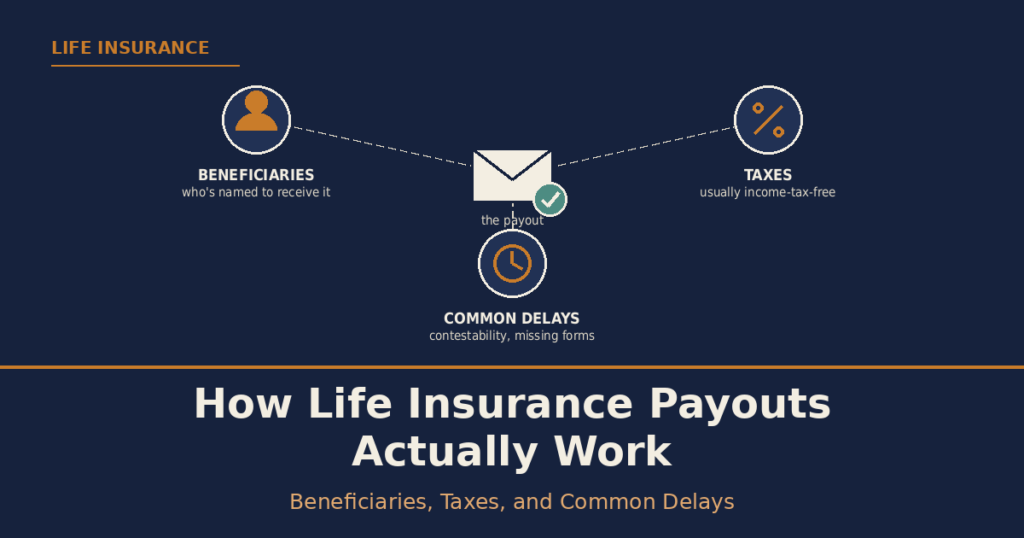
Buying a policy is the easy part. What happens after a death, how the payout actually reaches your family, tends to get far less attention. That gap matters, because small details in how a policy is set up can change whether the payout arrives smoothly or gets tangled in delays, taxes, or disputes nobody expected.
Who Actually Gets Paid, and Why the Beneficiary Form Matters More Than the Will
The single biggest misunderstanding about life insurance is thinking your will controls where the money goes. It doesn’t. The insurer pays whoever is named on the policy’s beneficiary designation form, regardless of what a will says.
This means an outdated beneficiary form can override even the most carefully written estate plan. If you named an ex-spouse decades ago and never updated it, that ex-spouse can still be legally entitled to the payout, even if your will says otherwise and even if you’ve since remarried.
Reviewing your beneficiary designations after any major life change, marriage, divorce, a new child, a death in the family, is one of the simplest things you can do to prevent this outcome.
Primary vs. Contingent Beneficiaries
Most policies let you name both a primary beneficiary and a contingent, or backup, beneficiary. The contingent beneficiary only receives the payout if the primary beneficiary has already died. Naming a contingent beneficiary avoids a scenario where, without one, the payout could default to your estate and get pulled into probate instead of going directly to your family.
How the Claims Process Actually Works
Filing a claim starts with the beneficiary contacting the insurer directly and submitting a certified copy of the death certificate, along with a claim form. Most insurers process straightforward claims within roughly 30 to 60 days once they have complete documentation, though this varies by insurer and by how complicated the claim is.
Some claims take considerably longer. If the policyholder died within the policy’s contestability period, typically the first two years, the insurer may investigate the application for material misstatements before paying out. Claims involving an unclear cause of death, a missing or outdated beneficiary form, or multiple people claiming to be the rightful beneficiary can also extend the timeline well beyond the typical window.
Is the Payout Taxable?
For most people, no. The death benefit itself is generally not subject to federal income tax, regardless of whether the policy is term or whole life. A beneficiary receiving a $500,000 death benefit as a lump sum typically keeps the full $500,000, with nothing owed to the IRS on that amount.
There are exceptions worth knowing about, though.
Interest counts as income. If a beneficiary chooses to leave the payout with the insurer rather than take it as a lump sum, any interest that accumulates before it’s eventually paid out is taxable as ordinary income.
Large estates can trigger estate tax. If the policyholder owned the policy on their own life, meaning they retained rights like the ability to change the beneficiary or borrow against it, the death benefit is generally included in their taxable estate. For 2026, the federal estate tax exemption is $15 million per individual, so this only becomes relevant for genuinely large estates. Below that threshold, most families won’t encounter estate tax on a life insurance payout at all.
A three-party ownership setup can create a taxable gift. If the policy owner, the insured person, and the beneficiary are three different people, the IRS may treat the payout as a taxable gift from the policy owner to the beneficiary. This situation, sometimes called the “Goodman triangle,” is avoidable with the right ownership structure, which is worth discussing with a financial or tax professional before a policy is set up rather than after a death.
A Practical Example
Imagine a father buys a $400,000 term policy on his own life and names his daughter as the sole primary beneficiary. When he passes away, she files a claim with the death certificate, and the insurer pays her the full $400,000 as a tax-free lump sum. No income tax, no estate tax concern, since his total estate falls well below the federal exemption.
Now imagine a variation: the father buys the policy on his wife’s life instead, and names their son as beneficiary. If the wife dies, the IRS may treat that payout as a taxable gift from the father to the son, since the father owned the policy but the death benefit is going to someone else. The death benefit itself still isn’t income taxed, but the gift tax exposure is a different issue entirely, and one that a different ownership structure could have avoided from the start.
Common Mistakes That Cause Delays or Disputes
- Outdated beneficiary designations. This is the single most common cause of disputes and unintended payouts, and it’s entirely preventable with periodic review.
- No contingent beneficiary named. Without one, an unexpected sequence of deaths can send the payout into probate instead of directly to your family.
- Keeping the policy a secret. If beneficiaries don’t know a policy exists, or don’t know which insurer holds it, claims can go unfiled for years. The National Association of Insurance Commissioners offers a free policy locator service specifically for this situation.
- Splitting a policy across “per stirpes” vs. “per capita” designations without understanding the difference. These terms determine what happens to a beneficiary’s share if they predecease the insured, and getting them mixed up can produce outcomes you didn’t intend.
What to Actually Do With This Information
Review your beneficiary designations now, not after the next major life event catches you off guard. Confirm you have both a primary and a contingent beneficiary named, tell your beneficiaries the policy exists and which company holds it, and if your estate could approach the federal exemption threshold, or if a three-party ownership situation applies to you, talk to a financial or estate planning professional about how the policy is structured before it becomes relevant.
Final Thoughts
A life insurance payout is usually simpler than people expect: file the claim, receive a tax-free lump sum, and move forward. The complications that do arise almost always trace back to outdated paperwork or an ownership structure nobody thought through in advance. A few minutes reviewing your beneficiary form is a small trade for avoiding a real headache during an already difficult time.
Disclaimer: This article is for general informational purposes only and does not constitute financial, legal, or tax advice. Tax thresholds, claims procedures, and beneficiary rules vary by insurer, state, and individual circumstances, and can change over time. Review your policy documents and consult a licensed insurance professional, estate planning attorney, or tax advisor for advice about your specific situation.
Sources
- Internal Revenue Service (IRS) — Publication 525 and IRC §101(a), irs.gov
- U.S. News & World Report — “Do Beneficiaries Pay Taxes on Life Insurance?,” usnews.com
- National Association of Insurance Commissioners (NAIC) — Life Insurance Policy Locator Service, naic.org
- MassMutual — “Understanding the Income Taxation of Life Insurance,” massmutual.com