
This guide covers life insurance in the United States. Specific dollar figures below are illustrative; your actual coverage need depends on your family’s location, number of children, and financial situation.
Life insurance conversations in most households default to whoever brings home a paycheck. That leaves a real gap for families with a stay-at-home parent, since losing that parent creates an immediate financial hole even though no salary ever showed up on a pay stub to replace.
The Financial Value That Doesn’t Show Up on a W-2
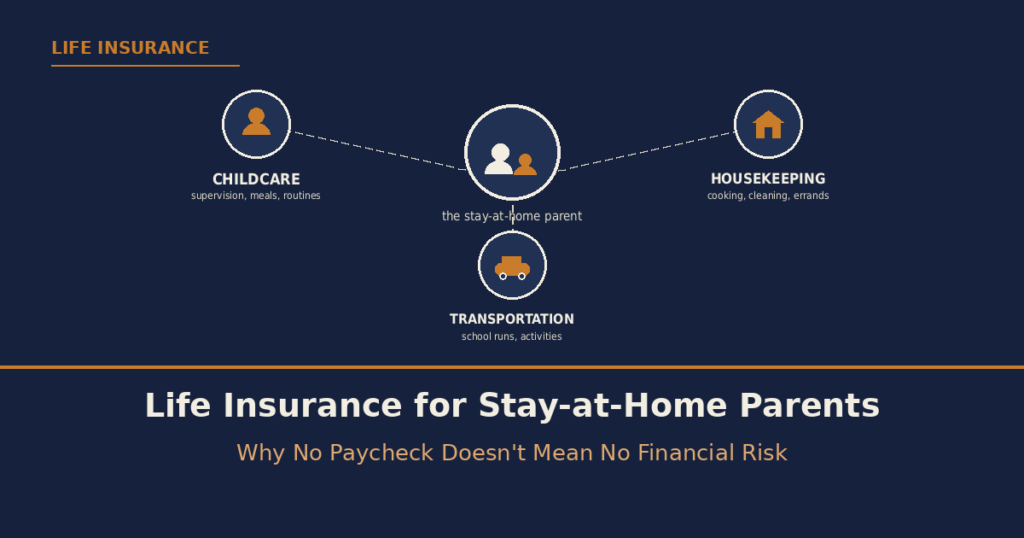
A stay-at-home parent typically provides childcare, meal preparation, housekeeping, transportation, and general household management, all of which cost real money to replace if that parent is no longer there to provide them. If something happened to this parent, the surviving spouse would generally face a choice: pay out of pocket for childcare and household help, reduce work hours to cover the gap themselves, or some combination of both, often at a real cost to their career and income at the same time.
There’s also a less obvious gap worth knowing about. If a working parent dies, survivors may receive Social Security survivor benefits based on that parent’s earnings record. A stay-at-home parent generally has little or no earnings history of their own, so their death doesn’t trigger a comparable benefit, leaving a hole that life insurance is left to fill entirely on its own.
How to Actually Calculate a Reasonable Coverage Amount
Industry sources describe a wide range of suggested coverage amounts for a stay-at-home parent, and the range is wide enough that no single figure works as a reliable rule of thumb. What sources agree on far more consistently is the calculation method itself: adding up specific, realistic replacement costs rather than picking a round number because it sounds sufficient.
A reasonable approach starts with your local, realistic cost of full-time childcare for your specific number of children, since this is typically the single largest line item. From there, add estimated costs for housekeeping, meal preparation, and transportation or after-school logistics your family would need to replace. Multiply that combined annual figure by the number of years until your youngest child would reasonably be more independent, commonly used as a rough proxy for age 18, and add a buffer for the surviving spouse’s own reduced income or career disruption during the adjustment period.
This kind of specific, needs-based calculation, rather than a flat industry rule like “50% of the working spouse’s coverage,” tends to produce a number that actually reflects your family’s real financial exposure. Given how much local childcare costs and family circumstances vary, running this calculation for your own situation, rather than relying on a number that sounds reasonable in the abstract, is worth the time it takes.
Term Life Is Generally the Better Fit Here
For most families, term life insurance is the more appropriate choice for a stay-at-home parent’s coverage, for the same reason it’s often recommended for the primary earner: the need is tied to a specific window, generally the years before children are grown and more financially independent, and term premiums are considerably lower than permanent policies for the same death benefit. That lower cost means a family can generally afford a meaningfully larger death benefit through term coverage, which tends to matter more here than a permanent policy’s cash value feature.
A 20-year or 30-year term, aligned with your youngest child’s expected timeline to greater independence, is a common structure, though the right length depends on your children’s current ages and your family’s specific plans.
Common Reasons Families Skip This Coverage, and Why They’re Worth Reconsidering
The most common reason stay-at-home parents go uninsured is straightforward: without a paycheck to point to, the financial impact of their absence is genuinely easy to underestimate until someone actually prices out what replacing their daily work would cost. Industry research on this topic consistently describes non-working spouses as significantly underinsured relative to working spouses, reflecting this same blind spot across many households, not just a rare oversight.
Cost is sometimes cited as a barrier too, but term life insurance for a healthy adult is often considerably more affordable than families expect, particularly when purchased while young and in good health. Given how much a family stands to lose without this coverage, treating the premium as a small trade-off relative to the risk it addresses is usually the more accurate framing.
A Practical Example
Imagine a family with two young children, where one parent stays home full-time. The working parent estimates that replacing childcare, meals, housekeeping, and transportation would cost a meaningful amount annually in their area, and multiplies that by the roughly fifteen years until their youngest child turns 18, adding a buffer for their own reduced work hours during an adjustment period.
That calculation produces a coverage target considerably higher than a generic round number the family might have defaulted to otherwise. A 20-year term policy sized to that actual figure, rather than an arbitrary guess, gives the family a realistic financial cushion if the stay-at-home parent were no longer there to provide these services.
Common Mistakes to Avoid
- Assuming no income means no insurable need. The services a stay-at-home parent provides carry real, calculable financial value, even without a salary attached.
- Picking a round coverage number without running the actual math. A needs-based calculation, based on your specific childcare costs and family situation, produces a far more reliable target than a generic industry guideline.
- Choosing a joint, first-to-die policy instead of two separate policies. A joint policy typically leaves the surviving spouse without any ongoing coverage after the first payout, whereas two individual policies keep both parents insured for the full term.
- Not reviewing coverage after a new child, a move, or a significant financial change. Childcare costs, family size, and financial obligations shift over time, and a policy sized for an earlier stage of family life may no longer reflect current needs.
Final Thoughts
A stay-at-home parent’s absence carries a real financial cost, even without a paycheck to serve as an obvious reference point. Calculating that cost specifically, rather than relying on a generic rule of thumb, and choosing an appropriately sized term policy while the parent is young and healthy, is what actually protects a family’s financial stability if the unexpected happens.
Disclaimer: This article is for general informational purposes only and does not constitute financial or insurance advice. Coverage needs, childcare costs, and appropriate policy amounts vary significantly by location and family circumstances. Consult a licensed insurance agent or financial advisor to determine the right coverage amount for your specific situation.
Sources
- Insurance By Heroes — “How Much Life Insurance Does a Stay-at-Home Parent Need?,” insurancebyheroes.com
- Zander Insurance — “How Much Life Insurance Does a Stay-at-Home Parent Need?,” zanderins.com
- Trust My Policy — “Best Life Insurance for Families: 2026 Guide,” trustmypolicy.com