
This guide covers life insurance in the United States. Specific dollar examples below are illustrative; your actual number depends on your income, debts, and family situation.
“How much coverage do I need?” is usually the hardest question in the entire life insurance process, harder than choosing between term and whole life. Generic advice like “buy 10 times your income” gives you a starting point, but it ignores your mortgage, your kids’ future college costs, and whatever debt you’re already carrying. A more precise method exists, and it takes only a few minutes to work through.
Why the Simple Multiplier Falls Short
The most common shortcut is a flat income multiplier, often somewhere between 10 and 12 times your annual salary. It’s easy to calculate and gives you a rough ballpark, which makes it a reasonable starting point if you just need a quick number.
The problem is that it treats every family the same. It doesn’t account for a large mortgage balance, multiple young children heading toward college, a spouse who doesn’t work outside the home, or debt beyond what’s typical. Two people earning the same salary can have very different actual needs, and a flat multiplier can’t tell the difference.
The DIME Method: A More Precise Alternative
Many financial planners use a method called DIME, which stands for Debt, Income, Mortgage, and Education. Instead of one flat multiplier, it adds up your family’s actual financial obligations.
Debt
Add up everything outside your mortgage: credit cards, car loans, student loans, and any other personal debt. Include a reasonable estimate for final expenses, since funeral and burial costs add up quickly and are often overlooked in these calculations.
Income
Multiply your annual income by the number of years your family would need that income replaced. This is typically the largest number in the calculation. Financial planners commonly suggest somewhere in the range of 5 to 15 years, depending on your children’s ages and how long your family would realistically need support. Younger children generally mean a longer replacement window.
Mortgage
Add your remaining mortgage balance. You don’t necessarily need to cover the entire amount if paying off the home isn’t a priority for your family, but including it gives you the option.
Education
Estimate future education costs for each child. Public university costs and private university costs differ substantially, so use a figure that reflects the kind of school your family actually anticipates, understanding that any estimate this far out is inherently a rough one.
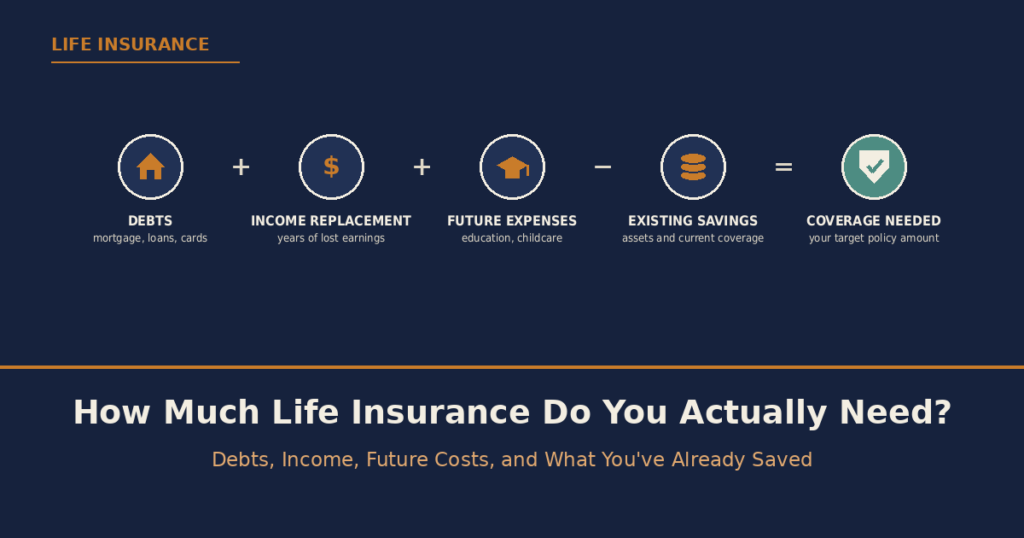
Once you’ve added these four categories together, subtract any existing coverage you already have, including group life insurance through an employer, which is often just one or two times your salary and rarely covers the full gap on its own.
A Practical Example
Imagine a 35-year-old parent earning $80,000 a year, with two young children and a $300,000 mortgage.
Their debt, outside the mortgage, totals $20,000. They estimate their family would need income replacement for 15 years, which comes to $1,200,000. Their mortgage balance adds $300,000. Education for two children, estimated conservatively, adds roughly $150,000 combined.
Added together, that’s $1,670,000. If they already have $150,000 in coverage through a workplace policy, their remaining need comes out to roughly $1.5 million.
That number can look intimidating next to a flat “10 times income” estimate of $800,000. But it reflects actual obligations rather than a rough guess, and term life insurance at that coverage level is often more affordable than people expect for someone young and healthy, since term premiums scale with age and health more than with the death benefit alone.
Adjustments the Formula Doesn’t Make Automatically
DIME gives you a solid starting number, but a few factors are worth layering on top.
Your spouse’s income. If your partner earns a meaningful income and would continue working, your family may not need full income replacement on your policy alone. This can lower the number reasonably.
Existing savings and investments. Retirement accounts, other savings, and existing life insurance policies all reduce what a new policy needs to cover.
How close you are to retirement. Someone in their 50s or 60s with grown children and a paid-off mortgage generally needs far less coverage than someone in their 30s with young kids and a fresh mortgage.
Self-employment income. If your income fluctuates year to year, using a multi-year average gives a more realistic figure than a single year’s number.
Common Mistakes to Avoid
- Relying only on employer-provided coverage. Workplace life insurance is usually a modest multiple of your salary, often nowhere near what the DIME method suggests, and it typically doesn’t transfer if you leave the job.
- Forgetting to subtract existing coverage. Double-counting a policy you already have inflates your perceived need.
- Treating the number as permanent. Life insurance needs change as your mortgage shrinks, kids grow up, and savings build. Revisiting the calculation every few years, or after a major life change, keeps the coverage aligned with your actual situation.
- Choosing a number based only on what feels affordable today. Term coverage is often less expensive than people assume, and starting with an accurate needs calculation, then adjusting the term length or coverage amount if the premium doesn’t fit, tends to produce a better outcome than underinsuring from the start.
Final Thoughts
A flat income multiplier is a fine starting point if you need a rough number quickly, but the DIME method gets you closer to what your family would actually need. The calculation only takes a few minutes, and the resulting figure gives you something concrete to bring to an insurance agent or financial planner, rather than guessing at round numbers that may leave a real gap.
Disclaimer: This article is for general informational purposes only and does not constitute financial or insurance advice. Coverage needs, costs, and appropriate calculation methods vary by individual circumstances. Consult a licensed insurance agent or financial planner to determine the right coverage amount for your specific situation.
Sources
- NerdWallet — “How Much Life Insurance Do I Need? 2026 Calculator,” nerdwallet.com
- U.S. News & World Report — “How Much Life Insurance Do I Need?,” usnews.com
- Ogletree Financial — “DIME Method: Calculate Life Insurance Needs,” ogletreefinancial.com