This guide covers homeowners insurance in the United States. Non-renewal notice periods, protections, and last-resort coverage options are set at the state level and vary significantly, particularly in wildfire- and hurricane-prone states, so confirm current rules with your state’s Department of Insurance.
Getting a non-renewal letter from your home insurer can feel like a personal judgment on your house. In most cases, it isn’t. Across large parts of the country, insurers are pulling back from entire regions due to wildfire risk, hurricane exposure, and rising reinsurance costs, non-renewing policies well beyond any single homeowner’s control. Knowing what triggered it, and what your actual options are, makes the situation far less overwhelming than the letter itself suggests.
Non-Renewal Is Different From Cancellation
These two terms get used interchangeably, but they work differently, and the difference affects your options.
A cancellation ends your policy before its scheduled expiration date, and insurers generally need a specific, often serious reason to do this mid-term, like non-payment or fraud. A non-renewal happens at the natural end of your policy term. The insurer simply chooses not to offer you a new term. Insurers generally have more flexibility with non-renewals than with mid-term cancellations, which is part of why non-renewals have become the more common tool insurers use when pulling back from high-risk areas.
Insurers typically must give you written notice before a non-renewal, commonly somewhere in the range of 30 to 75 days depending on your state, and many states require the insurer to state a reason. Checking your specific state’s requirement tells you exactly how much notice you’re legally owed and what information you’re entitled to receive.
Why This Is Happening So Often Right Now
If you’re facing a non-renewal, it helps to understand that this is frequently a market-wide pullback rather than a decision specific to your home. Insurers evaluate risk using data like wildfire severity zone ratings, hurricane exposure, and flood history for entire regions, not just individual properties. After a major catastrophic event, insurers often reassess their exposure across an entire area at once.
Reinsurance costs, essentially insurance that insurers themselves buy to manage their own risk, have also risen substantially in disaster-prone regions in recent years. Some states, notably California, additionally regulate how quickly insurers can raise rates to reflect current risk, which some insurers cite as a factor in deciding to reduce their presence in that market rather than operate at rates they consider inadequate for the risk. The result across several states has been a wave of non-renewals concentrated in wildfire zones in Western states and hurricane-exposed areas in Florida, Louisiana, and similar coastal regions.
None of this means your specific home did anything wrong. It generally reflects an insurer’s broader assessment of an entire risk category.
What to Actually Do After a Non-Renewal
Confirm the Reason and Check for State Protections
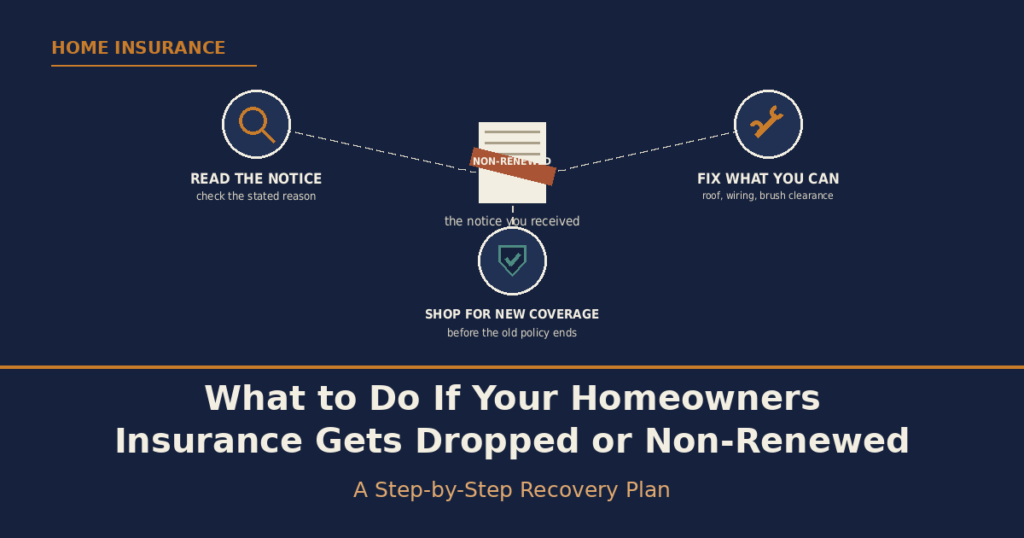
Start by reading the notice carefully and confirming exactly why your policy wasn’t renewed. If your state requires insurers to state a reason and the notice doesn’t provide one, or if you believe the reason is inaccurate, you generally have the right to contest the decision with your state’s Department of Insurance.
Some states have added specific protections in response to the current wave of non-renewals. California, for example, enacted a moratorium temporarily preventing cancellations and non-renewals in specific ZIP codes designated after major wildfire disasters. Oregon prohibits insurers from canceling a policy based solely on wildfire risk map data. Florida has specific waiting periods tied to hurricane and windstorm-affected homes. These protections are state-specific and change as legislatures respond to conditions, so checking your own state’s current rules, rather than assuming a rule from a news story about another state applies to you, matters here.
Look Into Mitigation Steps
If wildfire or another specific risk factor drove the non-renewal, documented mitigation steps can sometimes move you back toward eligibility with a standard insurer, or at minimum improve your options and pricing elsewhere. Common mitigation measures include installing a fire-resistant roof, clearing vegetation and debris near the home, and other defensible-space improvements specific to your region’s primary risk. Some states run formal programs that certify this kind of mitigation work, which insurers increasingly reference when evaluating a property.
Shop the Private Market Before Assuming You’re Uninsurable
A non-renewal from one insurer doesn’t necessarily mean every insurer will decline you. Specialty and surplus-lines insurers, which operate somewhat differently from standard admitted insurers, sometimes still write policies in higher-risk areas that standard carriers have pulled back from, generally at a higher premium. Shopping multiple insurers, including ones that specialize in higher-risk properties, is worth doing before assuming a state’s last-resort plan is your only remaining option.
The FAIR Plan as a Last Resort
If you can’t secure coverage through the standard market, most states offer a FAIR Plan, an insurer of last resort designed specifically for homeowners who’ve been declined elsewhere. FAIR Plans typically cover fire and some related perils but often exclude things a standard policy would include, like liability coverage or water damage, which commonly requires a separate supplemental policy, often called a difference-in-conditions policy, to fill those gaps.
FAIR Plan coverage is generally intended as a bridge rather than a permanent solution. Premiums are often higher than standard market rates, and the coverage itself is narrower. Continuing to pursue mitigation and periodically re-shopping the private market, even after landing on a FAIR Plan, is a reasonable ongoing strategy rather than treating the FAIR Plan as a final destination.
A Practical Example
Imagine a homeowner in a wildfire-prone area who receives a non-renewal notice after their insurer reduces its overall exposure in that region, unrelated to any claim the homeowner has filed. They confirm their state requires 60 days’ notice and check whether their ZIP code falls under any current state moratorium, finding it doesn’t.
They then invest in defensible space clearing and a fire-resistant roof upgrade, and get quotes from two additional standard insurers along with a surplus-lines carrier that specializes in higher-risk properties. If none of those options work out, they fall back to their state’s FAIR Plan, paired with a supplemental policy for the liability and water damage coverage the FAIR Plan itself doesn’t include, while continuing to re-shop annually as their mitigation work strengthens their case with standard insurers over time.
Common Mistakes to Avoid
- Letting coverage lapse while shopping for a new policy. If you have a mortgage, a lapse can trigger expensive force-placed insurance from your lender, which is generally far costlier than arranging your own coverage.
- Assuming a non-renewal means something is uninsurable about your specific home. It’s frequently a market-wide decision unrelated to any individual claim history.
- Not checking your state’s specific notice and protection rules. Requirements and current moratoriums vary significantly by state and change over time.
- Treating the FAIR Plan as a complete replacement for standard coverage. Its narrower coverage, particularly around liability and water damage, often requires a supplemental policy to close real gaps.
Final Thoughts
A non-renewal notice is unsettling, but it’s rarely the dead end it can feel like in the moment. Understanding your state’s specific notice requirements and protections, pursuing mitigation where it applies, and working through the market systematically, from standard insurers to specialty carriers to a FAIR Plan as a last resort, gives most homeowners a genuine path back to coverage, even in the highest-risk areas.
Disclaimer: This article is for general informational purposes only and does not constitute financial, legal, or insurance advice. Non-renewal notice periods, state protections, mitigation programs, and FAIR Plan availability and coverage vary by state and change over time. Contact your state’s Department of Insurance or a licensed insurance professional for advice about your specific situation.
Sources
- NerdWallet — “Homeowners Insurance Non-Renewal: What to Know,” nerdwallet.com
- Insurify — “Home Insurance in High Fire-Risk Areas: Coverage, Costs, and Options,” insurify.com
- Singleton Schreiber — “Is Your Homeowners Insurance at Risk This Wildfire Season?,” singletonschreiber.com
- National Association of Insurance Commissioners (NAIC) — naic.org