
This guide covers final expense, or burial, insurance in the United States. Costs, coverage amounts, and underwriting vary by insurer and individual health, so treat the figures here as general reference points rather than a personal quote.
Funeral costs rarely come up in everyday conversation, which is part of why so many families are caught off guard by them. Final expense insurance exists for exactly this gap: a modest, permanent life insurance policy designed to cover funeral costs and small remaining debts, without requiring the kind of underwriting or coverage amount a full life insurance policy involves.
What Final Expense Insurance Actually Is
Final expense insurance, also called burial insurance, is a small whole life insurance policy. Because it’s whole life, it’s permanent: coverage doesn’t expire after a set term, and as long as premiums are paid, the policy stays in force for the rest of your life. Premiums are also locked in at purchase and don’t increase later due to age or a change in health.
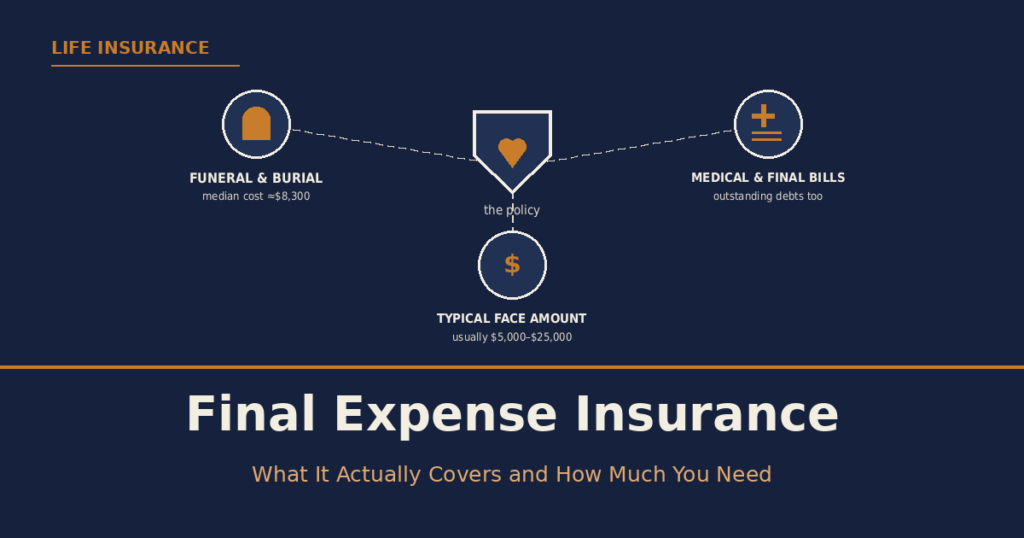
Coverage amounts are intentionally modest compared to a standard life insurance policy, typically ranging from around $2,000 up to $50,000, with most people landing somewhere between $5,000 and $25,000. The goal isn’t income replacement or leaving an inheritance. It’s making sure funeral and burial costs, along with any small remaining debts, don’t become a financial burden for whoever is left to handle them.
The death benefit is paid directly to your named beneficiary as cash, not to a funeral home. A common misconception is that this money is somehow locked into a contract with a specific funeral provider. It isn’t. Your beneficiary can use it however they see fit, whether that’s the funeral itself, outstanding medical bills, credit card debt, or anything else.
How Much Coverage Actually Makes Sense
The starting point for sizing a policy is understanding what funeral costs actually look like. According to National Funeral Directors Association data, the median cost of a funeral with a viewing and burial has been in the range of roughly $8,000 to $10,000 in recent estimates, though this varies by service type, region, and specific choices like the casket, plot, and headstone. Cremation, without a full traditional service, tends to run considerably lower, though a cremation with a memorial service and an urn placement can still add up meaningfully.
Given that range, many people land on a policy between $10,000 and $20,000: enough to cover a traditional funeral and burial, with some cushion left over for smaller outstanding debts like medical bills or a credit card balance. Someone planning for cremation without a full service may reasonably choose a smaller policy, while someone who wants both a traditional service and a buffer for other final expenses may lean toward the higher end of that range.
There’s no single right number. The right amount depends on the kind of arrangements you or your family expect, plus any other small debts you’d want covered alongside the funeral itself.
Simplified Issue vs. Guaranteed Issue
Final expense policies generally come in two underwriting types, and the difference affects both your cost and how quickly coverage actually starts.
Simplified issue requires answering a handful of health questions, but no medical exam. If your answers qualify you, coverage typically begins immediately, and premiums are lower than the guaranteed issue alternative. This route generally suits people in fair to good health who can answer the health questions favorably.
Guaranteed issue requires no health questions and no exam at all. Anyone within the eligible age range is approved, which makes it the fallback option for people with health conditions serious enough to complicate simplified issue underwriting. The trade-off is a meaningfully higher premium, commonly cited as running 20% to 30% more than an equivalent simplified issue policy, and a graded death benefit for an initial period, often the first two to three years. If the insured dies from natural causes during that window, beneficiaries typically receive a refund of premiums paid plus interest rather than the full death benefit; the full benefit generally applies to deaths after the graded period, or to accidental deaths from the start.
What It Actually Costs
Reported premium ranges vary across insurers and depend heavily on age, gender, health, and coverage amount. As a general reference point, a handful of industry sources describe simplified issue premiums for $10,000 in coverage landing somewhere in the range of roughly $25 to $60 a month for a 65-year-old, with the exact figure depending on gender and health, and rates increasing meaningfully at older ages, sometimes reaching $95 to $120 a month or more for the same coverage amount at 75. Guaranteed issue policies cost more on top of that baseline, consistent with the trade-off described above.
Men typically pay more than women for the same coverage, reflecting differences in average life expectancy, with one notable exception: Montana state regulations prohibit insurers from charging different rates based on sex, so this gender gap doesn’t apply there.
Because these figures vary considerably by insurer, and your own health profile matters more than any general estimate, getting actual quotes from a few insurers is the only reliable way to know your real cost.
A Practical Example
Imagine someone in their late 60s in reasonably good health, wanting to make sure their family isn’t left covering funeral costs unexpectedly. They qualify for a simplified issue policy with $15,000 in coverage, answering a short set of health questions with no exam required. Coverage begins immediately, and their premium is locked in at that starting rate for life.
Compare that to someone in their mid-70s with a more complicated health history that would likely complicate simplified issue underwriting. They instead choose guaranteed issue coverage at a similar amount. Coverage is approved automatically, but at a meaningfully higher premium, and if they were to pass away from natural causes within the policy’s graded period, their beneficiary would receive a refund of premiums with interest rather than the full $15,000 benefit.
Both people end up with permanent coverage aimed at the same goal, but the underwriting path, cost, and early-year protection look quite different based on their health at the time of applying.
Common Mistakes to Avoid
- Buying more coverage than actually needed. Since this product is meant for a specific, boundable expense, oversizing it mostly just means paying more in premiums than necessary.
- Assuming guaranteed issue is the default option. Simplified issue is generally cheaper and starts coverage immediately without a graded period, and it’s worth trying that route first if your health reasonably allows it.
- Not accounting for the graded death benefit period on guaranteed issue policies. If your beneficiary would need the full benefit immediately, this waiting period is a real limitation worth understanding upfront.
- Confusing this with a larger life insurance need. If you also have significant income replacement needs, a mortgage, or dependents, final expense coverage alone isn’t a substitute for a larger term or whole life policy sized to those broader needs.
Final Thoughts
Final expense insurance solves a specific, well-defined problem: making sure funeral and burial costs, plus a modest cushion for small remaining debts, don’t land unexpectedly on your family. Sizing the policy around realistic funeral costs, choosing simplified issue when your health allows it, and understanding the trade-offs of guaranteed issue if you need it, are the decisions that actually shape whether this coverage does its job well.
Disclaimer: This article is for general informational purposes only and does not constitute financial or insurance advice. Coverage amounts, underwriting requirements, graded benefit periods, and costs vary by insurer and individual health, and can change over time. Consult a licensed insurance agent for advice about your specific situation.
Sources
- National Funeral Directors Association (NFDA) — funeral cost data, nfda.org
- Choice Mutual — “Cost Of Burial & Final Expense Insurance,” choicemutual.com
- DG Life Group — “Final Expense & Burial Insurance Guide,” dglifegroup.com