This guide covers car insurance in the United States. Whether exclusions are permitted, and under what conditions, is set at the state level and varies by insurer, so confirm the specific rules that apply to you directly.
Adding a high-risk driver to a household policy can push the premium up dramatically, sometimes doubling or tripling what everyone else in the house pays. A named driver exclusion is the tool insurers offer to solve that problem: formally remove that specific person from coverage, and the household’s rate reflects only the drivers who remain. It’s a genuinely useful cost-saving option. It’s also a much harder line than most people expect once it’s actually in place.
What Getting Excluded Actually Means
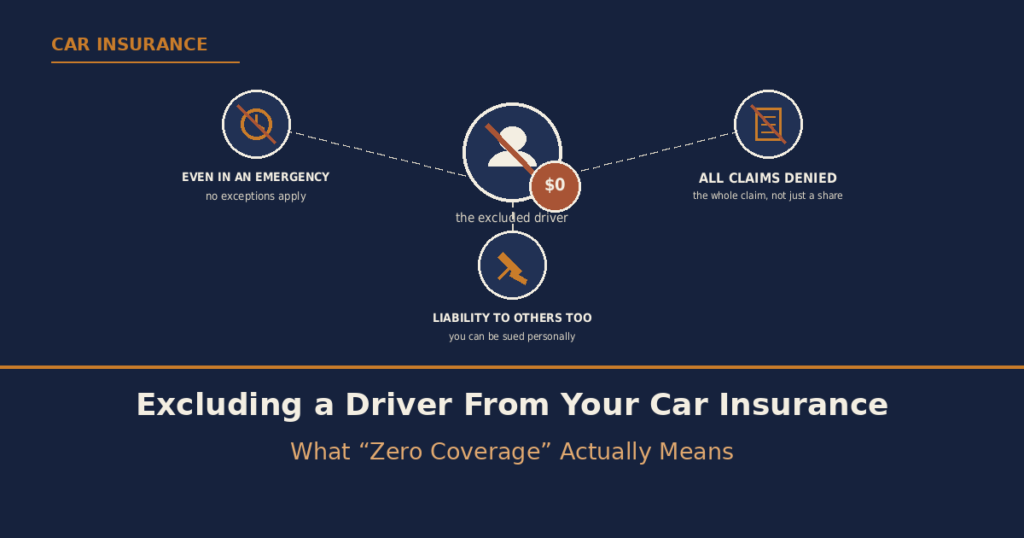
A named driver exclusion is a signed endorsement identifying a specific person who is not covered under your policy, under any circumstances, while operating your insured vehicle. This isn’t a reduced level of coverage for that person. It’s zero coverage: no liability protection if they injure someone or damage property, no collision or comprehensive coverage for your own vehicle, and no legal defense if they’re sued after an accident.
There’s no emergency exception built into this arrangement. If an excluded driver gets behind the wheel even once, for a genuine emergency, a single errand, anything, and causes an accident, the claim is denied in full. Both the excluded driver and the vehicle’s owner can be held personally liable for the resulting damages, potentially including the other driver’s injuries, property damage, and legal costs, entirely out of pocket.
Why Households Choose to Exclude Someone
The most common reason is straightforward cost management. If someone in the household has a DUI conviction, a suspended license, or a pattern of at-fault accidents and violations, adding them to the policy can dramatically raise the premium for everyone on it, even if that person rarely drives the insured vehicle. Excluding them removes their risk profile from the household’s combined rate calculation entirely.
Common situations where households consider this option include a family member with a DUI or DWI on their record, someone with a suspended or revoked license, a household member whose driving record is poor enough that the insurer won’t offer coverage at all unless that person is excluded, or someone who genuinely doesn’t drive due to age, health, or disability, where formalizing that with the insurer avoids ambiguity later.
Not Every State Allows This
Whether you can exclude a driver at all depends on your state. Some states permit named driver exclusions broadly. Others don’t allow them at all, and still others allow them only under specific conditions, such as requiring the excluded driver to show proof of their own separate insurance policy before the exclusion takes effect, precisely to avoid leaving that person driving with no coverage anywhere.
Some states also impose specific disclosure requirements. In Texas, for example, state law requires written disclosure confirming that any unlisted or excluded driver has no coverage under the policy, reflecting how seriously this arrangement is treated at the regulatory level. Given how much this varies, confirming your specific state’s rules, and your insurer’s specific process, directly is essential before assuming this option is even available to you.
The Consequence for the Excluded Person’s Own Future Coverage
Here’s a detail that catches people off guard: being formally excluded from a policy is documented as being tied to a high-risk driving history. When that excluded person later applies for their own separate auto policy, insurers reviewing their record will generally see this history and price their coverage accordingly. Some insurers specifically require the excluded driver to already have their own policy in place before finalizing the household’s exclusion, which sidesteps the risk of that person going without any coverage at all, but doesn’t change the underlying cost impact on their own future insurance.
A Practical Example
Imagine a household where one adult child has a recent DUI conviction and no longer holds a valid license, but continues living at home. The parents exclude this person from their auto policy, formally documenting that they will never operate the household vehicles, which brings the family’s premium back down to reflect only the parents’ own clean driving records.
Now imagine a different scenario: that same excluded person, in a moment of genuine emergency, drives one of the household’s cars and is involved in an accident. Despite the emergency circumstances, the insurer denies the claim entirely, since the exclusion applies without exception. The family is left personally responsible for the other driver’s damages and their own vehicle’s repair costs, a dramatically worse financial outcome than simply paying the higher premium would have been.
This is exactly the tension every source on this topic emphasizes: the savings are real, but they only make sense if the household can genuinely guarantee the excluded person will never, under any circumstance, drive the insured vehicle.
Alternatives Worth Considering First
Before excluding someone entirely, a few alternatives are worth exploring. Some insurers offer a named-driver-only policy, which limits coverage strictly to the drivers explicitly listed, potentially lowering the premium without the same all-or-nothing risk structure. If the high-risk driver owns their own vehicle, insuring them separately on that specific car, rather than as an occasional driver of the household’s main vehicle, can sometimes reduce the overall household risk rating without a full exclusion. For someone who needs coverage due to a serious violation like a DUI, a separate SR-22 or non-owner policy may be a more appropriate path than either full inclusion or full exclusion.
Common Mistakes to Avoid
- Excluding someone who might reasonably need the car in an emergency. If there’s any realistic chance this person would drive the vehicle, even once, the financial risk of a denied claim generally outweighs the premium savings.
- Assuming exclusions work the same way in every state. Availability, disclosure requirements, and conditions vary significantly, and some states don’t permit this option at all.
- Not confirming the excluded driver has their own coverage. Some insurers require this before finalizing an exclusion, specifically to avoid leaving that person completely uninsured.
- Underestimating the effect on the excluded person’s future insurance costs. This history follows them when they eventually seek their own policy, and it’s worth having that conversation openly within the household.
Final Thoughts
A named driver exclusion can meaningfully lower a household’s premium when a specific person’s driving record is dragging down everyone’s rate. It comes with an absolute condition attached: that person can never drive the insured vehicle, not even once, not even in an emergency, without triggering a complete denial of coverage. Whether that trade-off makes sense depends entirely on how confident your household is that the arrangement will actually hold, not just on the premium savings alone.
Disclaimer: This article is for general informational purposes only and does not constitute financial, legal, or insurance advice. Exclusion availability, requirements, and disclosure rules vary by state and insurer, and can change over time. Contact your insurance provider and confirm your state’s specific rules before excluding a driver from your policy.
Sources
- Progressive — “What is an excluded driver?,” progressive.com
- U.S. News & World Report — “What is an Excluded Driver?,” usnews.com
- The Zebra — “Why Exclude a Driver From Your Car Insurance Policy?,” thezebra.com
- CarInsurance.com — “What is a Named Driver Exclusion on a Car Insurance Policy?,” carinsurance.com