This guide covers renters insurance in the United States. Landlord requirements, typical costs, and available coverage vary by state, property, and insurer, so confirm specifics with your landlord and insurance provider.
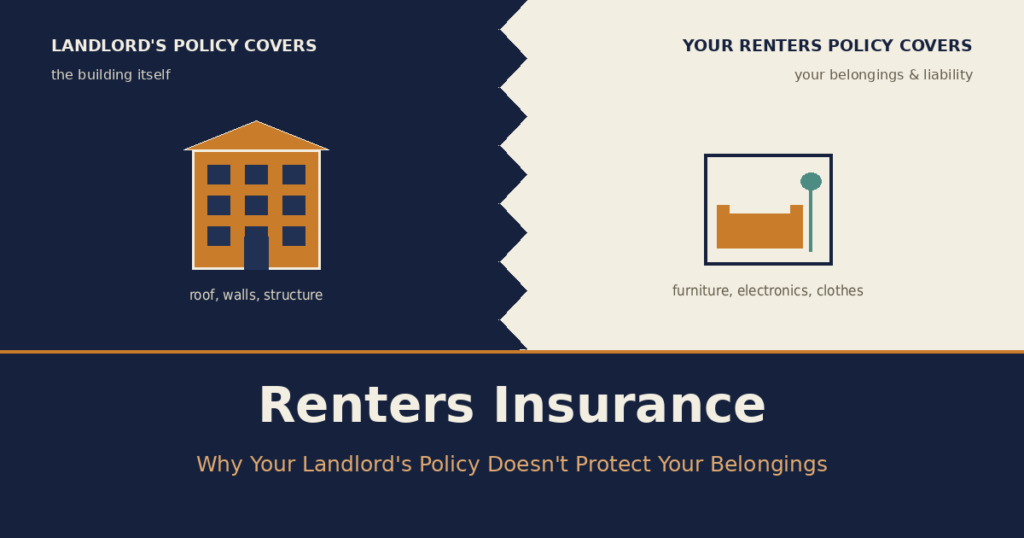
A surprising number of renters assume their landlord’s insurance somehow extends to cover their own belongings. It doesn’t, and it was never designed to. Your landlord’s policy protects the building they own. Everything inside your unit that belongs to you is entirely your own responsibility to insure, which is exactly the gap renters insurance exists to close.
What Renters Insurance Actually Covers
A standard renters policy covers four main components, each protecting a different kind of risk.
Personal property covers your belongings, furniture, electronics, clothing, and similar items, against covered perils like fire, theft, vandalism, and certain types of water damage. If a covered event damages or destroys your things, this is what pays to repair or replace them, up to your policy’s coverage limit.
Personal liability protects you if someone is injured in your rental unit and sues you, or if you accidentally cause damage to someone else’s property. A common starting liability limit cited across the industry is $300,000, and higher limits often cost relatively little more, given the added protection they provide if a serious claim ever arises.
Medical payments coverage pays a guest’s minor medical bills, commonly in the range of $1,000 to $5,000, regardless of who was at fault. If a friend trips and gets hurt in your apartment, this coverage can handle a smaller medical bill directly, without escalating into a full liability claim.
Loss of use, sometimes called additional living expenses, covers costs like a hotel stay and meals if a covered event makes your rental temporarily uninhabitable while repairs are completed. This is typically set as a percentage of your personal property limit, commonly in the range of 20% to 30%.
What It Doesn’t Cover
Renters insurance never covers damage to the physical structure of the building itself. That’s the landlord’s responsibility, insured through their own separate landlord policy. Standard renters insurance also generally excludes flood and earthquake damage, which require separate coverage, and it doesn’t cover a roommate’s personal belongings unless that roommate is specifically named on your policy.
High-value items like jewelry, fine art, and certain collectibles are typically subject to sublimits well below their actual worth, similar to how these categories work under homeowners insurance. If you own anything genuinely valuable, scheduling those specific items separately, sometimes called a rider or floater, is worth doing rather than assuming your standard policy covers them at full value.
What It Actually Costs
Renters insurance is consistently described across multiple independent sources as one of the more affordable types of coverage available, commonly running somewhere in the range of $15 to $30 a month for a typical policy, with some lower-risk situations available for as little as $10 to $12 a month. Your specific premium depends on your coverage limits, deductible, location, and, in most states, your credit-based insurance score.
For personal property specifically, many renters find that coverage somewhere between $15,000 and $50,000 reasonably reflects the actual replacement cost of their furniture, clothing, electronics, and other belongings. Rather than guessing, walking through what it would genuinely cost to replace everything you own is a more reliable way to choose an appropriate limit than defaulting to whatever a quote tool suggests.
Why Landlords Increasingly Require It
No state law mandates that tenants carry renters insurance, but many landlords require it as a condition of the lease, and they’re legally permitted to do so in all fifty states, provided they don’t require you to buy from one specific company. A commonly cited minimum requirement is $100,000 in liability coverage, with some landlords also requesting to be listed as an “additional interest” or “interested party” on your policy.
The reasoning is straightforward from a landlord’s perspective. Without tenant coverage, a liability claim, say from a guest injured in a tenant’s unit, can end up directed at the landlord instead, along with any dispute over a tenant-caused fire or water damage incident. Requiring renters insurance shifts many of these claims toward the tenant’s own policy first, which tends to preserve the landlord-tenant relationship and speed up resolution when something does go wrong.
A Practical Example
Imagine a tenant without renters insurance whose kitchen accident causes a fire, damaging both their own belongings and part of the unit’s interior. Their own possessions, furniture, electronics, everything lost or damaged, aren’t covered by anyone, since the landlord’s policy only protects the building itself. Depending on the circumstances, the tenant could also be held personally liable for the damage caused to the landlord’s property.
Now imagine the same scenario with a renters policy in place. Personal property coverage helps replace the tenant’s own damaged belongings, and liability coverage can address the landlord’s claim for the damage to the unit, resolving both sides of the incident through the tenant’s own policy rather than becoming a personal financial crisis or a lawsuit.
Common Mistakes to Avoid
- Assuming the landlord’s policy covers your belongings. It doesn’t, and this remains one of the most common and costly misunderstandings among renters.
- Underestimating your personal property’s actual value. Walking through what it would cost to replace everything you own gives a far more accurate coverage target than a default quote.
- Not scheduling high-value items separately. Standard sublimits on jewelry, art, and similar categories can leave a serious gap for anyone with a few genuinely valuable pieces.
- Skipping coverage because it feels optional. Even where a landlord doesn’t require it, the combination of low cost and real liability protection makes it a reasonable purchase for almost any renter.
Final Thoughts
Renters insurance fills a gap that’s easy to overlook until something goes wrong: your landlord’s policy was never built to protect what you personally own, or to shield you from liability if someone is hurt in your unit. Given how affordable this coverage typically is relative to the protection it provides, reviewing your own coverage limits against what you’d actually need to replace your belongings is a small task with real financial upside.
Disclaimer: This article is for general informational purposes only and does not constitute financial, legal, or insurance advice. Coverage limits, landlord requirements, and costs vary by state, property, and insurer, and can change over time. Review your policy documents and contact your insurance provider or landlord for details about your specific situation.
Sources
- Insurify — “How Much Is Renters Insurance? 2026 Average Cost,” insurify.com
- Lemonade — “This Is How Much Renters Insurance Actually Costs,” lemonade.com
- Obie — “Renters Insurance Requirements for Landlords,” obieinsurance.com