This guide covers homeowners insurance in the United States. Flood insurance rules, requirements, and federal program status can change, so verify current details with FEMA or your insurance provider before making a decision.
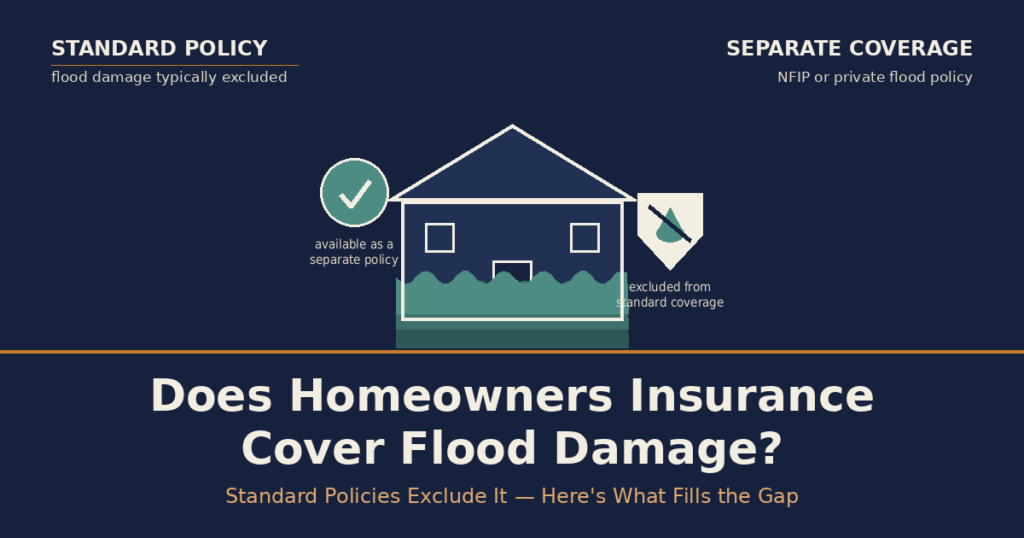
Here’s a piece of information that surprises a lot of homeowners: a standard homeowners policy generally does not pay for flood damage. Fire, theft, wind, and most storm damage are usually covered. Flooding, in almost every case, is not. That gap catches people off guard precisely when they need coverage most, right after water has already entered their home.
Why Standard Homeowners Insurance Excludes Flooding
Homeowners policies are built to cover sudden, specific perils like fire, lightning, hail, and wind. Flooding gets treated differently because it tends to affect entire neighborhoods at once rather than a single property. Insuring that kind of correlated risk through ordinary homeowners policies would make them far more expensive for everyone, so insurers exclude it and route flood coverage through a separate product instead.
This is where the National Flood Insurance Program, or NFIP, comes in. Managed by FEMA, the NFIP is the main source of flood insurance for homes across the country. Some private insurers also sell flood policies outside the NFIP, and comparing both is often worth the time.
What Counts as a “Flood” Matters More Than You’d Think
The word “flood” has a specific insurance definition, and it affects what actually gets paid. The NFIP defines a flood as a general and temporary condition where water covers normally dry land, generally affecting two or more acres or two or more properties.
That definition creates some genuinely confusing edge cases. If a heavy rainstorm causes a sewer to back up, and the backup is a direct result of flooding in your area, an NFIP policy would typically cover it. If that same sewer backup happens because of a clogged pipe with no broader flooding involved, it wouldn’t. Similarly, rain that gets in through a storm-damaged window or a hole in your roof is usually treated as wind damage, which your regular homeowners policy may cover, not as flood damage.
Reading that distinction carefully matters, because getting it wrong can mean filing a claim with the wrong policy entirely.
What an NFIP Policy Actually Pays For
NFIP flood insurance comes in two parts, and they’re purchased separately, each with its own deductible.
Building coverage protects your home’s structure: the foundation, electrical and plumbing systems, central air and heating equipment, and permanently installed items like cabinets and some appliances. Coverage tops out at $250,000.
Contents coverage protects your belongings: furniture, clothing, and personal electronics. Coverage tops out at $100,000.
Some things are excluded no matter what. Currency, precious metals, and stock certificates aren’t covered. Neither are cars, though comprehensive auto coverage may help there separately. Outdoor property like decks, fences, landscaping, and swimming pools generally falls outside a flood policy too.
Who Actually Needs to Buy It
If your home sits in a FEMA-designated high-risk flood zone and you have a mortgage from a federally regulated or government-backed lender, flood insurance is typically required, not optional. Outside those high-risk zones, it’s usually your choice.
That choice deserves more thought than it often gets. Nearly a third of NFIP claims over the past decade came from properties outside currently mapped high-risk areas. Flood risk isn’t static, either. Development, changing rainfall patterns, and shifting drainage all affect it over time, and FEMA periodically updates its flood maps to reflect that. Checking your current flood zone status, even if you were told years ago that you weren’t at risk, is a reasonable thing to do periodically.
A Practical Example
Imagine a homeowner outside a designated high-risk zone who skips flood coverage, reasoning that their risk is low. A summer storm overwhelms local drainage, and a foot of water enters their ground floor.
Their standard homeowners policy would typically deny the claim, since the damage came from flooding rather than a covered peril like wind or fire. Without a separate flood policy, they’d be paying for structural repairs and damaged belongings out of pocket. Even modest flooding adds up quickly. Just an inch of floodwater in an average-sized home can cause tens of thousands of dollars in damage, according to FEMA figures. This is precisely the scenario flood insurance exists for, and it’s why “not in a high-risk zone” isn’t the same thing as “no risk.”
A Timing Detail Worth Knowing
New NFIP policies typically carry a 30-day waiting period before coverage takes effect. Some exceptions apply, including certain situations tied to a mortgage closing or a recent flood map change, but as a general rule, you can’t buy a flood policy once a storm is already approaching and expect same-day protection. Buying flood coverage is something to handle well before hurricane season or any period of elevated risk, not during it.
A Time-Sensitive Note on the Program Itself
Because the NFIP depends on periodic congressional reauthorization, its authority to issue new or renewed policies has lapsed more than once in recent years, most recently during a federal government shutdown in late 2025. As of this writing, the NFIP is authorized through September 30, 2026. If Congress doesn’t act again by that deadline, the program could temporarily lose its authority to sell new or renewed policies, though existing policies would generally remain in force and claims would continue to be paid as funds allow. Given this history, it’s worth confirming the program’s current status directly with FEMA or your agent if you’re buying or renewing coverage close to that date.
Common Mistakes to Avoid
- Assuming you’re safe because you’re outside a high-risk zone. A meaningful share of flood claims come from lower-risk areas.
- Waiting until a storm is forecast to buy coverage. The standard waiting period means it’s often too late by then.
- Confusing wind-driven rain damage with flood damage. They’re handled by different policies, and misfiling a claim wastes time during an already stressful situation.
- Assuming your contents are automatically covered. Building and contents coverage are purchased separately under the NFIP, and skipping contents coverage leaves your belongings unprotected.
Final Thoughts
Standard homeowners insurance and flood insurance solve different problems, and conflating them is one of the more costly assumptions a homeowner can make. If you’re unsure about your risk, checking FEMA’s flood maps and getting a flood insurance quote takes a small amount of time compared to the cost of finding out the hard way that your homeowners policy doesn’t apply.
Disclaimer: This article is for general informational purposes only and does not constitute financial, legal, or insurance advice. Coverage options, requirements, program authorization status, and pricing can change over time and vary by location, lender, and insurer. Review your policy documents carefully and contact FEMA, your insurance provider, or a licensed insurance professional for advice about your specific situation.
Sources
- FEMA / FloodSmart.gov — “Buy a Flood Insurance Policy,” floodsmart.gov
- FEMA — “Flood Insurance,” fema.gov
- FEMA — “Congressional Reauthorization for the National Flood Insurance Program,” fema.gov
- National Association of Insurance Commissioners (NAIC) — content.naic.org
- Congressional Research Service — “What Happens If the National Flood Insurance Program (NFIP) Lapses?,” congress.gov