This guide covers business insurance in the United States. Coverage structures, required limits, and costs vary by company size, industry, and funding stage, so confirm specifics with a licensed commercial insurance broker.
Founders and small business owners often assume D&O insurance is something only large public corporations need, the kind of coverage that protects boardrooms full of executives at companies far bigger than theirs. In practice, any company with outside investors, a formal board, or real decision-making authority carries this exposure, often well before it feels like a “big company” problem.
What D&O Insurance Actually Protects
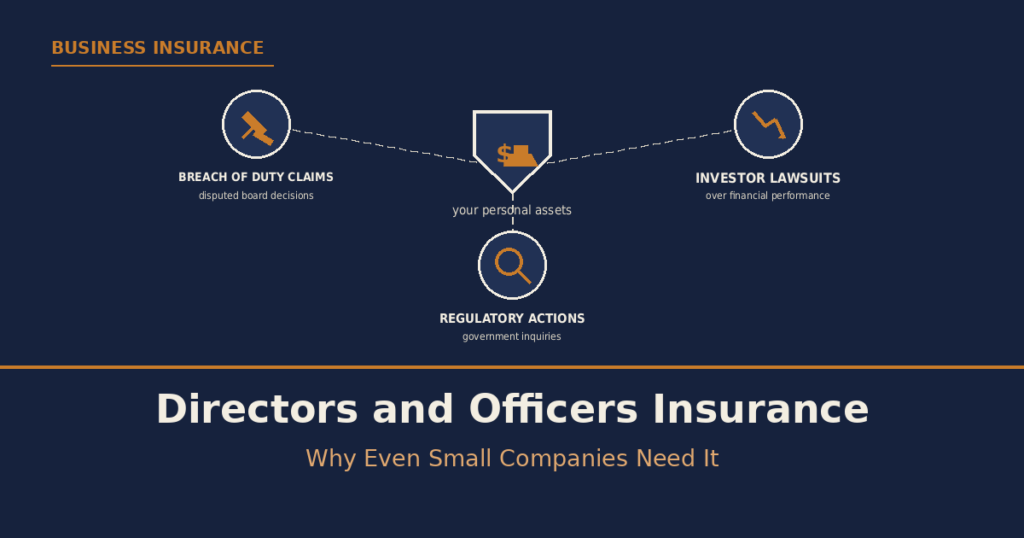
Directors and officers insurance protects the personal assets of a company’s directors, officers, and sometimes other decision-makers, from lawsuits alleging wrongful acts connected to decisions they made on the company’s behalf. That includes claims like mismanagement, breach of fiduciary duty, regulatory violations, and disputes arising from major corporate decisions like a merger, an acquisition, or a fundraising round.
The core distinction that separates this from other business coverage: D&O protects people, not just the company itself. Without it, a director or officer named personally in a lawsuit could face that claim against their own personal assets, home, savings, investments, regardless of whether the company itself also carries other insurance.
The Three Coverage Sides Worth Understanding
D&O policies are typically structured around three components, often called Side A, Side B, and Side C coverage, and understanding the difference matters when you’re deciding how much protection you actually have.
Side A covers individual directors and officers directly when the company can’t indemnify them, commonly because of bankruptcy or a legal restriction on indemnification. This protects personal assets when the company itself isn’t in a position to cover the cost.
Side B reimburses the company when it does indemnify its directors and officers, covering the company’s own outlay for their legal defense and settlements.
Side C, sometimes called entity coverage, protects the company itself when it’s named alongside its directors and officers in the same lawsuit, which is common in securities claims and similar disputes.
Some outside board members, particularly at venture-backed startups, request an additional Side A-only policy layered on top, sometimes called a difference-in-conditions or DIC policy, for extra personal protection independent of the company’s broader coverage.
Why Startups and Small Companies Specifically Need This
Venture capital firms routinely require D&O coverage as a condition of investment, particularly from the Seed stage onward, and term sheets frequently specify a minimum coverage limit that must be in place within a set window after closing. For founders raising outside capital, this isn’t optional in practice, even if no general law mandates it.
Beyond investor requirements, small companies face real exposure independent of their size. Employment-related claims, wrongful termination, discrimination, harassment, are among the most common sources of D&O claims at smaller companies, alongside disputes tied to fundraising representations, contract disputes, and creditor claims during periods of financial distress. Even a company with no public shareholders and a small board can face a lawsuit naming its officers personally, and legal defense costs alone can run into six figures regardless of how the case ultimately resolves.
Nonprofit organizations face a related version of this exposure. Board members of nonprofits can be named personally in disputes over regulatory compliance, donor conflicts, or employment claims, and many experienced, qualified people simply won’t join a nonprofit board without this protection in place.
How Much Coverage Is Actually Appropriate
Appropriate coverage limits vary considerably by company stage and structure. Industry guidance commonly suggests pre-seed and seed-stage startups often start around $1 million to $2 million in coverage, with limits scaling up through funding stages as the company grows, investor requirements increase, and overall risk exposure expands. Larger private and public companies carry substantially higher limits, reflecting their scale, shareholder base, and litigation exposure.
Coverage limits under a D&O policy are typically “wasting,” meaning legal defense costs themselves draw down the same limit that would otherwise fund a settlement. A policy that spends heavily on defense before a case resolves has correspondingly less remaining for an eventual settlement or judgment, which is worth understanding when deciding how much coverage is genuinely adequate for your specific risk profile.
What It Actually Costs
Cost data from two independent sources analyzing thousands of small business policies converges closely: both report an average small business D&O premium of $133 a month, with roughly four in ten policyholders paying less than $100 a month, and total annual costs commonly ranging from several hundred dollars up to well over $10,000 depending on coverage limits and risk profile.
For venture-backed startups specifically, other industry sources describe a somewhat higher typical range, commonly starting around $3,500 to $10,000 a year for $1 million to $3 million in coverage, reflecting the different risk profile and higher requested limits common at that stage. Because these figures vary by company type, industry, board size, and claims history, getting a specific quote is the only reliable way to know your actual cost.
A Practical Example
Imagine a small startup with three founders and two outside board members, having just closed a Series A round that requires $3 million in D&O coverage as a condition of the investment. A disgruntled former employee later sues, naming the CEO and the board personally, alleging wrongful termination and mismanagement of company funds.
Without D&O coverage, the named individuals would face this claim against their own personal assets, and the company would need to fund their legal defense directly if it chose to indemnify them at all. With the required D&O policy in place, the policy’s Side A, B, and C components respond according to how the claim and indemnification play out, covering legal defense costs and any resulting settlement up to the policy’s limit, protecting both the individuals and the company from an otherwise open-ended financial exposure.
Common Mistakes to Avoid
- Assuming D&O is only for large public companies. Investor requirements and real employment-claim exposure make this relevant even to small, privately held companies.
- Choosing a coverage limit based on price rather than realistic exposure. A limit too low to cover both legal defense and a potential settlement can leave a real gap precisely when it matters most.
- Not understanding the “wasting” nature of the limit. Prolonged litigation can consume a meaningful share of the policy before any settlement is reached.
- Overlooking employment-related claims as a D&O risk. These are among the most common sources of claims against small company leadership, not just securities or shareholder disputes.
Final Thoughts
D&O insurance protects the people making decisions on a company’s behalf, not just the business itself, and that distinction is exactly why even small, privately held companies carry real exposure here. Investor requirements often force the question at the funding stage, but the underlying risk, employment claims, fiduciary disputes, creditor actions, exists independent of whether anyone requires the coverage. Matching your coverage limit to your company’s actual risk, with guidance from a licensed commercial broker, is worth doing before a claim forces the question.
Disclaimer: This article is for general informational purposes only and does not constitute financial, legal, or insurance advice. Coverage structures, appropriate limits, and costs vary by company size, industry, funding stage, and individual circumstances, and can change over time. Contact a licensed commercial insurance broker for advice about your specific business.
Sources
- Insureon — “Directors and Officers Insurance Cost,” insureon.com
- TechInsurance — “Directors and Officers Insurance Cost,” techinsurance.com
- Vouch — “Directors & Officers Insurance Cost in 2026,” vouch.us