
This guide covers health insurance in the United States. The federal out-of-pocket maximum figures cited below apply to ACA-compliant plans; employer plans may set lower limits, so check your specific plan documents.
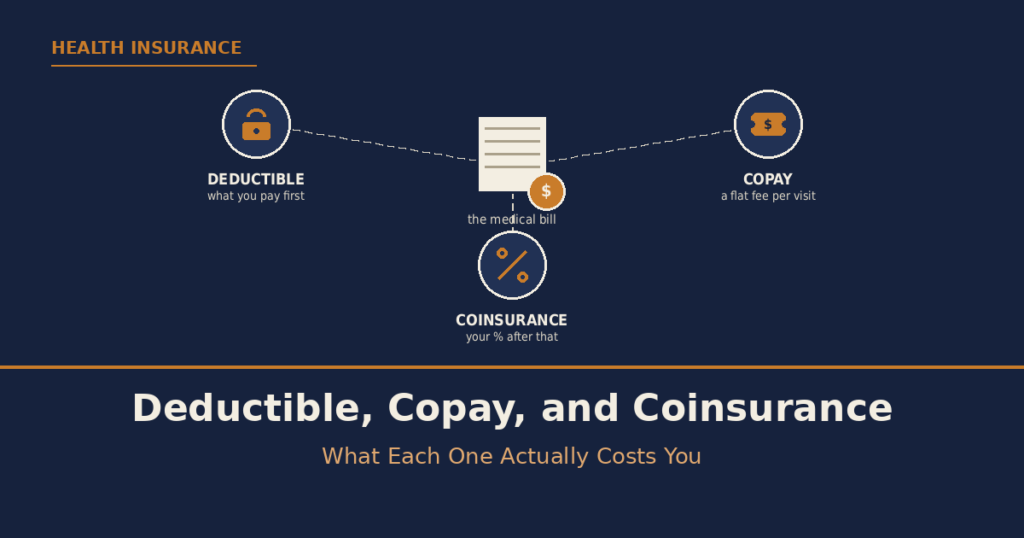
A medical bill arrives, and suddenly three unfamiliar terms determine how much you owe: deductible, copay, coinsurance. They get used almost interchangeably in casual conversation, but they work differently, and mixing them up can lead to a real surprise when the bill comes.
The Deductible: What You Pay Before Insurance Starts Sharing Costs
Your deductible is the amount you pay out of pocket for covered services before your plan starts sharing costs with you. Until you hit that number, you’re generally responsible for the full negotiated rate, not the sticker price on the bill, but the discounted rate your insurer has agreed to with that provider.
A common misconception is that you pay the full billed amount during this phase. You don’t, as long as you stay in-network. Even before your deductible is met, you’re only responsible for the insurer’s negotiated rate, which is usually well below what an uninsured patient would be charged. Checking your Explanation of Benefits, not just the provider’s bill, is the way to confirm what you actually owe.
Some costs skip the deductible entirely. Under the ACA, preventive care like annual physicals, vaccines, and standard screenings is generally covered at no cost to you, regardless of whether you’ve met your deductible.
Copays: Fixed, Predictable Fees
A copay is a flat dollar amount you pay for a specific service, like $30 for a primary care visit or $50 for a specialist. You typically pay it at the time of service, and it doesn’t require any calculation. Some plans apply copays even before you’ve met your deductible, particularly for routine visits and prescriptions, while reserving the deductible-then-coinsurance structure for bigger-ticket services like hospital stays or surgery.
Whether your plan uses copays at all, and for which services, varies by plan. Some plans skip copays entirely and rely purely on deductible-and-coinsurance for everything.
Coinsurance: Your Percentage Share After the Deductible
Coinsurance kicks in after you’ve met your deductible. Instead of a flat fee, you pay a percentage of the cost, and your insurer covers the rest. A common structure is 20% coinsurance, meaning you pay 20% of the allowed amount for a covered service, and your insurer pays the remaining 80%.
This is where costs can climb quickly for expensive procedures. Twenty percent of a $1,200 MRI is $240. Twenty percent of an $18,000 surgery is $3,600. That’s exactly why the next concept, the out-of-pocket maximum, matters so much.
The Out-of-Pocket Maximum: Your Financial Ceiling
The out-of-pocket maximum is the most you’ll pay for covered, in-network care in a single plan year. Your deductible payments, copays, and coinsurance all count toward this number. Once you hit it, your plan pays 100% of covered, in-network costs for the rest of the year.
For 2026, federal rules cap this limit for ACA-compliant plans at $10,600 for individual coverage and $21,200 for family coverage, following a revised calculation methodology that raised these limits from earlier projections. Many employer plans set their own out-of-pocket maximum below these federal caps, so check your specific plan documents rather than assuming the federal limit applies to you.
One detail worth knowing: your monthly premium never counts toward your out-of-pocket maximum. You keep paying it even after you’ve hit the cap. The out-of-pocket maximum only covers costs tied to actually using care.
Family Plans Have Their Own Wrinkle
If you have a family plan, each individual member also has their own embedded out-of-pocket limit, separate from the family-wide total. This means one family member with high medical costs can hit their individual cap and stop owing further cost-sharing, even if the broader family limit hasn’t been reached yet.
How These Pieces Work Together
Most plans follow the same basic sequence: you pay the full negotiated rate for non-preventive care until you hit your deductible, then you start sharing costs through copays or coinsurance, and once your total spending reaches the out-of-pocket maximum, your plan covers 100% of covered, in-network care for the rest of the year.
A Practical Example
Imagine a plan with a $2,000 deductible, 20% coinsurance after the deductible, and a $6,500 out-of-pocket maximum.
In January, you need knee surgery with a total allowed amount of $18,000. You pay your $2,000 deductible, then 20% of the remaining $16,000, which comes to $3,200. Your total for that visit: $5,200, and your plan covers the other $12,800.
In July, you have an unrelated emergency room visit with a $7,000 allowed amount. You’ve already paid $5,200 toward your $6,500 out-of-pocket maximum, so you only owe the remaining $1,300 before hitting your cap. From that point through the end of the plan year, your insurer covers 100% of your covered, in-network costs.
Common Mistakes to Avoid
- Assuming a low deductible always means a better plan. Plans with lower deductibles often carry higher monthly premiums, so the better choice depends on how much care you expect to use during the year.
- Confusing the deductible with the out-of-pocket maximum. The deductible is just the first threshold. The out-of-pocket maximum is the real ceiling on your annual spending.
- Forgetting that out-of-network care usually doesn’t count toward these limits. Depending on your plan, out-of-network spending may not apply toward your deductible or out-of-pocket maximum at all, or may accumulate toward a separate, higher limit.
- Not checking whether a service is exempt from the deductible. Preventive care and, on some plans, primary care copays apply before the deductible is met, which can meaningfully change what you actually owe for routine care.
Final Thoughts
These three terms describe different stages of the same process: your deductible is the threshold you cross first, copays and coinsurance are how you share costs after that, and your out-of-pocket maximum is the ceiling that protects you from unlimited exposure in a bad year. Understanding how they interact, rather than treating them as interchangeable jargon, makes it much easier to compare plans and estimate what a major medical event would actually cost you.
Disclaimer: This article is for general informational purposes only and does not constitute financial, legal, or insurance advice. Deductible amounts, cost-sharing structures, and out-of-pocket maximums vary by plan, insurer, and employer, and federal limits can change from year to year. Review your specific plan documents and contact your insurer or HealthCare.gov for details about your coverage.
Sources
- Cigna Healthcare — “Copays, Deductibles, and Coinsurance,” cigna.com
- MetLife — “Deductible vs. Out-of-Pocket Maximum,” metlife.com
- WTW — “CMS releases revised 2026 out-of-pocket expense limits,” wtwco.com
- Centers for Medicare & Medicaid Services (CMS) — 2026 Notice of Benefit and Payment Parameters, cms.gov