This guide covers business insurance in the United States. Coverage exclusions, pricing, and market conditions vary by insurer and industry, and this market has shifted noticeably in recent years, so get current quotes before making a decision.
Every underlying business policy has a limit, and a serious enough claim can exceed it. A commercial umbrella policy exists specifically for that scenario: it sits above your other coverage and pays the difference when a claim runs past what your primary policies cover. It’s often overlooked by business owners who think of their operations as low-risk, right up until a single severe claim proves that assumption wrong.
How It Actually Works
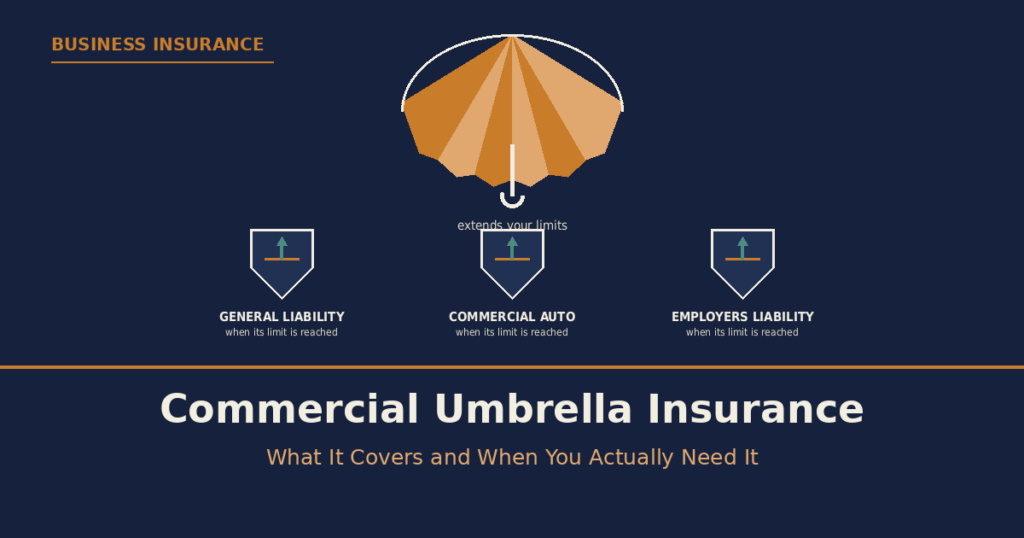
Think of your insurance program as a stack. At the bottom sit your primary policies, general liability, commercial auto, and employer’s liability, each with its own coverage limit, commonly $1 million per occurrence. A commercial umbrella policy sits on top of that stack and activates once a claim exceeds those underlying limits.
Here’s a simplified version of how that plays out. Your general liability policy has a $1 million limit. A customer suffers a severe injury at your business, and a judgment against your company comes in at $1.8 million. Your general liability policy pays the first $1 million. Your umbrella coverage then pays the remaining $800,000, protecting your business from covering that gap directly. Without umbrella coverage, your business would be responsible for that remaining amount itself.
One structural detail matters here: you generally need the underlying primary policies in place first. An umbrella policy doesn’t work as a standalone product. It requires a base layer of coverage to sit on top of.
What It Actually Covers, and What It Doesn’t
Commercial umbrella insurance extends the liability coverage of your existing policies, things like third-party bodily injury, property damage claims, and vehicle collision liability, once those policies’ limits are exhausted.
It generally doesn’t cover categories of risk your primary policies don’t already include in some form. Common exclusions include professional liability or errors and omissions claims, employment practices claims like wrongful termination or discrimination unless specifically endorsed, pollution liability, and damage to your own business property, which falls under commercial property insurance instead. Workers’ compensation itself also isn’t covered directly, though umbrella coverage can sit above the employer’s liability portion of a workers’ comp policy.
The general rule: if something is excluded from your underlying general liability, auto, or employer’s liability policy, your umbrella policy typically won’t cover it either. The umbrella follows the primary policies. It doesn’t create new categories of coverage on its own.
Is It Legally Required?
No. Unlike general liability or workers’ compensation in most states, commercial umbrella insurance isn’t mandated by law. In practice, though, contracts often function as a requirement. Clients frequently require a minimum total liability limit, sometimes $2 million or more, before agreeing to work with a business, and commercial leases sometimes include similar requirements. For many businesses, it’s the contract, not the law, that makes umbrella coverage a practical necessity.
What It Actually Costs
Coverage is typically sold in $1 million increments, with common layer sizes ranging from $1 million up to $25 million depending on the insurer and the business’s needs.
Reported cost ranges vary considerably. Some industry sources cite figures in the range of roughly $300 to $1,500 per $1 million of coverage annually for lower-risk small businesses, with meaningfully higher costs, into the thousands per $1 million, for higher-risk trades like roofing, trucking, or businesses handling hazardous materials. Other sources report an average small business umbrella cost in the range of roughly $40 to $85 per month for the first $1 million layer. Given how much these figures vary by source, industry, and underlying risk, treating any of them as more than a rough starting point, and getting current quotes directly, is the only reliable way to know your actual cost.
Why This Market Has Tightened Recently
Multiple industry sources report that commercial umbrella pricing and available capacity have shifted noticeably in the past couple of years, with some insurers reducing the maximum limits they’re willing to offer on a single policy and premiums rising accordingly, sometimes substantially at renewal. This reflects a broader industry trend often described as a “hard market” for excess liability coverage, driven in part by an increase in unusually large jury verdicts across several industries. If a renewal quote comes in noticeably higher than expected, that increasingly reflects broader market conditions rather than something specific to your individual business.
The Self-Insured Retention Detail Worth Understanding
Some umbrella policies include a self-insured retention, often starting around $10,000, that applies in a specific situation: when the umbrella policy covers something the underlying primary policy doesn’t. In that scenario, the business pays the retention amount itself before the umbrella coverage responds.
This is different from an ordinary deductible, which applies within your primary policy’s own structure. A self-insured retention is a separate, out-of-pocket amount tied specifically to claims that fall into a gap between your primary coverage and your umbrella policy. Understanding whether your specific policy includes this, and what could trigger it, matters for cash flow planning if a claim like this ever arises.
A Practical Example
Imagine a contracting business with a $1 million general liability policy and a $1 million umbrella policy above it. A serious job-site accident results in a $2.5 million judgment against the business.
The general liability policy pays its full $1 million limit. The umbrella policy then covers the next $1 million. That leaves $500,000 exceeding both policies combined, which the business would need to cover itself, since the umbrella layer purchased wasn’t large enough to fully absorb a claim of this size.
Had the business purchased a $2 million umbrella layer instead of $1 million, the full judgment would have been covered by the combined policies. This is exactly the kind of calculation, matching your umbrella limit to your realistic worst-case exposure, that makes working with a knowledgeable commercial insurance agent worthwhile before deciding on a specific coverage amount.
Common Mistakes to Avoid
- Assuming a “low-risk” business doesn’t need umbrella coverage. Businesses that think of themselves this way are often the ones most likely to be caught without adequate coverage when a severe claim does occur.
- Buying umbrella coverage without checking underlying policy limits align. Insurers typically expect specific minimum limits on your primary policies before extending umbrella coverage, and gaps between the two can create coverage problems.
- Assuming the umbrella covers everything a primary policy excludes. It generally only extends categories of coverage your underlying policies already include, not new categories entirely.
- Not revisiting coverage limits as contracts and business size change. A limit that was adequate at a smaller revenue level, or before a specific client contract required higher limits, may no longer be sufficient.
What to Actually Do Next
Add up your business’s realistic worst-case exposure: the value of your assets, your revenue, and the kind of claims your specific industry tends to generate. Compare that figure against your current combined primary and umbrella limits, and check whether any client contracts or leases specify a minimum total liability requirement you need to meet. A licensed commercial insurance agent can help translate that assessment into an appropriate coverage amount and shop current market pricing, which given how much this market has shifted recently, is worth doing even if you already carry umbrella coverage.
Final Thoughts
Commercial umbrella insurance is often inexpensive relative to the protection it provides, but it isn’t automatic and it isn’t unlimited. It requires the right underlying policies in place, a coverage amount that actually matches your realistic exposure, and periodic review as your business and its contracts change. Given how much recent market conditions have affected pricing and availability, current quotes matter more here than a general sense of what coverage “should” cost.
Disclaimer: This article is for general informational purposes only and does not constitute financial, legal, or insurance advice. Coverage exclusions, pricing, available limits, and market conditions vary by insurer, industry, and individual business, and this market has shifted meaningfully in recent years. Contact a licensed commercial insurance agent or broker for advice about your specific business.
Sources
- The Hartford — “Commercial Umbrella Insurance,” thehartford.com
- MoneyGeek — “Commercial Umbrella Insurance: What It Is and How It Works,” moneygeek.com
- Insureon — commercial umbrella insurance guidance, insureon.com
- National Association of Insurance Commissioners (NAIC) — naic.org