This guide covers business auto insurance in the United States. Coverage requirements, costs, and underwriting details vary by insurer, state, and industry, so confirm specifics with a licensed commercial insurance agent.
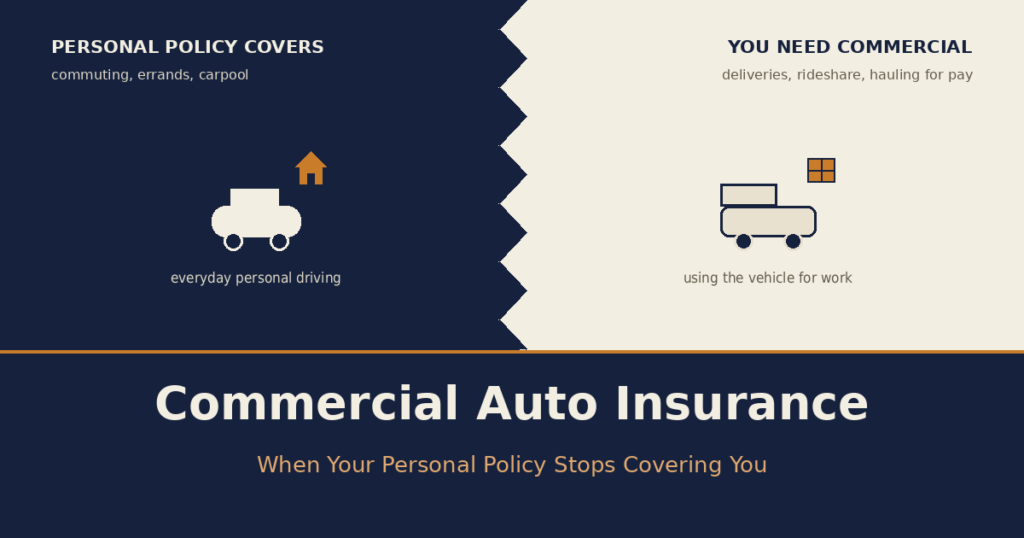
A lot of small business owners and contractors drive the same vehicle for both errands and work, and assume their personal auto policy covers both. It usually doesn’t. Personal auto policies are written around private, predictable driving: commuting, errands, family trips. The moment that same vehicle starts generating income, hauling materials, or carrying clients, it can fall outside what a personal policy was ever designed to cover.
The Core Problem: The Business Use Exclusion
Nearly every personal auto policy contains some form of business use exclusion. It’s built into the underlying assumption behind personal auto pricing: insurers price these policies based on typical personal driving patterns, not the added exposure that comes with revenue-generating activity.
That exclusion means a claim tied to business use, hauling equipment, making deliveries, driving between job sites, can be denied even if you’d otherwise be a covered driver on that policy for personal trips. The specific line between “personal” and “business use” isn’t always obvious in the moment, which is exactly why this gap catches so many self-employed people and small business owners off guard.
What Actually Counts as Business Use
Insurers generally look at the purpose and frequency of the driving, not just the vehicle’s ownership. A vehicle titled in your own name can still need commercial coverage if you’re using it regularly for work. Common activities that typically require commercial auto coverage include transporting goods, tools, or equipment for a job, driving as part of delivery or rideshare work, transporting clients or employees, traveling between job sites during the workday, and driving a vehicle owned by a business entity rather than an individual.
Occasional, incidental use, like driving to a single client meeting a few times a year, may fall into a gray area some personal policies tolerate. Regular, income-generating use generally doesn’t. If your work involves any of the activities above with any regularity, it’s worth having an explicit conversation with your insurer rather than assuming your personal policy extends to cover it.
What Commercial Auto Insurance Actually Adds
Commercial auto insurance is underwritten specifically for business-related driving exposure, and it typically includes several components a personal policy doesn’t.
Higher liability limits. Commercial policies often carry a combined single limit around $1 million, a level frequently required by client contracts, vendor agreements, and certificates of insurance that a job site or business partner may request before you can even begin work.
Coverage for employees and multiple drivers. Personal policies are generally built around household drivers. Commercial policies can be structured around scheduled drivers or specific driver classes, which matters if employees or subcontractors also drive for your business.
Hired and non-owned auto coverage. This addresses a liability gap that surprises a lot of business owners: what happens when an employee uses their own personal vehicle for a work errand, or when your business rents a vehicle for a job. A standard personal policy provides no business liability protection in these situations, and this specific coverage, often shortened to HNOA, exists to close that gap without requiring you to insure vehicles you don’t even own.
Coverage tailored to cargo and equipment. Collision and comprehensive coverage under a commercial policy is underwritten with business use, and the specific cargo or equipment often carried, in mind, rather than assuming ordinary personal cargo.
What It Actually Costs
Cost estimates vary considerably across sources, reflecting how much vehicle type, industry, driving records, coverage limits, and location affect commercial auto pricing. Some industry sources describe average costs for a light-duty commercial vehicle somewhere in the range of roughly $150 to $400 a month, though your specific quote depends heavily on these individual risk factors rather than any single average.
Because this range is wide, and because the underlying pricing factors vary so much by business type and vehicle use, getting quotes directly from a few insurers or a commercial broker is the only reliable way to know your actual cost.
A Practical Example
Imagine a self-employed contractor who uses a personal pickup truck for both weekend errands and hauling tools and materials to job sites during the week. One day, while driving between two job sites with a truck bed full of equipment, they’re involved in an accident that damages another vehicle.
If their insurer determines this trip falls under the personal policy’s business use exclusion, the claim could be denied, leaving the contractor personally responsible for the other driver’s damages, on top of their own vehicle’s repair costs. Had they carried a commercial auto policy, or at minimum notified their personal insurer about the vehicle’s actual business use and secured appropriate coverage, this same accident would likely have been handled as a covered claim instead.
Common Mistakes to Avoid
- Assuming a personal policy covers “occasional” business use without confirming with your insurer. The threshold for what counts as excluded business use isn’t always intuitive, and it’s worth getting a direct answer rather than guessing.
- Overlooking hired and non-owned auto coverage. If employees ever use their own vehicles for work tasks, or your business rents vehicles occasionally, this gap exists whether or not you own a dedicated commercial fleet.
- Not matching your liability limits to what contracts actually require. Many client and vendor agreements specify a minimum coverage limit, commonly $1 million, before work can even begin.
- Waiting for a claim to find out your policy excludes business use. Confirming coverage before an incident, not after, is the only way to avoid a denied claim at the worst possible time.
What to Actually Do Next
Take an honest inventory of how your vehicles are actually used: how often for business, what’s being hauled or transported, and whether employees or subcontractors ever drive for work purposes. Bring that specific picture to a licensed commercial insurance agent, who can determine whether a dedicated commercial auto policy, a business-use endorsement on an existing policy, or hired and non-owned auto coverage best fits your actual exposure.
Final Thoughts
The line between personal and commercial auto insurance comes down to intent and use, not just who owns the vehicle. A personal policy assumes predictable, non-income-generating driving, and it can deny a claim the moment that assumption doesn’t hold. Confirming your actual coverage before an accident happens, rather than discovering a gap during a claim, is the difference between a manageable incident and a serious financial setback.
Disclaimer: This article is for general informational purposes only and does not constitute financial, legal, or insurance advice. Coverage requirements, exclusions, and costs vary by insurer, state, vehicle type, and business activity, and can change over time. Contact a licensed commercial insurance agent or broker for advice about your specific business.
Sources
- American Family Insurance — “Commercial auto insurance vs. personal,” amfam.com
- ConstructionCoverage.com — “Commercial vs. Personal Auto Insurance for Contractors,” constructioncoverage.com
- Insureon — commercial auto insurance cost data referenced via industry guidance