
This guide covers COBRA continuation coverage in the United States. Some states run parallel “mini-COBRA” laws with different rules, so check your state’s requirements alongside the federal ones described here.
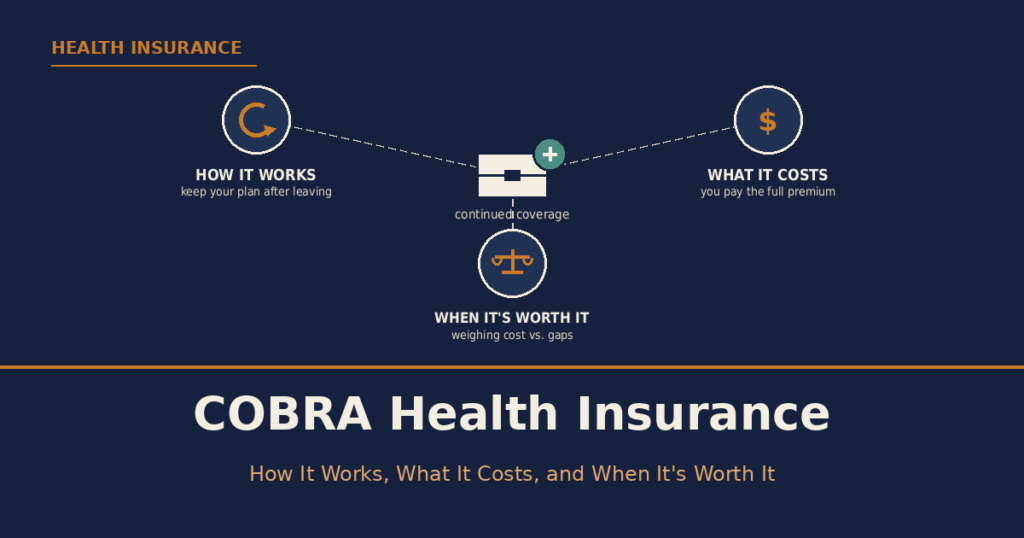
Losing job-based health coverage tends to arrive at the worst possible time, right in the middle of dealing with a job loss itself. COBRA exists to soften that specific problem: it lets you keep your existing employer health plan for a while after you leave, instead of losing coverage the same day your job ends. It comes at a real cost, though, and it isn’t automatically the right choice for everyone.
What COBRA Actually Does
COBRA, short for the Consolidated Omnibus Budget Reconciliation Act, lets you continue the exact same health plan you had through your employer. Same network, same benefits, same prescription formulary. Nothing about the coverage itself changes. What changes is who pays for it.
Federal COBRA applies to employers with 20 or more employees. If you worked for a smaller employer, federal COBRA doesn’t apply, but many states run their own version, often called mini-COBRA, that extends similar rights to employees of smaller companies. Rules and duration under these state programs vary, so check your specific state’s requirements if your employer falls under this threshold.
What Triggers COBRA Eligibility
COBRA becomes available after specific “qualifying events” that would otherwise end your coverage. These include voluntary or involuntary job loss, a reduction in work hours that drops you below eligibility for the health plan, divorce or legal separation from a covered employee, a dependent child aging out of the plan, or the covered employee becoming eligible for Medicare. Losing coverage under any of these circumstances is what opens the door to electing COBRA.
How Long Coverage Lasts
Standard COBRA coverage runs up to 18 months for the most common triggers: job loss or a reduction in hours. Certain other qualifying events, including divorce, legal separation, or a dependent aging out of the plan, can extend coverage up to 36 months instead.
There’s also a lesser-known extension: if you become disabled within the first 60 days of COBRA coverage, you may qualify for an additional 11 months, bringing your total eligible period to 29 months. Confirm the exact rules for your situation with your plan administrator, since qualifying criteria and documentation requirements apply.
What COBRA Actually Costs
This is where COBRA surprises most people. While employed, your employer typically covers a meaningful share of your premium, often a majority of the total cost. Under COBRA, that subsidy disappears. You pay the full premium your employer was paying on your behalf, plus your own previous share, plus a 2% administrative fee. In practice, this usually works out to 102% of the plan’s total cost.
Because employer plans vary widely in generosity and network strength, so does the resulting COBRA premium. Individual coverage often runs several hundred dollars a month, with family coverage substantially higher. Your specific number depends entirely on what your former employer’s plan actually costs, which your plan administrator can tell you directly. Don’t assume a number you saw elsewhere applies to your situation.
The Enrollment Window Is Stricter Than It Looks
You generally have 60 days from either the date you lose coverage or the date you receive your COBRA election notice, whichever is later, to decide whether to enroll. Missing that window means losing your COBRA rights entirely, with no extensions.
Here’s a detail worth understanding: you don’t have to decide immediately, and you don’t have to pay immediately either. Your first premium payment is typically due 45 days after you elect coverage, and that payment can retroactively cover the gap back to your original coverage loss date. In effect, this means you can wait, watch whether you actually incur medical expenses during that window, and decide based on what happens. If you stay healthy and incur no costs, you’re not obligated to pay anything until you actually elect. If something happens, you can elect COBRA and have it apply retroactively.
COBRA vs. Marketplace Coverage
Losing employer coverage is itself a qualifying life event that opens a Special Enrollment Period for ACA Marketplace plans through HealthCare.gov. Being offered COBRA doesn’t disqualify you from Marketplace coverage or from premium tax credits, and for many people, a subsidized Marketplace plan ends up considerably cheaper than paying the full COBRA premium.
The trade-off is continuity. COBRA keeps you on the exact same plan, same doctors, same prescription coverage, with zero disruption. A Marketplace plan might mean a different network or formulary, which matters more if you’re in the middle of ongoing treatment, managing a chronic condition, or have a procedure already scheduled with a specific provider.
A Practical Example
Imagine someone laid off mid-treatment for a chronic condition, with a specialist they’ve seen for years and a specific medication their current plan covers well. For them, the continuity COBRA offers, keeping that exact specialist and formulary uninterrupted, may be worth the higher cost, at least temporarily while they sort out longer-term coverage.
Now imagine someone else laid off with no ongoing treatment and generally good health. For them, running the numbers on a subsidized Marketplace plan is usually worth the ten minutes it takes, since the premium difference over even a few months can be substantial.
Neither situation has a universally correct answer. It depends on your health needs, your income for subsidy purposes, and how long you expect to need coverage.
Common Mistakes to Avoid
- Letting the 60-day window pass without deciding. Even if you’re unsure, the option to elect retroactively means there’s rarely a reason to let the deadline lapse without at least confirming your choice.
- Assuming COBRA is your only option. Marketplace plans, Medicaid if your income has dropped, or a spouse’s employer plan may all be available and worth comparing.
- Not checking your state’s mini-COBRA law if your employer is small. Federal COBRA’s 20-employee threshold isn’t the end of the story in every state.
- Missing a premium payment. COBRA coverage can be terminated for late or missed payments, so confirm your plan’s specific grace period and due dates.
Final Thoughts
COBRA solves a real problem, keeping your exact coverage in place during a disruptive transition, but it does so at a real cost, since you’re now paying the portion your employer used to cover. Whether it’s worth it comes down to your specific health needs, your budget, and how the numbers compare to a subsidized Marketplace plan. Running that comparison before your 60-day window closes is worth the effort, even if COBRA ends up being the right call after all.
Disclaimer: This article is for general informational purposes only and does not constitute legal, financial, or insurance advice. COBRA eligibility, costs, and duration vary by employer, state, and individual circumstances, and can change over time. Contact your plan administrator, your state’s insurance department, or HealthCare.gov for details about your specific situation.
Sources
- U.S. Department of Labor — “An Employee’s Guide to Health Benefits Under COBRA,” dol.gov
- HealthCare.gov — “COBRA & the Marketplace,” healthcare.gov
- Centers for Medicare & Medicaid Services (CMS) — cms.gov