
This guide covers commercial insurance documentation in the United States. Contract requirements and endorsement availability vary by insurer and agreement, so review specific contract language with your insurance agent or broker.
Two phrases appear constantly in commercial contracts, vendor onboarding forms, and commercial leases: “certificate holder” and “additional insured.” A lot of business owners treat them as roughly the same thing. They aren’t close. One gives you a piece of paper. The other gives you actual insurance coverage, including a legal defense if you get sued.
What a Certificate of Insurance Actually Is
A certificate of insurance, commonly shortened to COI, is a one-page summary proving that a business carries active insurance coverage. It isn’t the policy itself. It’s a snapshot confirming that coverage exists and meets whatever requirements a contract, lease, or project specifies.
Nearly all COIs in the United States use a standardized form called ACORD 25, produced by the Association for Cooperative Operations Research and Development. Because the format is standardized, anyone reviewing one knows where to find the key details: the issuing agent or broker, the named insured, the types of coverage carried, policy numbers, effective dates, coverage limits, and the certificate holder receiving the document.
Landlords request them before handing over keys. General contractors request them from subcontractors. Clients request them before signing. COIs aren’t usually legally mandated, but they’re contractually required in the vast majority of commercial relationships.
The Distinction That Actually Matters
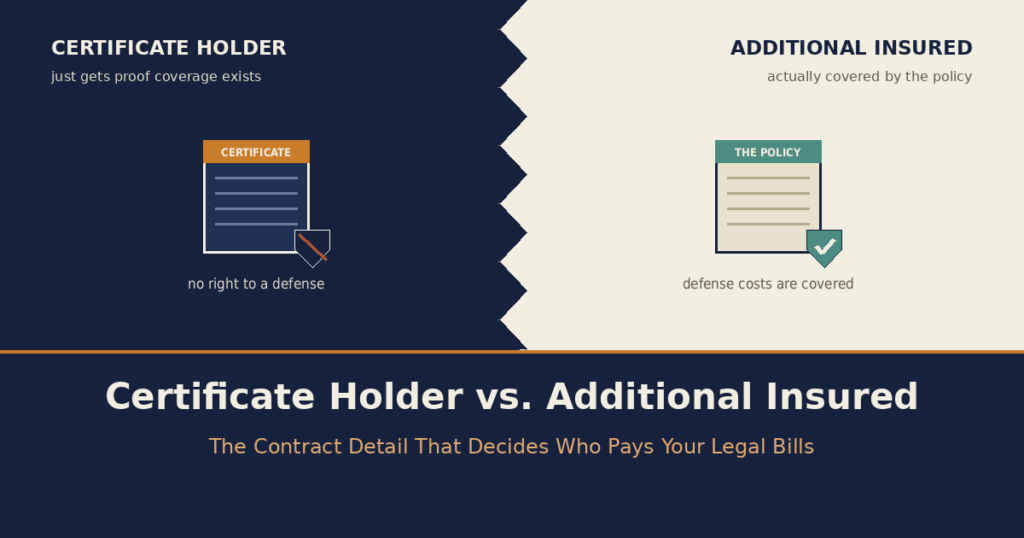
A certificate holder is simply the party who receives a copy of the COI. That’s the entire relationship. You have documentation confirming someone else carries insurance. You have no rights under their policy whatsoever.
A useful way to think about it: receiving a photocopy of someone’s driver’s license confirms they’re licensed, but it doesn’t let you drive their car.
An additional insured is fundamentally different. This designation, added to the named insured’s policy through a specific endorsement, extends actual coverage to you under their policy. If a third party sues you over an incident connected to the named insured’s operations, their insurer generally has a duty to defend you: assigning attorneys, covering defense costs, and handling settlements within the policy’s limits.
Certificate holders receive none of that. Sued over the same incident, with only a COI in hand, you’re funding your own legal defense entirely. The insurer owes you nothing.
Why the Endorsement Is the Real Product
Here’s the practical consequence of that distinction, and the part most worth internalizing: a certificate listing you as an additional insured is evidence, not coverage. The actual coverage comes from the endorsement attached to the underlying policy.
That’s why experienced risk managers verify the endorsement separately rather than accepting the certificate alone. A COI can list you as an additional insured without a corresponding endorsement ever having been added to the policy, or with conditional language narrow enough to be effectively meaningless when a claim arises. Requesting a copy of the actual additional insured endorsement, not just the certificate referencing it, is the step that confirms you have what the contract promised.
Why Contracts Require This Arrangement
The purpose is risk transfer. When a general contractor requires a subcontractor to name them as an additional insured, they’re shifting liability exposure from the subcontractor’s work onto the subcontractor’s insurance carrier, rather than absorbing it through their own policy and claims history.
This works in both directions depending on which side of the contract you’re on. As the party requiring it, you gain real protection. As the party providing it, you’re extending your policy’s coverage to someone else, which is worth understanding before you agree to it in a contract you haven’t read closely.
Notably, an additional insured typically pays no premium for this protection, but also has no control over the policy. They can’t change coverage amounts or direct how claims get handled. What they do get, when a covered incident occurs, is defense coverage and access to claim payments much as if the policy were their own.
A Practical Example
Imagine a fitness instructor who teaches classes at an independent studio. The studio requires the instructor to carry general liability insurance and to name the studio as an additional insured on that policy.
If a client later sues over an injury during one of the instructor’s classes, the instructor’s policy responds, covering the legal defense for both the instructor and the studio. The studio’s own insurance and claims history stay out of it.
Now imagine the studio had only asked to be listed as a certificate holder. They’d have documentation confirming the instructor carries insurance, and nothing more. Facing the same lawsuit, the studio would hire and pay for its own legal defense, with no claim against the instructor’s policy at all, despite holding a certificate that made them feel covered.
Common Mistakes to Avoid
- Treating certificate holder status as coverage. It’s documentation only, and this misunderstanding creates a genuine blind spot in a lot of vendor relationships.
- Accepting a COI without verifying the endorsement exists. The certificate references coverage; the endorsement provides it, and the two don’t always match.
- Not reading the additional insured language closely. Conditional or narrowly worded endorsements can be far less protective than the certificate suggests.
- Agreeing to add additional insureds without understanding the effect on your own policy. You’re extending your coverage to another party, which is a real commitment worth discussing with your agent first.
What to Actually Do Next
If a contract requires you to name someone as an additional insured, contact your insurance agent or broker directly rather than assuming your COI alone satisfies the requirement. Some insurers allow you to add additional insureds online; others require a call.
If you’re on the requiring side, ask for both the certificate and a copy of the additional insured endorsement itself, and have your agent review the endorsement language against what your contract actually requires. That review takes a few minutes and is the difference between believing you’re covered and actually being covered.
Final Thoughts
The gap between a certificate holder and an additional insured is the gap between holding a document and holding coverage. Contracts use both terms, often in the same paragraph, and the practical consequences only become visible when a lawsuit arrives. Verifying the endorsement, not just the certificate, is what turns a contractual requirement into genuine protection.
Disclaimer: This article is for general informational purposes only and does not constitute financial, legal, or insurance advice. Endorsement terms, contract requirements, and coverage availability vary by insurer, policy, and agreement, and can change over time. Contact a licensed commercial insurance agent or broker, or an attorney, for advice about your specific contracts and coverage.
Sources
- Progressive Commercial — “Certificate of Insurance (COI),” progressivecommercial.com
- NerdWallet — “Certificate of Insurance: What It Is, How to Get One,” nerdwallet.com
- Vouch — “What Is a Certificate of Insurance (COI)?,” vouch.us
- Coverage Criteria — “Certificate of Insurance Requirements,” coveragecriteria.com