This guide covers car insurance in the United States. Rate rules after a claim vary by state and insurer, so check your policy and your state’s regulations for specifics.
You’re weighing whether to file a claim after a fender bender, and a familiar worry creeps in. Will this make your premium jump for years? The honest answer is: it depends. Not every claim raises your rate, and the ones that do vary a lot depending on fault, claim type, and your specific insurer.
The Short Answer
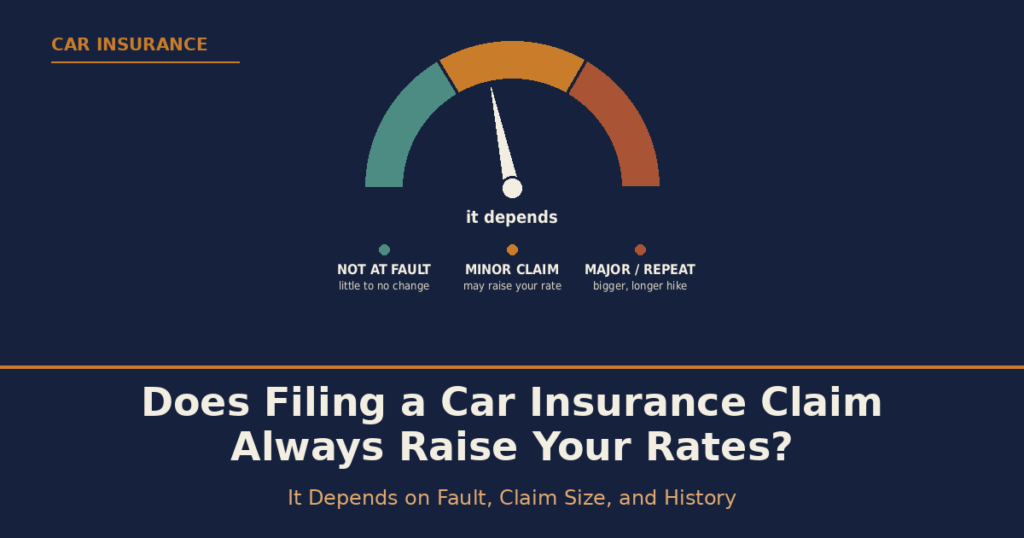
At-fault accidents almost always raise your rate. Not-at-fault accidents and comprehensive claims often don’t, or raise it by less, though “often” isn’t “never.” Multiple claims in a short window tend to compound the increase regardless of fault. Beyond that general pattern, the specifics depend heavily on your state and your insurer’s own rules.
At-Fault Accidents: The Claims That Raise Rates Most
If you’re found at fault for an accident, expect your premium to increase at your next renewal. Insurers treat an at-fault accident as a direct signal of future risk, and industry sources commonly cite increases in the range of 30% to 50%, though your actual number depends on the accident’s severity, the claim amount, your prior driving record, and your specific insurer’s pricing rules.
These increases typically stay on your record, and affect your rate, for around three to five years. After that window, many insurers stop factoring the accident into your premium, though it may still appear in a shared claims history database for longer.
Not-At-Fault Accidents: More Protected, But Not Immune
Here’s something that surprises a lot of drivers: even an accident that wasn’t your fault can sometimes affect your rate. Insurers look at claim frequency, not just who caused the incident, reasoning that someone who files claims more often, for any reason, may be more likely to file again.
Several states have passed laws specifically prohibiting insurers from raising rates after a not-at-fault accident. Where those protections exist, they meaningfully change the calculation. Where they don’t, some insurers may still apply a smaller increase than they would for an at-fault claim. Checking your specific state’s rules, and your policy’s fine print, is the only way to know where you stand.
Comprehensive Claims: Usually the Smallest Impact
Comprehensive coverage handles damage from events outside a collision: hail, theft, vandalism, or hitting a deer. Because these events are generally outside your control, comprehensive claims tend to have a smaller impact on your rate than at-fault accidents, and sometimes none at all.
That said, “smaller impact” isn’t the same as “no impact.” Some insurers do factor in comprehensive claims, particularly if you file more than one. There’s also a broader effect worth knowing about: rising comprehensive claims across your area, from other policyholders, can push up rates region-wide, since they signal increased local risk from theft or severe weather.
Accident Forgiveness: What It Actually Does
Accident forgiveness is a feature, sometimes built into a policy and sometimes purchased as an add-on, that prevents your first at-fault accident from raising your rate. Insurers structure it differently. Some apply it automatically after a period of clean driving, treating it as a reward. Others let you add it to a policy from day one as protection against a future first mistake.
It’s worth checking your policy directly, since accident forgiveness isn’t universal, and the details, what qualifies, how long it lasts, whether it transfers if you switch insurers, vary by company.
A Practical Example
Imagine two drivers, both with clean records, who each get into a minor accident in the same month.
The first driver is found at fault. Their next renewal reflects a meaningful premium increase, and that increase is likely to stick around for a few years unless they have accident forgiveness protection or their insurer has more lenient rules for minor first incidents.
The second driver is hit by someone who ran a red light and is found not at fault. Depending on their state’s laws and their insurer’s specific policies, they may see no change at all, or possibly a smaller increase tied simply to having filed a claim. The outcome here is genuinely less predictable than the at-fault scenario, which is exactly why checking your own state and insurer matters more than relying on a general rule.
Should You Avoid Filing a Claim to Protect Your Rate?
Some drivers, worried about a rate increase, consider paying for minor damage out of pocket instead of filing a claim at all. For genuinely small repair costs, that’s a reasonable calculation to run: compare the repair cost against your deductible and the likely rate impact.
But skipping a claim entirely carries its own risk. If the other party later disputes what happened, or files a claim of their own, having never reported the incident to your insurer can leave you without support just when you need it. Most insurers also require you to report accidents within a specific window regardless of whether you intend to file a claim, and missing that window can affect coverage if something develops later. Reporting an incident and choosing not to file a claim aren’t always the same decision, and it’s worth understanding your policy’s specific requirements before deciding to stay quiet about an accident.
Common Mistakes to Avoid
- Assuming every claim raises your rate the same amount. Fault, claim type, and claim history all change the calculation significantly.
- Not asking about accident forgiveness before you need it. Some policies include it automatically, others require you to add it, and it’s much easier to check in advance than to find out after an accident that you don’t have it.
- Skipping the police report on a minor accident. Even for claims you don’t plan to escalate, documentation protects you if the situation changes later.
- Not shopping around after a rate increase settles. Once the surcharge period from an at-fault accident ends, comparing quotes can reveal savings your current insurer won’t offer automatically.
Final Thoughts
Whether a claim raises your rate depends on fault, claim type, your state’s regulations, and your specific insurer’s rules, not on a single universal answer. At-fault accidents are the most likely to increase your premium, and by the widest margin. Not-at-fault accidents and comprehensive claims are more often protected, but not guaranteed to be. Knowing your own policy’s accident forgiveness terms, and your state’s rules on not-at-fault claims, is the most useful thing you can do before you’re actually deciding whether to file.
Disclaimer: This article is for general informational purposes only and does not constitute financial, legal, or insurance advice. Rate impacts, accident forgiveness terms, and state regulations vary by insurer, state, and individual circumstances, and can change over time. Review your policy documents and contact your insurance provider or your state’s Department of Insurance for details about your specific situation.
Sources
- Progressive — “How Much Does Insurance Go Up After an Accident?,” progressive.com
- GEICO — “How much does auto insurance go up after a claim?,” geico.com
- Liberty Mutual — “Will an accident increase my car insurance,” libertymutual.com
- Allstate — “How much does your car insurance increase after accident?,” allstate.com
- Bankrate — “Why filing a claim raises your insurance rates,” bankrate.com