This guide covers business insurance in the United States. Policy terms, waiting periods, and typical costs vary by insurer and policy, so review your specific policy documents for exact figures.
A fire, a burst pipe, or a major storm can shut a business down physically, and property insurance is what pays to repair the building. But rent, payroll, and loan payments don’t pause just because the doors are closed. That’s the gap business interruption insurance is built to fill, and it’s a gap many business owners don’t realize exists until they’re already living through it.
What This Coverage Actually Pays For
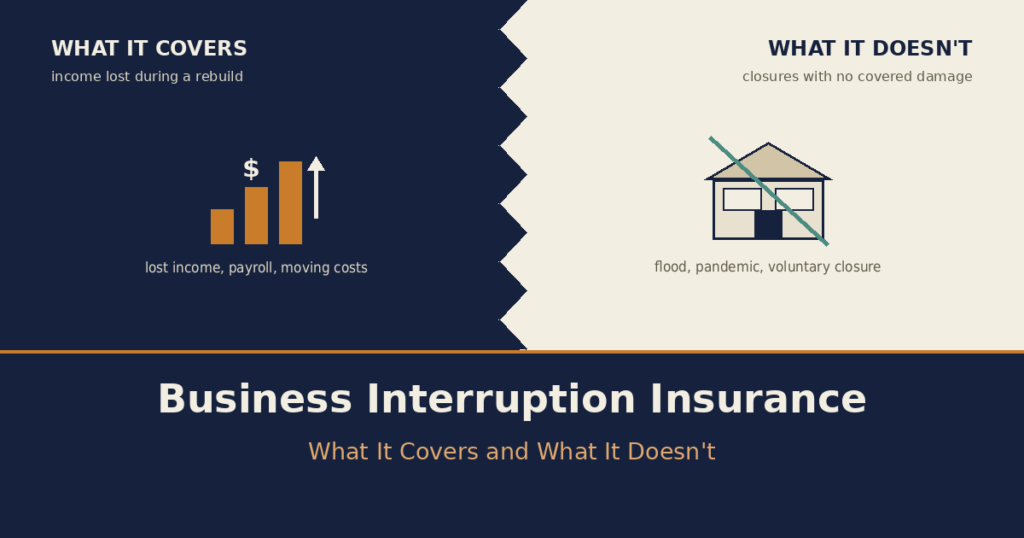
Business interruption insurance, sometimes called business income coverage, replaces the income your business loses when a covered event forces a temporary shutdown. It’s not property insurance. It doesn’t repair your building or replace damaged equipment. It covers the money you stop earning while you recover, plus the fixed costs that keep coming regardless of whether you’re open.
Typical covered costs include lost revenue based on your business’s financial history, employee payroll to retain your workforce during the closure, rent or mortgage payments, loan payments coming due during the interruption, taxes, and sometimes relocation costs if you need temporary space while repairs happen.
This coverage is rarely sold as a standalone policy. It’s typically added as an endorsement to a commercial property policy, or bundled into a Business Owner’s Policy, commonly called a BOP, alongside general liability and property coverage.
The Trigger: Why It Doesn’t Cover Everything
Business interruption coverage generally only activates after direct physical damage from a covered peril, things like fire, windstorm, hail, or vandalism, forces your operations to stop. That triggering requirement is the source of the most common and costly misunderstanding about this coverage.
Events that don’t involve physical property damage typically fall outside standard coverage. A cyberattack that shuts down your systems without physical damage generally isn’t covered here, which is exactly why cyber liability insurance exists as a separate product. Earthquakes and floods are also commonly excluded from standard business interruption coverage and usually require separate policies or endorsements. A broad government shutdown order unrelated to damage at your specific property is typically not covered either, though a related concept called civil authority coverage can apply in narrower circumstances, specifically when access to your property is restricted because of damage nearby, not because of a general public health or economic order.
Reading your policy’s specific list of covered perils, rather than assuming broad protection, is the only way to know what would actually trigger a payout for your business.
Two Details That Determine What You Actually Collect
The Waiting Period
Most policies include a waiting period, functioning similarly to a deductible, before coverage begins. This is commonly set around 72 hours after the physical damage occurs, though the specific length varies by policy. A shutdown resolved within that window generally wouldn’t trigger a payout at all.
The Period of Restoration
Coverage runs for what’s called the period of restoration: the time reasonably needed to repair the damage and resume operations. This period ends when your business is physically capable of reopening, not necessarily when your revenue actually returns to pre-loss levels. If your coverage limit is calculated for six months of lost income but recovery genuinely takes nine, you’re responsible for those final three months yourself. Getting this estimate right when you first set your coverage amount matters more than most business owners realize going in.
A Practical Example
Imagine a small restaurant with a kitchen fire that forces a three-month closure while repairs are completed. Property insurance covers the physical repairs, the damaged kitchen equipment and structure. Business interruption coverage, running alongside it, covers the revenue the restaurant would have earned during those three months, based on its financial history, plus ongoing costs like staff wages the owner chooses to keep paying, the building lease, and a pending loan payment that comes due mid-closure.
Now imagine the same restaurant instead loses several days of sales because a widespread regional power outage, unrelated to any damage at the property itself, makes cooking impossible. Depending on the policy’s specific language, this kind of interruption without direct physical damage to the business’s own property may not trigger standard coverage at all, since it doesn’t meet the physical damage trigger most policies require.
Same category of financial loss, different structural cause, and potentially a very different coverage outcome.
Common Mistakes to Avoid
- Assuming this coverage is included automatically with property insurance. It’s usually a separate endorsement or a specific component of a BOP, not a default feature of every commercial property policy.
- Underestimating the recovery timeline when setting coverage limits. A coverage period that runs out before your business actually reopens leaves you covering the remaining gap yourself.
- Assuming a cyberattack or a flood is covered. These commonly require separate policies, cyber liability and flood insurance respectively, since standard business interruption coverage typically excludes them.
- Not accounting for the waiting period in cash flow planning. Knowing you’ll cover the first few days yourself, before coverage begins, helps avoid a surprise gap right after a loss occurs.
What to Actually Do Next
Review your business’s actual monthly fixed costs, payroll, rent, loan payments, and estimate realistically how long a serious disruption might take to resolve for your specific type of operation. A licensed commercial insurance agent can help translate that estimate into an appropriate coverage limit and period, and can clarify exactly which perils your specific policy would and wouldn’t cover. Asking your agent to walk through a sample claim scenario for your business is a useful way to confirm the policy does what you think it does before you actually need it.
Final Thoughts
Business interruption insurance exists specifically because a shutdown’s damage isn’t limited to the physical property. Rent, payroll, and loan payments don’t pause on their own. The coverage is only as useful as its triggering conditions and its coverage period actually match your business’s real recovery timeline, which makes reviewing those specifics, rather than assuming broad protection, the most important step in getting this right.
Disclaimer: This article is for general informational purposes only and does not constitute financial, legal, or insurance advice. Coverage triggers, waiting periods, restoration periods, and costs vary by insurer and policy, and can change over time. Review your policy documents carefully and contact a licensed commercial insurance agent for advice about your specific business.
Sources
- MoneyGeek — “Business Interruption Insurance: What It Is and How It Works,” moneygeek.com
- Compare.com — “Business Interruption Insurance: What You Should Know,” compare.com
- Smartest Dollar — “The Best Business Interruption Insurance,” smartestdollar.com
- National Association of Insurance Commissioners (NAIC) — naic.org