This guide covers business insurance in the United States. Costs and underwriting requirements shift quickly in this market, so treat the figures below as general reference points and get current quotes directly from insurers or a broker.
Most small business owners assume cyberattacks are a big-company problem. They’re not. Small businesses are frequently targeted precisely because their defenses tend to be weaker, and a single breach can be enough to shut a small operation down. The insurance product built for this risk, cyber liability insurance, still isn’t something every business owner understands or carries.
What Cyber Liability Insurance Actually Covers
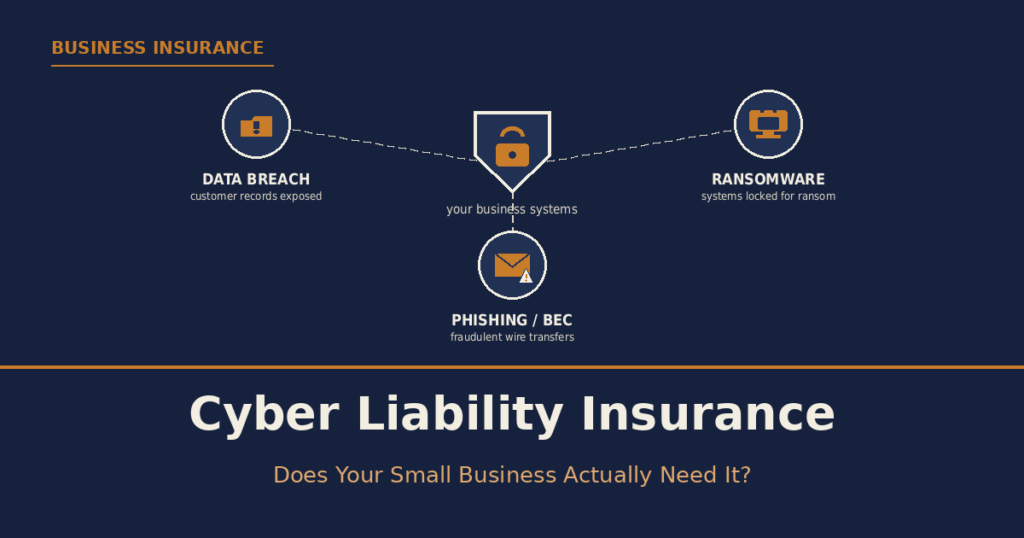
Cyber liability insurance covers financial losses tied to data breaches, ransomware attacks, business email compromise, and network outages caused by hackers. This matters because traditional business insurance generally excludes cyber events entirely. If a customer database gets stolen or ransomware locks your systems, a standard general liability or property policy typically won’t pay toward the recovery.
Coverage usually splits into two categories.
First-party coverage pays for costs your business incurs directly: data recovery, breach notification to affected customers, credit monitoring for those customers, forensic investigation of what happened, and business interruption losses while your systems are down.
Third-party coverage pays for claims against you: lawsuits from affected customers, regulatory investigations and fines, and legal defense costs when a breach exposes your business to liability from people outside your company.
Some policies also include cyber extortion coverage, which addresses ransom demands and the costs associated with responding to them.
Is It Legally Required?
No federal law requires small businesses to carry cyber liability insurance. That said, plenty of contracts effectively require it in practice. Government contracts, agreements with larger corporate clients, and work in regulated industries like healthcare or financial services frequently include a cyber insurance requirement as a condition of doing business, even without a broader legal mandate behind it.
What It Actually Costs
Pricing varies considerably by industry, revenue, the sensitivity of the data you handle, and your existing security practices. For a small business seeking around $1 million in coverage, reported ranges commonly fall somewhere between roughly $500 on the low end for lower-risk service businesses and several thousand dollars a year for businesses handling more sensitive data or operating in regulated industries. Businesses in healthcare, financial services, or other data-heavy sectors can see meaningfully higher premiums, reflecting the greater regulatory and breach exposure those industries carry.
Because this market has shifted quickly in recent years, and because your own quote depends heavily on your specific risk profile, getting current quotes from more than one insurer or broker is the only reliable way to know your actual cost.
Underwriting Has Gotten More Demanding
A notable shift in this market: insurers increasingly expect specific security controls before they’ll issue a policy, rather than relying on a simple questionnaire. Multi-factor authentication, endpoint detection and response tools, and tested data backups have become common baseline expectations from underwriters.
Employee training also factors into underwriting in many cases, since human error plays a role in a large share of cyber incidents. Insurers may look favorably on businesses that can document regular security awareness training, since that documentation demonstrates active risk management rather than a static, one-time compliance checkbox.
If your business currently lacks these fundamentals, it’s worth addressing them before you shop for a policy. Beyond potentially improving your premium, they’re good practice independent of whether you carry insurance at all.
A Practical Example
Imagine a small accounting firm that stores client financial records digitally and processes online payments. A ransomware attack locks their systems for several days, and their attacker demands payment to restore access.
Without cyber coverage, this firm would face the ransom decision alone, along with forensic investigation costs, the expense of notifying affected clients, potential regulatory scrutiny given the sensitivity of financial data, and lost revenue during the outage, all out of pocket.
With a cyber liability policy in place, many of these costs, the extortion response, the forensic investigation, the notification process, and the business interruption losses, would typically be covered subject to the policy’s specific terms and limits. The firm still faces a disruptive event, but not one that threatens to end the business financially on top of the operational disruption.
Cyber Liability vs. Technology E&O
Businesses that build or sell technology products or services sometimes need a related but distinct policy: technology errors and omissions insurance. This covers claims that your product or professional technology services caused a client financial harm, for instance if a software bug led to a client’s data loss.
Technology companies frequently need both cyber liability and tech E&O, since the risks overlap but aren’t identical. A general business without a technology product typically only needs cyber liability coverage on its own.
Common Mistakes to Avoid
- Assuming general liability insurance covers cyber incidents. It almost always doesn’t, since standard commercial policies specifically exclude digital risks.
- Waiting until a client or contract requires it to look into coverage. Underwriting has gotten stricter, and scrambling to meet security requirements under a deadline is harder than addressing them proactively.
- Not documenting security practices. Insurers increasingly want evidence of ongoing training and technical controls, not just a claim that they exist.
- Assuming your business is too small to be a target. Smaller businesses are frequently targeted precisely because attackers expect weaker defenses.
What to Actually Do Next
Start by identifying what sensitive data your business actually handles, customer payment information, health records, financial data, and how a breach involving that data would realistically play out. From there, a broker experienced in cyber liability can help match coverage limits and policy terms to your actual exposure, and can advise on which security controls would most improve both your risk and your premium.
Final Thoughts
Cyber liability insurance fills a gap that traditional business policies leave wide open. It isn’t federally mandated, but contracts, client expectations, and the sheer cost of an uninsured breach make it a serious consideration for almost any business that handles digital customer data. Given how quickly both the threat landscape and underwriting requirements are shifting, current quotes and a conversation with a knowledgeable broker matter more here than in most other insurance categories.
Disclaimer: This article is for general informational purposes only and does not constitute financial, legal, or insurance advice. Coverage availability, costs, underwriting requirements, and regulatory exposure vary by business, industry, and insurer, and this market continues to evolve quickly. Contact a licensed commercial insurance broker for advice about your specific business.
Sources
- Federal Trade Commission (FTC) — Cybersecurity guidance for small businesses, ftc.gov
- Cybersecurity and Infrastructure Security Agency (CISA) — cisa.gov
- National Association of Insurance Commissioners (NAIC) — content.naic.org