
This guide covers workers’ compensation insurance in the United States. Requirements, thresholds, and penalties are set at the state level and vary significantly, so verify the specifics for your state before making coverage decisions.
Hiring your first employee changes more than payroll. In nearly every state, it also triggers a legal requirement most new business owners don’t see coming: workers’ compensation insurance. Skipping it isn’t a minor paperwork gap. In many states, it’s a criminal offense, and it can leave your business personally exposed to costs that ordinary liability insurance was never built to cover.
What Workers’ Compensation Actually Does
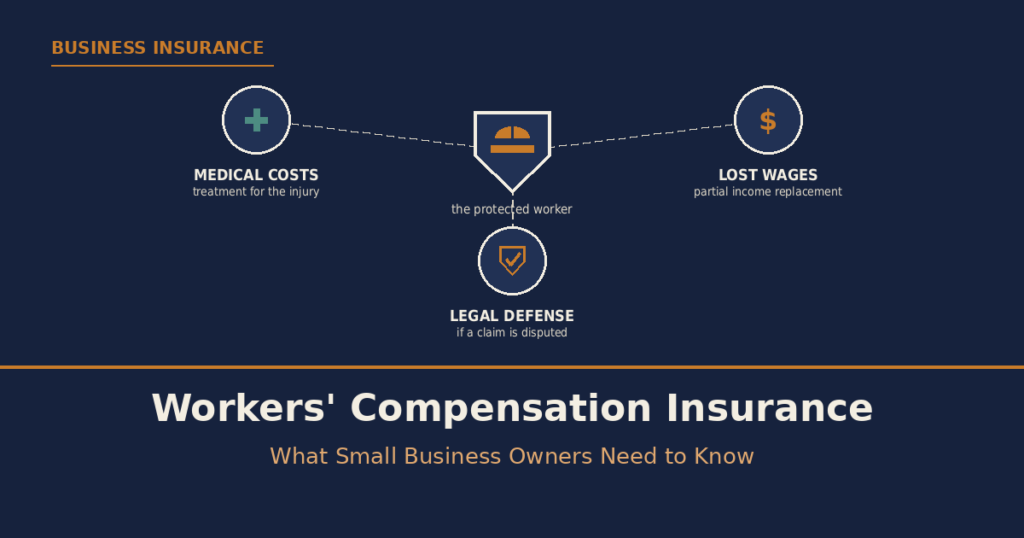
Workers’ comp operates as a no-fault system. If an employee gets hurt or becomes ill because of their job, the policy covers medical treatment, a portion of lost wages, rehabilitation costs, and, in the event of a workplace death, survivor and funeral benefits. In exchange, the injured employee generally gives up the right to sue the employer over the injury, outside a narrow set of exceptions like intentional harm.
That trade matters for employers as much as employees. Without workers’ comp, a serious workplace injury could turn into a personal injury lawsuit against your business, with no cap and no structured process. Workers’ comp replaces that open-ended exposure with a defined, insurance-backed system.
Is It Actually Required for Your Business?
In the vast majority of states, yes. Forty-nine states plus Washington, D.C. require most employers with employees to carry workers’ compensation coverage. Texas is a notable exception. It’s the one state where coverage remains largely optional for private employers, though many Texas businesses purchase it voluntarily rather than accept the legal exposure of going without.
Where coverage is required, the trigger point varies by state. Some states require it the moment you hire your first employee, regardless of whether that employee works full-time, part-time, or is a family member. Other states set a higher employee-count threshold before the requirement kicks in. Because this detail differs so much state to state, and can shift with new legislation, checking directly with your state’s workers’ compensation agency is the only reliable way to know your specific obligation.
Common Exemptions Worth Understanding
Even in states that generally require coverage, certain categories of workers are often excluded by default. Sole proprietors with no employees, some partnerships without employees, and independent contractors who genuinely meet a state’s legal test for contractor status are common exemptions.
That contractor exemption deserves particular caution. States apply specific, sometimes strict criteria to determine whether someone is truly an independent contractor or actually an employee in practice. Misclassifying a worker to avoid coverage can expose a business to significant penalties if a state agency or a court later determines the worker should have been covered.
What Happens If You Skip It
Penalties for going without required coverage vary by state, but they’re rarely minor. Consequences can include civil fines, often assessed per violation or per time period the business went uncovered, stop-work orders that halt your operations entirely, and in some states, criminal charges. California, for example, treats failing to provide required workers’ comp coverage as a criminal offense. New York can impose fines that accumulate every ten days a business remains out of compliance.
Beyond the legal penalties, going without coverage also removes the liability protection workers’ comp is designed to provide. An uninsured employer facing a workplace injury claim could face a direct lawsuit, with none of the structured, capped process that a compliant policy would have provided instead.
A Practical Example
Imagine a small landscaping business that just hired its second employee. In a state where coverage becomes mandatory at the first employee, the owner is now out of compliance the moment that second hire starts work, even if they intended to get coverage “once the business grew a bit more.”
A few months later, that employee suffers a back injury lifting equipment. Without workers’ comp in place, the business faces the injured employee’s medical bills directly, potential lost-wage claims, and exposure to a lawsuit the policy would otherwise have prevented, on top of whatever state penalty applies for having been uninsured in the first place.
Had the owner secured coverage at hiring, the same injury would have triggered a structured claims process instead: medical treatment covered, a portion of lost wages replaced, and the business shielded from a direct lawsuit over the incident.
Common Mistakes to Avoid
- Assuming a small headcount means no requirement. Many states trigger the requirement at the first employee, not after reaching some larger threshold.
- Misclassifying employees as independent contractors to avoid coverage. State agencies actively scrutinize this, and misclassification penalties can be substantial.
- Forgetting to post required notices. Many states require employers to conspicuously display information about their workers’ comp coverage, including the insurer’s name and policy number, and failing to do so can itself trigger penalties separate from the coverage requirement.
- Not reviewing coverage as the business grows or changes states. A business expanding into a new state needs to check that state’s specific requirements rather than assuming its home state’s rules apply.
What to Actually Do Next
Confirm your specific state’s employee threshold and any industry-specific rules through your state’s workers’ compensation agency or board, since these details genuinely vary and change over time. If you’re unsure whether a specific worker qualifies as an employee or a contractor under your state’s test, that’s worth confirming before you decide coverage isn’t needed, not after an injury forces the question. A licensed commercial insurance agent can also help identify whether your state runs its own state fund, requires private insurance, or offers both, since that structure differs by state as well.
Final Thoughts
Workers’ compensation isn’t optional paperwork in nearly every US state, and the penalties for skipping it, both legal and financial, tend to be more serious than business owners expect going in. The requirement usually triggers earlier than people assume, often with the very first hire. Confirming your obligation directly with your state, rather than guessing based on what a business in another state does, is the safest way to stay compliant.
Disclaimer: This article is for general informational purposes only and does not constitute legal, financial, or insurance advice. Workers’ compensation requirements, thresholds, exemptions, and penalties vary by state and change through legislation. Contact your state’s workers’ compensation agency, a licensed commercial insurance agent, or an attorney for advice about your specific business.
Sources
- Insureon — “Workers’ Compensation Laws and Requirements by State,” insureon.com
- National Federation of Independent Business (NFIB) — “Workers’ Compensation Laws – State by State Comparison,” nfib.com
- OnPay — “Navigating New York’s workers’ compensation insurance requirements,” onpay.com