This guide covers car insurance in the United States. SR-22 rules, alternative filings, and typical costs vary significantly by state, so confirm the specifics with your state’s DMV or your insurer.
If a court or your state’s DMV has told you that you need an SR-22, the first thing worth knowing is what it isn’t. It’s not a special type of insurance policy, and it’s not something you buy on its own. Understanding what it actually is makes the rest of the process, and the higher bill that comes with it, much easier to navigate.
What an SR-22 Actually Is
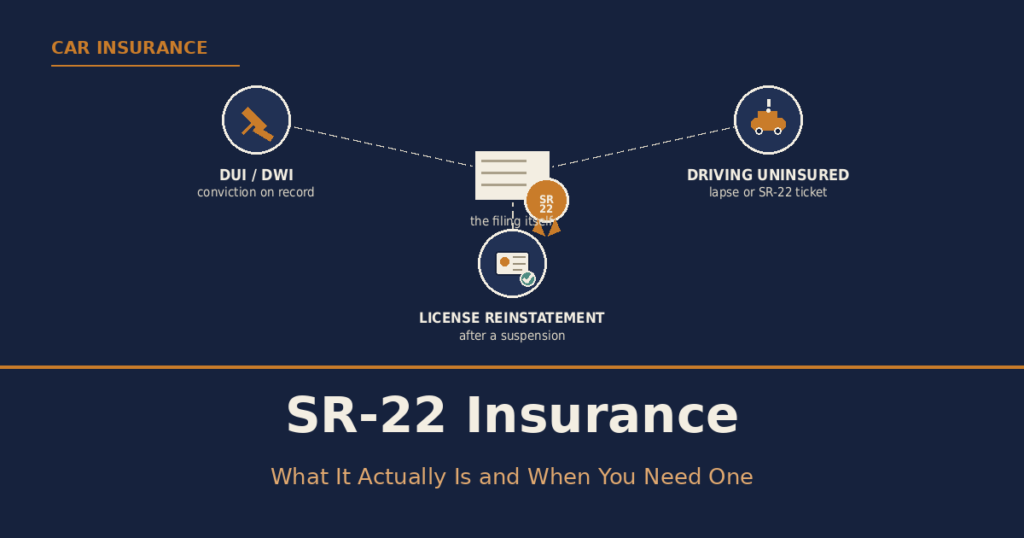
An SR-22 is a certificate of financial responsibility. Your insurance company files it directly with your state, confirming that you carry at least the state’s minimum required liability coverage. It’s paperwork layered on top of a regular liability policy, not a policy type in its own right.
Not every state uses this exact form. Virginia and Florida use a comparable filing called an FR-44, which typically requires higher liability limits than a standard SR-22. A handful of states, including Delaware, Kentucky, Minnesota, New Mexico, New York, North Carolina, Oklahoma, and Pennsylvania, don’t use SR-22 filings at all. They monitor high-risk drivers through other state-specific processes instead.
Who Actually Needs One
States generally require an SR-22 after serious driving violations. Common triggers include a DUI or DWI conviction, reckless driving, driving without insurance, accumulating multiple serious violations in a short period, or having your license suspended or revoked. A court or your state’s DMV will formally notify you if you’re required to file one. You won’t need to guess.
How Long You’re Required to Keep It
Most states require continuous SR-22 coverage for around three years, though this varies by state and by the severity of the violation. Some states use shorter windows, others longer, and repeat offenses can extend the requirement well beyond that range.
The clock’s starting point matters and catches people off guard. In many states, it begins on the date of your conviction or license reinstatement, not on the date of the original violation. If you delay getting coverage back in place, that delay can push your entire timeline out further.
Why Continuous Coverage Is Non-Negotiable
Here’s the detail that trips up the most people: your insurer is legally required to notify the state immediately if your SR-22 policy lapses or gets canceled, through a separate filing called an SR-26. The moment that notice reaches the DMV, your license is at risk of suspension, and in many states, your required filing period restarts from zero.
That means a single missed payment can undo months, or years, of progress toward satisfying the requirement. Setting up autopay, or otherwise making sure the policy never lapses even briefly, matters more here than with an ordinary policy.
What an SR-22 Actually Costs
The filing itself is inexpensive. Insurers typically charge a one-time fee somewhere between $15 and $50 to submit it, and this fee is separate from your actual insurance premium.
The real cost is the premium increase tied to whatever violation triggered the requirement in the first place. Reported increases vary widely by source, state, and violation severity, generally landing somewhere between a moderate premium bump and, in the more severe cases like a DUI, an increase that can run into several times your prior rate. Because the range is genuinely this wide, the only reliable way to know your actual cost is to get quotes directly, ideally from more than one insurer, since some carriers price high-risk drivers far more favorably than others.
If you don’t own a vehicle but still need to satisfy an SR-22 requirement, a non-owner policy is generally the cheaper route, since it only covers liability when you drive a car you don’t own, with no collision or comprehensive coverage attached.
A Practical Example
Imagine a driver convicted of a first DUI. The court orders an SR-22, and the driver’s insurer agrees to file it, charging a modest one-time filing fee. But the driver’s monthly premium jumps substantially compared to what they paid before the conviction, reflecting the higher risk the insurer now associates with them.
If that driver keeps the policy active without a single lapse for the full required period, typically around three years depending on the state, the SR-22 requirement ends, and they can ask their insurer to stop filing it. If instead the policy lapses even briefly at month 30, the state gets notified, the license faces suspension, and in many states, that three-year clock can start over.
The lesson isn’t just that an SR-22 costs more. It’s that consistency matters as much as the initial cost, since an interruption can cost far more than staying covered ever would.
Common Mistakes to Avoid
- Assuming any insurer will file an SR-22 for you. Not every carrier offers SR-22 filings, since some avoid the paperwork and the risk profile entirely. Confirm this before you commit to a policy.
- Letting coverage lapse even briefly. This is the single most common way people extend their own SR-22 requirement.
- Canceling the SR-22 the moment you think the period is up. The end date is often fixed to a specific conviction or reinstatement date, not a rough estimate. Confirm the exact date with your state before dropping coverage.
- Not comparing quotes. Because rate increases vary so much by insurer, shopping around after an SR-22 requirement can mean a meaningfully different price for the same coverage.
Final Thoughts
An SR-22 isn’t a punishment layered onto your insurance so much as a formal way for your state to confirm you’re carrying required coverage after a serious violation. The paperwork itself is cheap. What actually costs money is the higher-risk premium behind it, and what actually causes problems is any gap in coverage during the required period. Staying consistently insured, and shopping around for the best rate once you know you need one, are the two things most within your control here.
Disclaimer: This article is for general informational purposes only and does not constitute legal or insurance advice. SR-22 and FR-44 requirements, durations, and costs vary by state, insurer, and individual circumstances, and can change over time. Contact your state’s Department of Motor Vehicles, your insurance provider, or a licensed attorney for advice about your specific situation.
Sources
- Allstate — “SR-22 Insurance: What Does It Do?,” allstate.com
- Insurance.com — “SR-22 insurance cost: How does an SR-22 work?,” insurance.com
- Compare.com — “SR-22 Insurance: What It Is, How to File, and Cheapest Options,” compare.com
- Insure.com — “Average SR-22 insurance cost,” insure.com