This guide covers business insurance in the United States. Requirements and typical costs vary by state, industry, and insurer, so treat any figures here as general reference points.
New business owners often hear both terms in the same conversation and assume one covers the other. It doesn’t. General liability and professional liability insurance protect against two genuinely different kinds of risk, and confusing them can leave a real gap in your coverage right when you need it most.
The Core Difference: Physical Risk vs. Service Risk
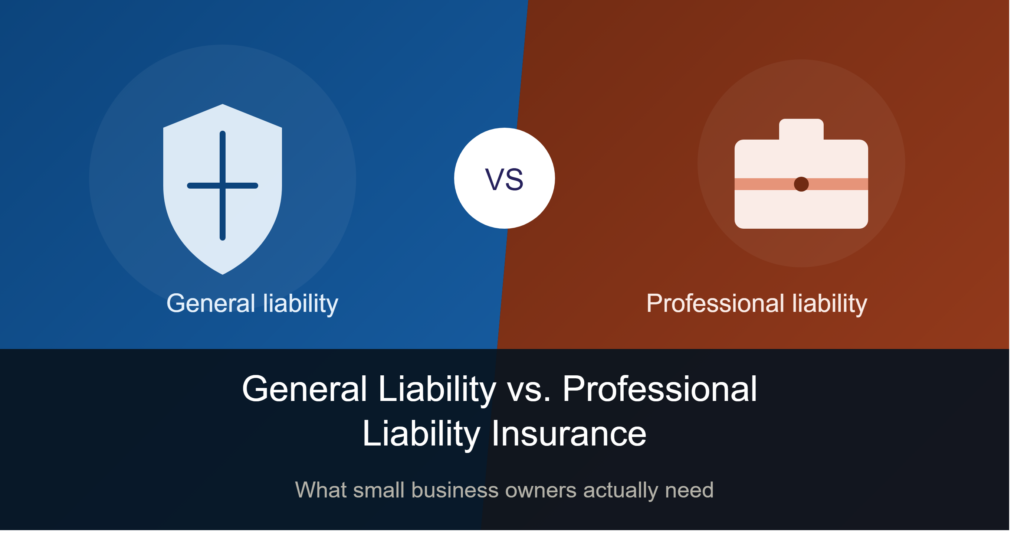
General liability insurance, sometimes called commercial general liability or CGL, protects your business against third-party claims involving physical harm. Think bodily injury, property damage, and certain reputational claims like slander or copyright issues in your advertising. If a customer slips on a wet floor in your shop, or your crew accidentally damages a client’s property on-site, this is the policy that responds.
Professional liability insurance, also called errors and omissions insurance or E&O, protects against a different kind of claim entirely: financial harm caused by your professional work. If a client says your advice, design, or service was negligent, incomplete, or caused them a financial loss, professional liability is what covers your legal defense and any resulting settlement.
The distinction, physical harm versus financial harm from your professional judgment, is what determines which policy actually responds to a given claim.
What General Liability Actually Covers
General liability is built around everyday operational risk. It typically covers bodily injury to a non-employee on your premises or as a result of your operations, property damage you or an employee cause to someone else’s belongings, and certain personal or advertising injury claims, such as defamation or accidental copyright infringement in a marketing campaign.
It’s often required contractually, not just recommended. Landlords frequently require it before signing a commercial lease, and many clients or government contracts won’t award work without proof of coverage.
What General Liability Doesn’t Cover
General liability does not cover mistakes in your professional advice or services. It also doesn’t cover your own employees’ injuries, which fall under workers’ compensation instead, or damage to property you own, which is typically handled through commercial property insurance.
What Professional Liability Actually Covers
Professional liability responds when a client claims your work, or the advice you gave, caused them financial harm. That could mean an alleged error in a report, a missed deadline that cost a client money, or a claim that your consulting recommendation led to a bad outcome.
One detail surprises a lot of first-time buyers: professional liability can help with defense costs even when the claim turns out to have no merit. A client doesn’t need to prove wrongdoing to file a claim, and legal defense costs alone can be significant regardless of the outcome.
This coverage matters most for service-based businesses: consultants, designers, accountants, real estate agents, marketing agencies, and technology providers among them. Some professions, including certain licensed fields, may face state-level requirements to carry it. Check your state’s licensing board or industry regulator for anything specific to your profession.
A Practical Example
Imagine a small marketing consulting firm. A client walks into the office for a meeting and trips over a loose floor tile, spraining an ankle. That’s a bodily injury claim tied to the business’s physical premises, and general liability would typically respond, covering medical costs and any related legal fees.
Now imagine a different scenario. The same firm delivers a marketing campaign, and the client later claims the strategy was poorly executed and cost them a significant amount in lost revenue. That’s not a physical injury. It’s an allegation about the quality of professional work, and general liability wouldn’t cover it. Professional liability would be the policy that responds.
The same business could reasonably face either kind of claim, which is exactly why many service-based companies carry both policies rather than choosing one.
Do You Need Both?
Whether you need one policy, both, or neither at a given size depends on how your business actually operates.
If your business deals with the public, has a physical location, or works on-site at other people’s property, general liability is close to a baseline expectation. Most business insurance advisors treat it as foundational coverage regardless of industry.
Professional liability becomes relevant specifically when you provide advice, expertise, or a service where a mistake could cost a client money rather than cause physical harm. A retail store with no consulting component may reasonably skip it. A consulting firm with no physical storefront may still need general liability if it interacts with clients or vendors on-site, or simply because clients require proof of coverage before signing a contract.
A Business Owner’s Policy, or BOP, is worth knowing about here too. It typically bundles general liability with commercial property insurance at a lower combined cost, but it generally does not include professional liability, which usually has to be purchased separately.
Common Mistakes to Avoid
- Assuming general liability covers professional mistakes. It doesn’t, and finding that out during a claim is the worst possible time.
- Skipping professional liability because “we’ve never had a complaint.” Claims can be filed even when the work was done correctly, and legal defense costs add up regardless of merit.
- Buying only what a single client or contract requires. Contractual minimums are a floor, not a full risk assessment of your business.
- Not revisiting coverage as the business grows. A business that starts purely physical (a shop) but adds consulting or advisory services can develop a professional liability gap without anyone noticing.
What to Actually Do Next
Start by mapping out the different ways your business could realistically be sued: physical accidents on your premises or job sites, and financial harm claims tied to your actual work product or advice. That mapping usually makes clear which policy, or combination, fits. From there, a licensed commercial insurance agent can quote both types of coverage together, and many insurers offer a discount for bundling them, which is worth asking about directly.
Final Thoughts
General liability and professional liability aren’t competing options. They protect against different kinds of claims, and many service-based businesses genuinely need both. The more useful question isn’t “which one is better” but “which risks does my business actually face,” since that’s what should drive the decision, not the price tag alone.
Disclaimer: This article is for general informational purposes only and does not constitute financial, legal, or insurance advice. Coverage requirements, costs, and policy terms vary by state, industry, and insurer, and can change over time. Review your policy documents carefully and contact a licensed commercial insurance agent or broker for advice about your specific business.
Sources
- The Hartford — “General Liability vs. Professional Liability Insurance,” thehartford.com
- Forbes Advisor — “General Liability Vs. Professional Liability Insurance,” forbes.com
- NerdWallet — “General Liability vs. Professional Liability Insurance: Do You Need Both?,” nerdwallet.com
- Insureon — “General Liability vs. Professional Liability Insurance,” insureon.com