
This guide covers homeowners, condo, and renters insurance in the United States. Specific claim documentation requirements vary by insurer, so confirm what your provider needs directly when filing.
After a fire, theft, or storm, insurers don’t simply take your word for what you owned. They need proof: what the item was, what it was worth, and that it actually existed before the loss. A home inventory is what supplies that proof, and the difference between having one and not having one often shows up directly in the size of the check you receive.
Why This Document Matters More Than People Expect
Insurance adjusters need supporting evidence, not just a homeowner’s memory, particularly for a claim involving significant loss. Without documentation, you’re reconstructing what you owned from memory alone, and memory under the stress of a major loss is genuinely unreliable. People forget entire categories of belongings: what’s in a garage, a closet, a junk drawer, adds up to real value that’s easy to underestimate even in calm circumstances.
According to Insurance Information Institute survey data, fewer than half of homeowners have actually prepared an inventory of their belongings for this purpose. That gap matters, since a documented inventory tends to move claims faster and with less friction than one built from scratch after a loss, when the details are hardest to reconstruct.
What a Home Inventory Actually Is, and Isn’t
A home inventory is a detailed record of your belongings compiled before a loss occurs: descriptions, estimated values, purchase dates, and supporting evidence like photos, videos, receipts, and serial numbers.
It’s worth distinguishing this from a related but different document: a proof of loss. A home inventory is preparation, built in advance. A proof of loss is a formal, often legally required document you complete after a loss, describing specifically what was damaged or stolen and how much you’re claiming. Your home inventory is what makes filling out an accurate proof of loss possible, especially when you’re compiling it under real time pressure after an actual disaster.
What to Actually Include
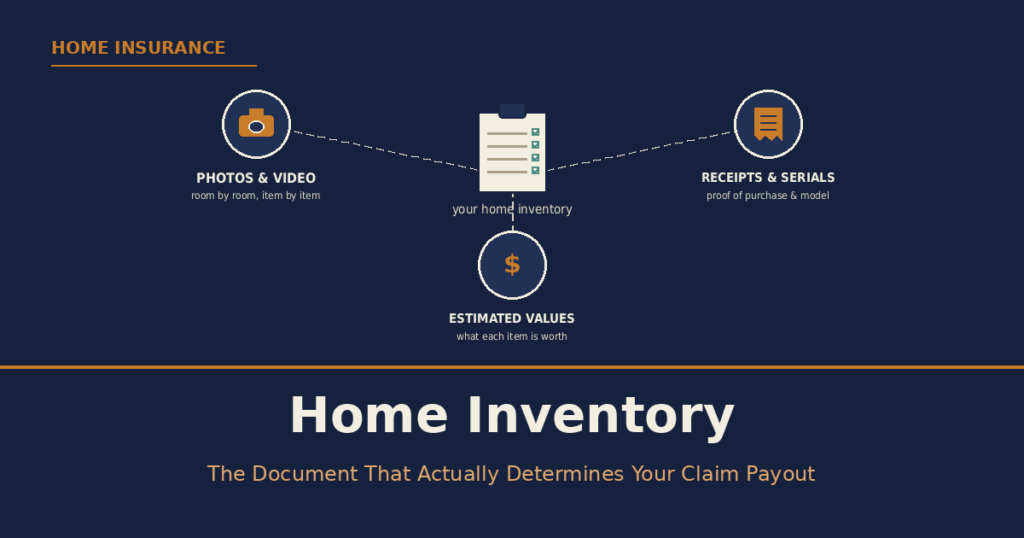
Following guidance consistent across the National Association of Insurance Commissioners and major insurers, a useful inventory generally records, for each item or category: a description, brand and model, approximate purchase date, purchase price or estimated value, and a serial number where applicable, supported by photos or a video walkthrough.
You don’t need painstaking individual entries for everything you own. Grouping ordinary items, everyday clothing, standard kitchenware, by category and general quantity is reasonable. Higher-value individual items, electronics, furniture, jewelry, art, and anything you’d consider genuinely valuable, deserve individual documentation instead, since these are exactly the items most likely to require detailed proof if a dispute arises.
For your most valuable possessions specifically, antiques, fine art, jewelry, and similar categories, getting a professional appraisal adds a level of documentation photos alone can’t provide, and it’s worth doing before you’d ever need to file a claim over them.
How to Actually Build One Without It Becoming a Project
The most efficient approach for most people is a room-by-room video walkthrough, narrating what you’re seeing as you go: opening closets, drawers, and cabinets, not just photographing visible surfaces. This single method captures far more than a written list alone, and it takes a fraction of the time a fully itemized inventory would.
Layer in supporting documents as you have them: receipts, appraisal certificates, and warranty cards for higher-value items. For older purchases without receipts, checking online purchase histories from major retailers, or reviewing old bank and credit card statements, can help reconstruct purchase dates and prices you’d otherwise be estimating from memory.
Several home inventory apps exist specifically to organize this information and store it securely, which can simplify both the initial creation and later updates compared to a folder of loose photos and documents.
Keeping It Current Matters as Much as Creating It
An inventory that’s several years out of date misses everything you’ve bought since, and undervalues everything that’s simply become more expensive to replace. Reasonable update triggers include after any major purchase, ideally logged while the receipt and details are still fresh, once a year, timed conveniently around your policy renewal, and after major life events like a move, marriage, or receiving inherited items.
Where to Actually Keep It
A home inventory does you no good if it’s destroyed in the same fire or flood that damaged the belongings it documents. Storing a copy somewhere outside your home, cloud storage, an inventory app with remote backup, or a copy with a family member or your insurance agent, is what makes the inventory useful precisely when you need it most.
A Practical Example
Imagine two households experiencing an identical house fire, each losing a comparable amount of personal property. One has a video walkthrough from eight months earlier, along with receipts for the more expensive items purchased in that period. The other has no inventory at all and is left trying to reconstruct, from memory, everything that was in every room.
The first household can hand its insurer organized, dated documentation supporting a specific claimed value. The second is negotiating from a considerably weaker position, having to justify each claimed item without supporting evidence, a process that tends to result in a lower settlement simply because so much of what was lost is difficult to prove and value after the fact.
Common Mistakes to Avoid
- Never creating an inventory until after a loss. By then, the details are hardest to reconstruct, and you’re building from memory under real stress.
- Only listing high-value items. Everyday belongings add up to meaningful value collectively, and skipping them can leave real money on the table.
- Storing the only copy inside the home it documents. A copy needs to survive whatever event might destroy the belongings themselves.
- Letting the inventory go stale. An outdated record misses recent purchases and understates what things actually cost to replace today.
Final Thoughts
A home inventory doesn’t prevent a loss, but it directly shapes how well you recover from one. Insurers settle claims based on documented evidence, not recollection, and the households that walk into a claim with photos, receipts, and an organized record consistently have an easier, faster, and more fully compensated experience than those starting from memory alone. A video walkthrough this weekend, stored somewhere outside your home, is a small task that pays off exactly when you’d need it most.
Disclaimer: This article is for general informational purposes only and does not constitute financial, legal, or insurance advice. Claim documentation requirements vary by insurer and policy. Contact your insurance provider for guidance specific to your coverage and situation.
Sources
- National Association of Insurance Commissioners (NAIC) — home inventory and claims filing guidance, naic.org
- Insurance Information Institute (III) — home inventory survey data, iii.org
- State Farm — “Home Inventory: How To Create One,” statefarm.com
- Allstate — “Proof of Ownership & Proof of Loss in Insurance,” allstate.com