This guide covers car insurance in the United States. Whether and how diminished value claims are allowed varies significantly by state and by case law, so confirm your specific state’s rules, ideally with an attorney, before pursuing a claim.
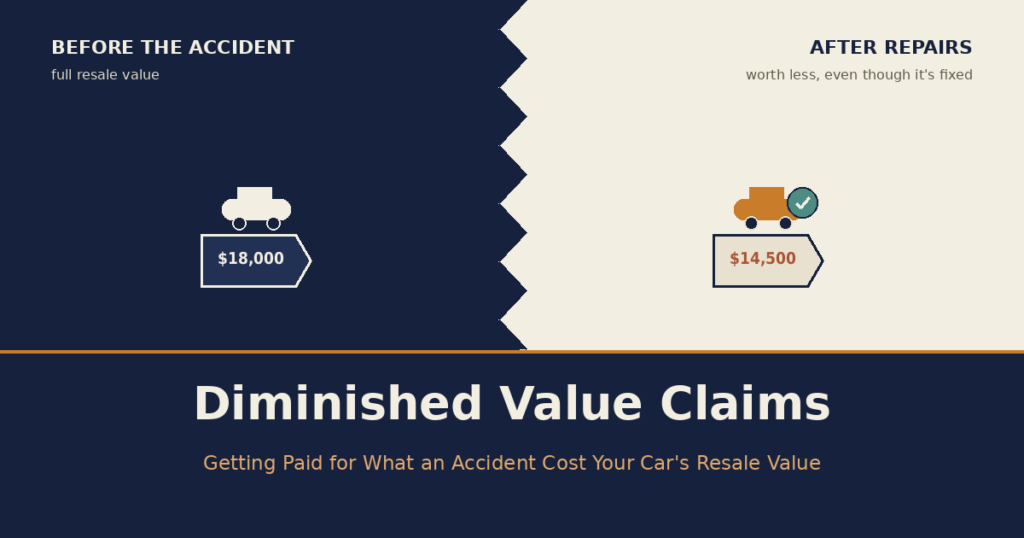
A repaired car can look flawless, drive perfectly, and still be worth less than an identical car with no accident history. That gap is called diminished value, and while it’s a real, recognized financial loss in most states, actually getting paid for it is one of the more misunderstood corners of car insurance.
What Diminished Value Actually Means
Diminished value is the difference between what your car was worth immediately before an accident and what it’s worth after it has been fully, professionally repaired. Even flawless bodywork with manufacturer-original parts doesn’t erase the accident from your vehicle’s history. Once that history shows up on a report like Carfax or AutoCheck, buyers and dealers price it in, and your car sells for less than an equivalent one with a clean record.
This is distinct from a total loss payout. If your insurer declared the car a total loss and paid its actual cash value, there’s no remaining diminished value claim to pursue, since you’ve already been compensated for the vehicle’s full value.
The Two Types, and Why the Distinction Matters
Inherent diminished value is the most common and most successfully pursued type. It reflects pure market stigma: the car is repaired correctly and looks the same, but its accident history alone reduces what a buyer will pay. This type doesn’t depend on the repair quality at all.
Repair-related diminished value stems from a repair that wasn’t done properly: mismatched paint, panel gaps, or parts that don’t perform quite like the originals. This type is harder to pursue and insurers are less likely to pay it, since the more direct remedy is generally to have the repair itself corrected rather than compensated for separately.
Most successful diminished value claims are inherent diminished value claims, and that’s the type worth understanding in depth.
Third-Party vs. First-Party: The Distinction That Decides Almost Everything
This is the single most important thing to understand before pursuing a claim, and it’s where a lot of confusion comes from.
Third-party claims, filed against the at-fault driver’s liability insurance when someone else caused your accident, are recognized in the large majority of states as a legitimate category of damages. If you weren’t at fault, you generally have a real path to recovering diminished value from the other driver’s insurer.
First-party claims, filed against your own insurer after your own collision coverage pays for repairs, are a much narrower story. Courts across different states have reached genuinely different conclusions here. Georgia’s Supreme Court, in State Farm Mutual Automobile Insurance Co. v. Mabry (2001), ruled that an insurer’s duty to “repair or replace” a vehicle includes compensating for residual diminished value after a proper repair. Florida’s Supreme Court, in a case called Siegle, reached the opposite conclusion: standard Florida collision policies satisfy their obligation once the vehicle is fully repaired, with no additional duty to pay diminished value on top of that. Many other states fall closer to Florida’s position, and some insurers have added explicit policy language excluding first-party diminished value entirely.
The practical result: if you caused your own accident, or you’re pursuing your own insurer for a diminished value payment, your chances depend heavily on your specific state’s law. If someone else caused the accident, your path through their liability insurer is considerably more established nationwide.
What Michigan and a Few Other States Do Differently
Michigan is commonly cited as the one state that doesn’t recognize third-party diminished value claims through the standard process at all, though pursuing a claim through small claims court remains an option there for the actual financial loss. In roughly two dozen states, drivers can also pursue a diminished value claim through their own uninsured motorist coverage if the at-fault driver has inadequate or no insurance, a route that wouldn’t exist without that coverage in place.
Given how much this varies state to state, and how much specific case law shapes the outcome even within a single state, confirming your own state’s current legal posture, ideally with an attorney experienced in these claims, is a reasonable step before assuming you have or don’t have a viable claim.
How Much a Claim Is Actually Worth
Diminished value estimates commonly cite a loss somewhere in the range of 10% to 25% of a vehicle’s pre-accident market value, though the actual figure depends heavily on the car’s age, mileage, brand, damage severity, and regional resale demand. Insurers frequently use a formula, sometimes called the 17c formula after the Georgia case that popularized it, which starts with a base percentage of the vehicle’s value, then adjusts downward based on damage severity and mileage.
Because insurers’ own formulas tend to produce lower figures than an independent assessment might, and because the actual loss varies so much by vehicle and market, getting a written appraisal from a qualified, independent appraiser is generally considered the stronger foundation for a claim than accepting the insurer’s internal calculation without question.
A Practical Example
Imagine someone driving a two-year-old sedan worth $28,000 before being rear-ended by another driver. The at-fault driver’s insurer pays for a complete, high-quality repair, and the car looks and drives exactly as it did before the accident. But because the vehicle now carries a reported accident on its history, an independent appraisal estimates its actual resale value has dropped by around 15%, or roughly $4,200.
This driver can file a third-party diminished value claim against the at-fault driver’s insurer, backed by that independent appraisal, seeking compensation for that $4,200 gap separately from the repair costs already covered. Had this same driver instead caused the accident themselves and sought the same payment from their own insurer, the outcome would depend heavily on their state’s specific legal treatment of first-party diminished value claims, which, as the split between Georgia and Florida shows, isn’t consistent nationwide.
Common Mistakes to Avoid
- Assuming a first-party claim works the same way as a third-party claim. The legal footing for these two paths differs substantially, and confusing them can lead to pursuing a claim your state doesn’t actually recognize in that form.
- Accepting the insurer’s internal diminished value calculation without an independent appraisal. Insurer formulas tend to minimize the payout, and a qualified appraisal generally provides a stronger basis for negotiation.
- Waiting too long to file. Diminished value claims are typically treated as property damage claims subject to a state’s statute of limitations, commonly a few years, so confirming your specific deadline matters.
- Assuming a totaled vehicle still has a diminished value claim. Once an insurer pays actual cash value for a total loss, there’s no remaining diminished value to pursue on top of that payout.
Final Thoughts
Diminished value is a real, well-documented financial loss, but whether you can actually recover it depends heavily on who caused the accident and which state you’re in. Third-party claims against an at-fault driver’s insurer rest on considerably firmer legal ground nationwide than first-party claims against your own insurer, where courts genuinely disagree. An independent appraisal, filed within your state’s deadline, is what turns this from an abstract loss into an actual, pursuable claim.
Disclaimer: This article is for general informational purposes only and does not constitute legal, financial, or insurance advice. Diminished value law varies significantly by state and continues to evolve through court decisions. Consult a licensed attorney or insurance professional for advice about a specific claim.
Sources
- ValuePenguin — “Diminished Value Claims Explained,” valuepenguin.com
- Insurance Information Institute (III) — “What is diminished value?,” iii.org
- State Farm Mutual Automobile Insurance Co. v. Mabry, 274 Ga. 498 (2001)
- Farber Law Firm — “Florida Diminished Value Claims,” thefarberlawfirm.com