
This guide covers life insurance in the United States. Contestability terms are generally consistent nationwide, but some details can vary by state and insurer, so review your specific policy documents for exact language.
Most life insurance policies include a provision that surprises beneficiaries at the worst possible time: if the insured dies within the policy’s first two years, the insurer has the right to investigate the original application before paying anything. This isn’t a loophole or a sign of bad faith. It’s a standard, disclosed feature of nearly every policy, and understanding how it works can prevent real confusion if a claim is ever delayed because of it.
What the Contestability Period Actually Is
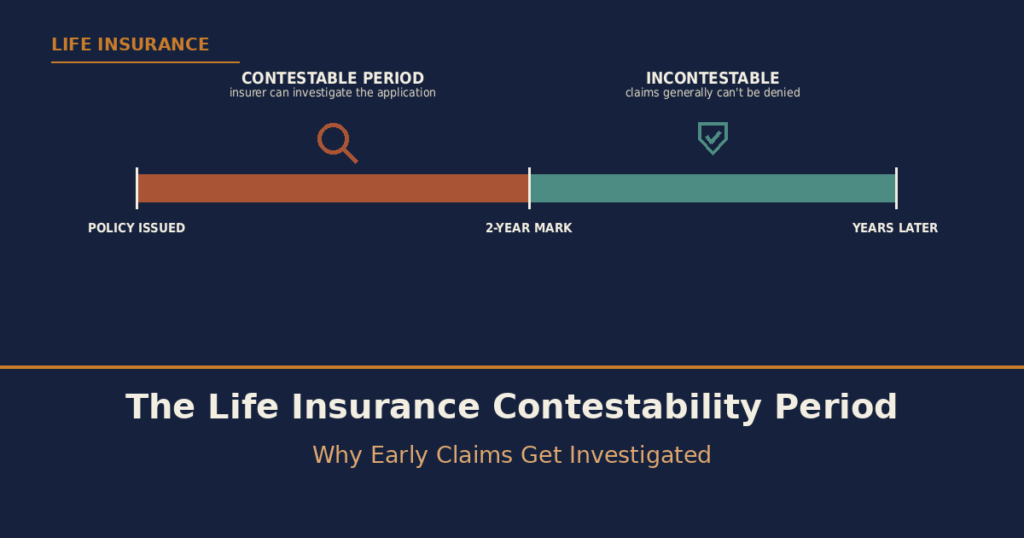
The contestability period is a window, typically two years, starting from a policy’s effective date, during which the insurer can investigate whether the original application was accurate. If the insured dies during this window, the insurer generally has the right to review medical records, prescription histories, and other verification sources before paying the claim, checking specifically for material misrepresentation.
Material misrepresentation means the applicant gave false or incomplete information that, had the insurer known the truth, would have changed the underwriting decision: a different rate class, an added exclusion, or an outright decline. Common examples include not disclosing a heart medication prescription, omitting a prior cancer diagnosis, or understating tobacco or alcohol use.
This provision appears across term and permanent policies alike, and it starts from the policy’s actual effective date, not the date you applied or first paid a premium.
Why This Provision Exists at All
Life insurance pricing depends entirely on accurate information about the applicant’s health and habits. If someone omits a serious condition or lies about smoking, their premium reflects a lower risk than they actually present, and the insurer has no realistic way to catch that at the time of application. The contestability period gives insurers a defined window to verify what was disclosed, specifically in situations where an early death makes an inaccurate application financially significant.
Most policyholders never experience a contestability investigation. Insurers generally reserve this scrutiny for claims where something specifically warrants a closer look, not as a routine step applied to every early death.
What Actually Triggers a Closer Look
Certain circumstances tend to prompt an investigation more reliably than others. A death occurring very early in the policy, especially within the first year, draws more scrutiny than one occurring near the end of the two-year window. A cause of death that’s vague, pending, or unusual, an overdose, an ambiguous medical examiner’s finding, or a death still under investigation, tends to slow claims down regardless of when it occurs.
One detail worth knowing specifically: if a policy lapsed and was later reinstated, a claim filed shortly after reinstatement is very likely to be investigated. In most states, reinstatement restarts the contestability clock, and a claim arriving soon after tends to draw exactly the kind of scrutiny the provision exists for.
The Suicide Clause Is a Separate Provision
It’s worth understanding that the contestability period and a policy’s suicide clause are two different things, even though both commonly run for the same two-year window and get discussed together.
The contestability period is about the accuracy of the application. The suicide clause is a separate coverage limitation, generally providing that if the insured dies by suicide within the policy’s first two years, the death benefit isn’t paid in full; instead, beneficiaries typically receive a refund of premiums paid. This applies regardless of whether the application itself was completely accurate, since it isn’t tied to misrepresentation at all. After this window passes, a policy’s death benefit generally applies the same way regardless of cause of death, subject to other standard exclusions.
What Happens After the Two Years Pass
Once the contestability period ends, a policy generally becomes incontestable. In practice, this means the insurer can no longer deny a claim based on an inaccuracy in the original application, except in narrow circumstances involving outright fraud, which carries a higher bar to prove than ordinary misrepresentation and remains difficult to establish even where suspected.
This incontestability protection is a meaningful guarantee for beneficiaries. It’s also exactly why the two-year window matters so much: it’s the one period where an old, possibly forgotten inaccuracy on an application can still affect whether a claim gets paid in full.
A Practical Example
Imagine someone who didn’t disclose a heart condition on their life insurance application, then dies of a heart attack fourteen months into the policy. Because this falls within the contestability period, the insurer can request medical records, discover the prior diagnosis, and determine that the applicant misrepresented their health at the time of application. Depending on the specifics and the state’s rules, the insurer might deny the claim, reduce the benefit, or rescind the policy and return the premiums paid.
Now imagine the same condition, undisclosed the same way, but the death happens three years into the policy, after the contestability period has closed. In this scenario, the same undisclosed condition generally can’t be used to deny the claim, since the policy has already become incontestable, absent evidence of outright fraud.
What Beneficiaries Should Actually Do If a Claim Gets Investigated
Being told a claim is under investigation during the contestability period isn’t the same as being denied. Insurers are required to conduct these reviews in good faith, not simply delay indefinitely, and a completed investigation that finds no misrepresentation results in the claim being paid as normal.
If a claim is ultimately denied, requesting the specific reason and the documentation behind it is a reasonable first step. Insurers are generally required to explain what they found and why it affected the decision. From there, beneficiaries can pursue an internal appeal, involve their state’s insurance department, or consult an attorney experienced in insurance claim disputes if the denial seems inconsistent with the actual facts.
Common Mistakes to Avoid
- Assuming any early death automatically triggers a denial. Most contestability reviews find nothing, and the claim is paid normally.
- Confusing the contestability period with the suicide clause. They’re separate provisions covering different situations, even though both commonly last two years.
- Letting a policy lapse and reinstating it without understanding the reset. Reinstatement generally restarts the contestability clock in most states, which matters if a claim follows soon after.
- Being less than fully honest on a life insurance application. Given how thoroughly insurers can verify medical and prescription history during a contestability investigation, inaccuracies are more likely to surface than applicants often assume.
Final Thoughts
The contestability period exists to protect the integrity of life insurance pricing, not to give insurers an excuse to avoid paying legitimate claims. For beneficiaries facing an early death and a delayed claim, understanding that this review is standard, time-limited, and focused specifically on application accuracy, rather than a sign of bad faith, makes an already difficult situation somewhat easier to navigate. For applicants, the real lesson is simpler: complete honesty on the application is what actually protects your beneficiaries once this window has closed.
Disclaimer: This article is for general informational purposes only and does not constitute legal or insurance advice. Contestability terms, suicide clause provisions, and reinstatement rules can vary by state and insurer. Review your policy documents and consult a licensed insurance professional or attorney for advice about a specific claim.
Sources
- U.S. News & World Report — “Life Insurance Contestability Period,” usnews.com
- MoneyGeek — “What Is the Life Insurance Contestability Period?,” moneygeek.com
- Western & Southern — “Contestability Period: What It Means for Life Insurance,” westernsouthern.com
- Insurance By Heroes — “Life Insurance Claim Investigations: What to Expect in 2026,” insurancebyheroes.com