This guide covers Explanation of Benefits statements for US health insurance plans. EOB layouts and terminology vary by insurer, so check your plan’s own glossary or member portal for definitions specific to your coverage.
An envelope arrives from your insurance company after a doctor’s visit, and inside is a document full of dollar amounts, codes, and a line that looks alarmingly like “amount you owe.” Many people either panic and pay it, or set it aside unread. Both reactions miss the point. An Explanation of Benefits isn’t a bill at all. It’s a decision letter, and like any decision, it can be wrong.
What an EOB Actually Is
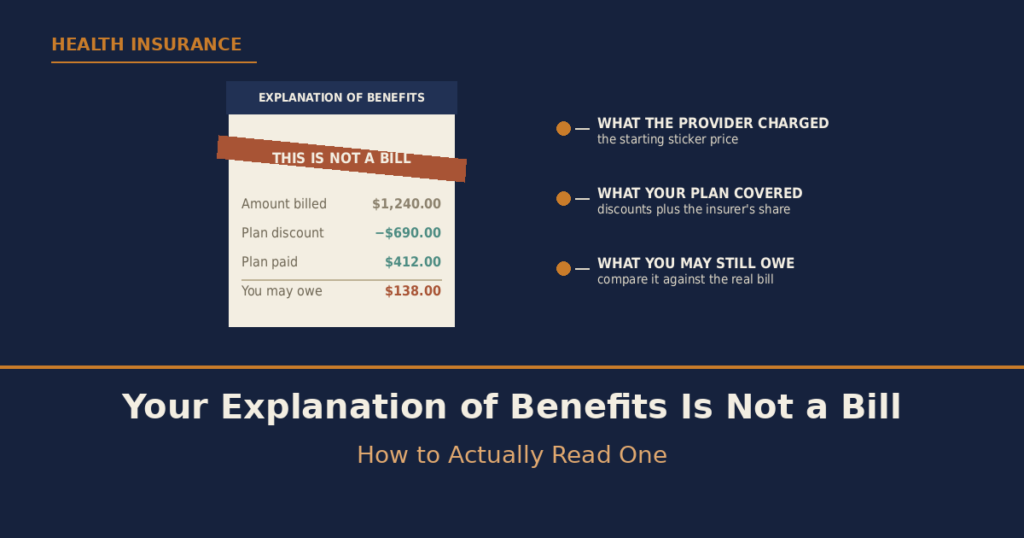
After your provider submits a claim, your insurance company processes it and sends you an EOB explaining, line by line, what happened. It shows what service the provider reported, what they charged, what amount your plan recognized as allowable, what your plan paid, and what portion your plan considers your responsibility.
The EOB typically arrives before the provider’s actual bill, which is part of why the timing feels like a payment demand. It isn’t. The provider will send a separate bill for whatever amount the EOB assigns to you, and that bill is the document you actually pay.
The Sections That Matter Most
Your member information. The top of the EOB identifies you by name, member ID, group number, and plan type. Verifying this first matters more than it seems: a member ID mismatch is a common early indicator that a claim was routed or processed incorrectly, which can cascade into an improper denial.
The service lines. This is the substance of the document. Each row typically shows a date of service, a description of the procedure, a billing code, the amount the provider charged, the amount your plan allowed, what your plan paid, and what your plan says you owe.
The adjustment or discount column. This reflects the difference between what the provider billed and what your plan’s negotiated rate actually allows. For in-network care, this amount generally isn’t your responsibility, which is exactly why this column can be confusing when the billed amount looks alarmingly high.
Your accumulator totals. Most EOBs show a running tally of your spending toward your annual deductible and out-of-pocket maximum. This is genuinely useful for tracking where you stand during the plan year, not just for the specific claim at hand.
The Number That Actually Matters
Of everything on the page, the “patient responsibility” or “amount you may owe” figure is the one to focus on. That’s the amount your insurer says the provider is entitled to collect from you.
Here’s the practical step most people skip: when the provider’s actual bill arrives, compare it directly against that figure on your EOB. If the two don’t match, that mismatch is a genuine red flag worth investigating before you pay anything, since it can indicate a billing error or, in some cases, improper balance billing.
How Common Are Billing Errors, Really?
You’ll frequently encounter a claim that a very high percentage of medical bills, sometimes cited as high as 80%, contain errors. Treat that figure with some skepticism. It circulates widely across billing-advocacy content, but its original methodology is difficult to trace, and at least one source repeating it acknowledges that the rate of errors with real financial consequences is meaningfully lower.
What’s more defensible is the underlying point, which multiple sources make consistently: errors do occur often enough that reviewing your EOB against your bill is worth the time, particularly for larger or more complex claims. You don’t need a dramatic statistic to justify checking a document that takes ten minutes to read.
What to Do If Something Looks Wrong
Start by identifying the specific issue. Look for the explanation code next to the affected service line, then find what that code means in your insurer’s EOB glossary or member portal rather than guessing from the abbreviation.
A denial doesn’t automatically mean the service wasn’t medically necessary. Claims are frequently denied because they need additional information, a corrected billing code, or supporting documentation from the provider. Similarly, an adjustment doesn’t automatically mean you owe the difference.
From there, call your provider’s office and request an itemized bill, which breaks out every charge individually rather than presenting a lump sum. Then call your insurer to ask directly about the specific line item in question. Keep a record of both calls, including dates and who you spoke with, along with copies of the EOB and the bill. If the issue isn’t resolved, ask your insurer about filing a formal appeal.
A Practical Example
Imagine someone who receives an EOB after a specialist visit showing a $400 billed charge, a $250 allowed amount, $200 paid by the plan, and $50 listed as patient responsibility. A week later, the provider’s bill arrives for $200.
That mismatch, $200 billed versus $50 the EOB says they owe, is worth a phone call before paying anything. It could indicate the provider billed before the insurance payment posted, a coding error, or in an in-network situation, improper billing for an amount the negotiated rate doesn’t permit them to collect. Paying the higher figure without checking would mean absorbing a cost the EOB itself says isn’t theirs.
Common Mistakes to Avoid
- Treating the EOB as a bill and paying it directly. It isn’t a payment request, and the provider’s separate bill is what you actually pay.
- Not comparing the EOB against the provider’s bill. This side-by-side check is the single most effective way to catch a discrepancy before your money is gone.
- Assuming a denial is final. Many denials stem from correctable issues like missing documentation or a coding error, not a determination that your care wasn’t covered.
- Discarding EOBs immediately. Keeping them at least until the final bill arrives and is resolved gives you documentation if a dispute develops later.
Final Thoughts
An Explanation of Benefits is one of the more useful documents your insurer sends, precisely because it tells you what your plan decided before you’re asked to pay anything. Reading it against the provider’s eventual bill, verifying the patient responsibility figure, and questioning anything that doesn’t match are straightforward habits that take little time and can prevent you from paying for an error you had every right to catch.
Disclaimer: This article is for general informational purposes only and does not constitute medical, legal, or insurance advice. EOB formats, terminology, coverage determinations, and appeal rights vary by insurer and plan. Contact your insurance provider, your provider’s billing department, or a licensed professional for help with a specific claim or bill.
Sources
- UnitedHealthcare — “Explanation of benefits (EOB),” uhc.com
- Centers for Medicare & Medicaid Services (CMS) — guidance on reading a medical bill, cms.gov
- Neolytix — “Explanation of Benefits in Medical Billing: How to Read an EOB,” neolytix.com