
This guide covers life insurance beneficiary law in the United States. Whether a divorce automatically removes an ex-spouse as beneficiary depends on your state and the type of policy, so confirm your specific situation with a family law attorney rather than relying on assumptions.
A lot of divorced people assume the paperwork automatically sorted this out: no more marriage, no more ex-spouse on the life insurance. That assumption is sometimes right, sometimes catastrophically wrong, and which one applies depends on a distinction most divorcing couples never think to ask about.
Two Completely Different Legal Systems Govern This Question
The single most important thing to understand is that life insurance beneficiary rules after divorce split into two entirely separate legal frameworks, and which one applies to your policy determines everything else.
State “revocation upon divorce” laws apply to individually owned life insurance policies, the kind you bought yourself, outside of an employer plan. Roughly 27 states have adopted some version of these statutes, which automatically revoke a former spouse’s beneficiary designation the moment a divorce becomes final. The U.S. Supreme Court upheld the constitutionality of these state laws in Sveen v. Melin in 2018.
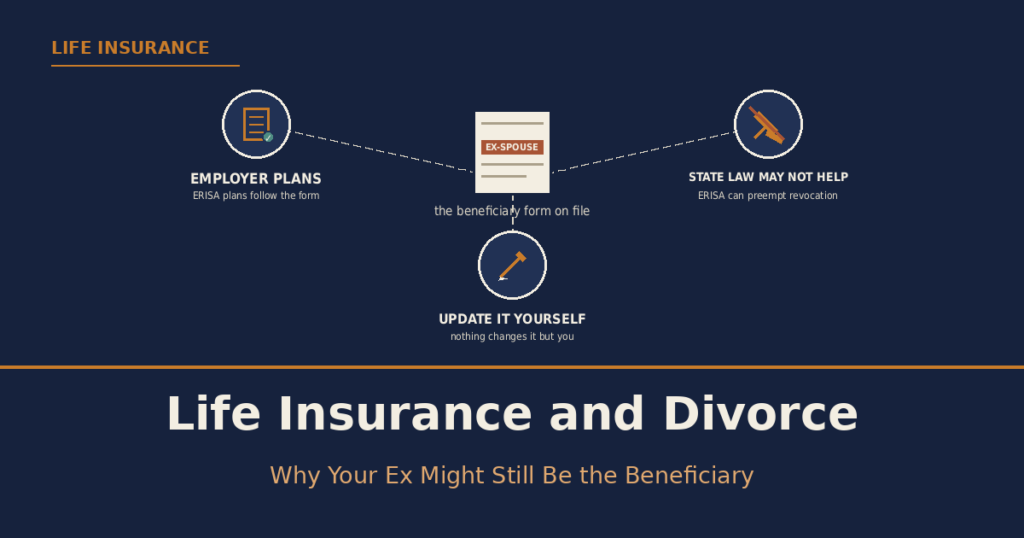
Federal ERISA law governs most employer-sponsored group life insurance plans, and it works completely differently. In Egelhoff v. Egelhoff, decided in 2001, the U.S. Supreme Court ruled that ERISA preempts these state revocation statutes for plans it governs. That means a plan administrator must generally pay whoever is named on the beneficiary form on file, even if that person is an ex-spouse, and even in a state with an automatic revocation law that would otherwise apply.
This split explains a real, documented pattern: divorce attorneys sometimes correctly apply a state’s automatic revocation statute to an individual policy, then mistakenly assume the same rule applies to an employer-provided policy, only to discover ERISA preemption controls instead, sometimes after the wrong person has already received a payout.
Why the Distinction Matters More Than People Expect
If your only life insurance is an individual policy in a state with a revocation statute, and your divorce decree doesn’t say otherwise, the law may handle this automatically. But if that same policy is instead an employer-sponsored group plan, none of that automatic protection applies. The named beneficiary form is what controls, full stop, regardless of your state’s law or the intentions everyone assumed were obvious.
This isn’t a hypothetical risk. The case law in this area exists precisely because it has gone wrong for real families: an ex-spouse still listed as beneficiary on an ERISA plan has, in documented cases, received a payout the deceased almost certainly didn’t intend for them to have, over the objections of children or a new spouse, simply because federal law required the plan to follow the form on file.
The Exceptions That Complicate Even the “Automatic” States
Even in states with a clear revocation-upon-divorce statute, several situations can override it.
An explicit divorce decree provision. If the divorce settlement specifically requires the policyholder to maintain life insurance naming the ex-spouse, commonly used to secure alimony or child support obligations, courts generally enforce that requirement even where a revocation statute would otherwise apply.
Reaffirming the designation after divorce. If the policyholder actively re-names their ex-spouse as beneficiary after the divorce is final, that reaffirmation generally overrides the automatic revocation.
Policy language that defers to state law versus policy language that doesn’t. Some policies explicitly incorporate state revocation statutes by reference; others use language that courts interpret as intending to control the outcome regardless of state law. This kind of contract-language dispute is exactly the sort of detail an attorney needs to review directly, since it can determine the outcome even within states that generally follow the automatic-revocation rule.
What Actually Protects You: A New Beneficiary Form
Given how much this depends on policy type, state law, and specific contract language, every source on this topic converges on the same practical advice: don’t rely on automatic revocation. File a new, explicit beneficiary designation form with your insurer or plan administrator the moment your divorce is final, regardless of what you believe your state’s law already handles.
This single step sidesteps the entire ERISA-versus-state-law question. It doesn’t matter whether a statute would have automatically removed your ex-spouse if you’ve already replaced them on the form directly. The only exception is when your divorce decree affirmatively requires your ex-spouse to remain as beneficiary, in which case following that court-ordered requirement takes priority over any personal preference.
The QDRO Angle Worth Knowing About for Employer Plans
For ERISA-governed plans specifically, a Qualified Domestic Relations Order, or QDRO, is a court order that can formally direct a plan administrator to treat a specific person, often a former spouse, as entitled to some or all of a benefit. QDROs are more commonly associated with dividing retirement accounts like a 401(k), but they can address life insurance in some circumstances as well.
Without a QDRO explicitly addressing life insurance, or without an updated beneficiary form, the form on file with the ERISA plan administrator generally controls the outcome, regardless of what the divorce settlement assumed would happen informally.
A Practical Example
Imagine someone divorces in a state with an automatic revocation-upon-divorce statute, and their only life insurance is an individually owned policy they purchased directly. If they never touch the beneficiary form again, the state statute may automatically remove their ex-spouse and redirect the benefit according to the policy’s contingent beneficiary or the estate, depending on the policy’s specific terms.
Now imagine the same person also has a separate, employer-provided group life insurance policy through work, with the same ex-spouse still listed as beneficiary. Because this second policy is governed by ERISA, the state’s automatic revocation statute doesn’t apply to it at all. Unless this person files a new beneficiary form with their employer’s plan directly, their ex-spouse remains entitled to that payout, regardless of the divorce, the state law, or anyone’s assumptions about what “obviously” should happen.
Common Mistakes to Avoid
- Assuming all life insurance works the same way after divorce. Individual and employer-sponsored policies follow entirely different legal rules, and confusing the two has led to real, documented financial losses.
- Relying on a state’s automatic revocation statute instead of filing a new form. Even where the law would help, filing directly removes any ambiguity and any risk from an overlooked exception.
- Not checking whether your divorce decree requires you to maintain a specific beneficiary. If it does, failing to comply can create its own legal exposure, separate from the insurance question itself.
- Forgetting employer-provided life insurance exists as a separate policy to update. People often update an individual policy and assume they’re done, overlooking a workplace plan governed by an entirely different set of rules.
Final Thoughts
Whether your ex-spouse remains entitled to your life insurance after divorce depends on a distinction most people never think to check: whether the policy is individually owned or employer-sponsored, and if employer-sponsored, whether ERISA’s federal preemption overrides your state’s automatic revocation law. Filing a new beneficiary form the moment your divorce is final sidesteps this entire question and is the one step every source on this topic agrees actually protects you, regardless of which legal framework applies to your specific policy.
Disclaimer: This article is for general informational purposes only and does not constitute legal, financial, or insurance advice. Beneficiary revocation laws, ERISA preemption, and divorce decree enforceability vary by state and individual circumstances, and case law in this area continues to develop. Consult a licensed family law attorney and update your beneficiary designations directly with your insurer or plan administrator.
Sources
- U.S. Supreme Court — Egelhoff v. Egelhoff, 532 U.S. 141 (2001)
- U.S. Supreme Court — Sveen v. Melin, 584 U.S. ___ (2018)
- Thomson Reuters — “ERISA Preempts State Law Revoking Beneficiary Designation Upon Divorce,” tax.thomsonreuters.com
- Peace Law Firm — “Life Insurance Divorce Beneficiary Rules Under ERISA Law,” peacelawfirm.com