This guide covers surety bonds and business insurance in the United States. Specific bond requirements are set by state and local licensing authorities and by individual contracts, so confirm the exact requirements that apply to your business or project.
“Licensed, bonded, and insured” gets repeated so often as a single phrase that a lot of business owners assume bonding and insurance work the same way. They don’t, and the difference isn’t just technical. It determines who actually gets paid if something goes wrong, and whether you end up owing money afterward even when the claim wasn’t disputed.
The Fundamental Difference: Who’s Actually Being Protected
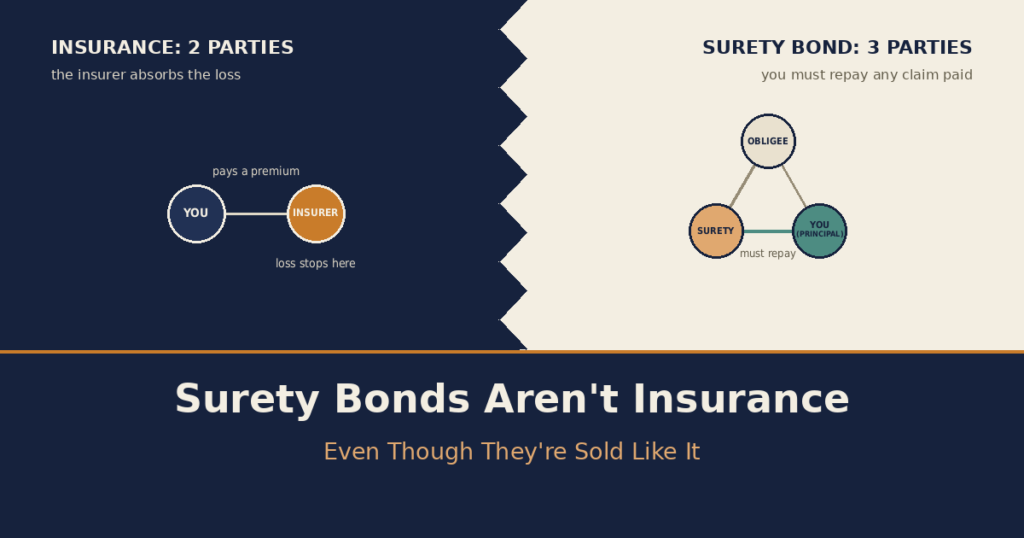
Insurance is a two-party arrangement. You pay premiums, and in exchange, the insurance company assumes your risk. If a covered loss happens, the insurer pays the claim and absorbs that cost itself. That’s the whole transaction.
A surety bond involves three parties: you, the principal, who’s required to get the bond; the obligee, typically a government agency, licensing board, or client who requires it; and the surety, the company that issues the bond and financially guarantees your performance. The bond exists to protect the obligee, not you. If you fail to meet your obligation, whether that’s completing a contracted project, paying subcontractors, or following licensing regulations, the obligee can file a claim against the bond.
That single distinction, who the product actually protects, is the one that explains everything else that follows.
What Happens When a Bond Claim Gets Paid
Here’s the part that surprises a lot of first-time bondholders: when a surety pays a valid claim, you’re generally required to reimburse the surety in full, plus costs. This is formalized in an indemnity agreement you sign when you apply for the bond, and it applies regardless of whether the claim is small or, on a large construction project, potentially worth millions of dollars.
Compare that to how an insurance claim works. If your general liability policy pays out after a covered incident, that’s the end of your financial obligation for that specific claim, aside from your deductible. With a bond, the payout is really more like the surety fronting the money on your behalf, with a legal expectation that you’ll pay it back. A bond is not free protection. It’s a guarantee backed by your own finances, extended through the surety’s underwriting and credit process.
Why Claims Trigger Differently
Insurance claims are triggered by actual damage, injury, or financial loss covered under the policy’s terms. Surety bond claims are triggered by a failure to fulfill an obligation, which can happen even without any damage occurring at all, simply by not completing a job on time or not paying a subcontractor as agreed.
This means a bond claim and an insurance claim can arise from entirely different kinds of situations on the same project. A worker injury on a job site is an insurance matter, handled through your workers’ compensation or general liability policy. A failure to finish the contracted work, or to pay the subcontractors who did the work, is a bonding matter entirely separate from anything an insurance policy would address.
The Common Bond Types Worth Knowing
License and permit bonds are required by many states and municipalities before you can legally hold a contractor’s license or operate in certain regulated professions. These protect consumers and the public from a licensee failing to follow applicable regulations.
Performance bonds guarantee that you’ll complete a contracted project according to its terms. If you default, the surety either finances completion by another contractor or compensates the project owner directly.
Payment bonds guarantee that your subcontractors and suppliers get paid for the labor and materials they provide on a project, protecting them from your failure to pay even if the work itself was completed.
Bid bonds guarantee that if you win a competitive bid, you’ll actually sign the contract and meet its terms. If you don’t, the project owner can claim the difference between your bid and the next-lowest one.
Beyond construction and licensing, court bonds guarantee obligations tied to legal proceedings, and specialty bonds exist for industries like freight brokerage, auto dealing, and customs.
Why “Licensed, Bonded, and Insured” Requires All Three
Each credential in that familiar phrase solves a different problem, and none substitutes for the others. Your license confirms you’re legally authorized to do the work. Your bond gives clients and regulators a financial guarantee if you don’t fulfill your obligations. Your insurance protects your business, and sometimes third parties, from the risks inherent in actually doing the work: injuries, property damage, and similar covered losses.
A bond won’t cover your legal defense costs after a customer slip-and-fall on your job site. An insurance policy won’t satisfy a licensing board’s bonding requirement. Contractors in particular generally need both bonding and insurance operating side by side, not as alternatives to each other.
A Practical Example
Imagine a contractor holding a $50,000 performance bond for a renovation project who fails to complete the work as contracted. The project owner files a claim, and after investigating, the surety determines it’s valid. The surety pays the project owner to hire a replacement contractor to finish the job, then turns to the original contractor for full reimbursement of that amount, under the indemnity agreement signed when the bond was issued.
Now imagine a different scenario on the same job site: a worker is injured during the original phase of construction. This is handled entirely separately, through the contractor’s workers’ compensation insurance, which investigates and pays medical costs and lost wages without seeking any reimbursement from the contractor afterward. Two very different financial outcomes, from two products that often get bundled together in casual conversation but work in fundamentally different ways.
Common Mistakes to Avoid
- Assuming a bond functions like insurance. A bond claim generally means you’ll owe that money back to the surety, not that the loss is absorbed the way an insurance payout would be.
- Treating bonding and insurance as interchangeable. They protect different parties from different kinds of failure, and most contractors need both operating together.
- Signing an indemnity agreement without understanding it. This document is what obligates you to reimburse the surety, and it applies to the full amount paid on a valid claim, not a negotiated portion.
- Not confirming your specific state or local bonding requirements. These are jurisdiction-specific, and a bond adequate in one state or city may not satisfy requirements elsewhere.
Final Thoughts
Surety bonds and insurance get sold together, discussed together, and often confused for one another, but they solve genuinely different problems. Insurance protects your business from covered losses. A bond protects your client, your licensing board, or your subcontractors from your own potential failure to deliver, with you ultimately on the hook to repay any valid claim. Understanding that distinction before you sign a bond application is what prevents a routine business obligation from becoming an unexpected, and unreimbursed, financial surprise.
Disclaimer: This article is for general informational purposes only and does not constitute financial, legal, or insurance advice. Bond requirements, terms, and indemnity obligations vary by state, industry, and individual contract, and can change over time. Contact a licensed surety bond provider or commercial insurance agent for advice about your specific business.
Sources
- Procore — “Contractor Bonds vs. Insurance: What to Know,” procore.com
- Grit Insurance Group — “Surety Bonds vs Insurance: Key Differences for Contractors,” gritinsurance.com
- Bryant Surety Bonds — “Surety Bonds vs. Insurance: Key Differences Explained,” bryantsuretybonds.com