This guide covers homeowners insurance and home-based business coverage in the United States. Specific limits and endorsement availability vary by insurer and state, so confirm details directly with your insurance provider.
Working from a spare bedroom feels a lot less exposed than renting commercial space, which is exactly why so many home-based business owners never think to check whether their homeowners policy actually covers what they’re doing. In most cases, it barely does. Standard homeowners insurance treats business activity almost like a foreign substance, walling it off with tight limits and, in many cases, excluding it from liability coverage entirely.
Why Your Policy Treats Business Property Differently
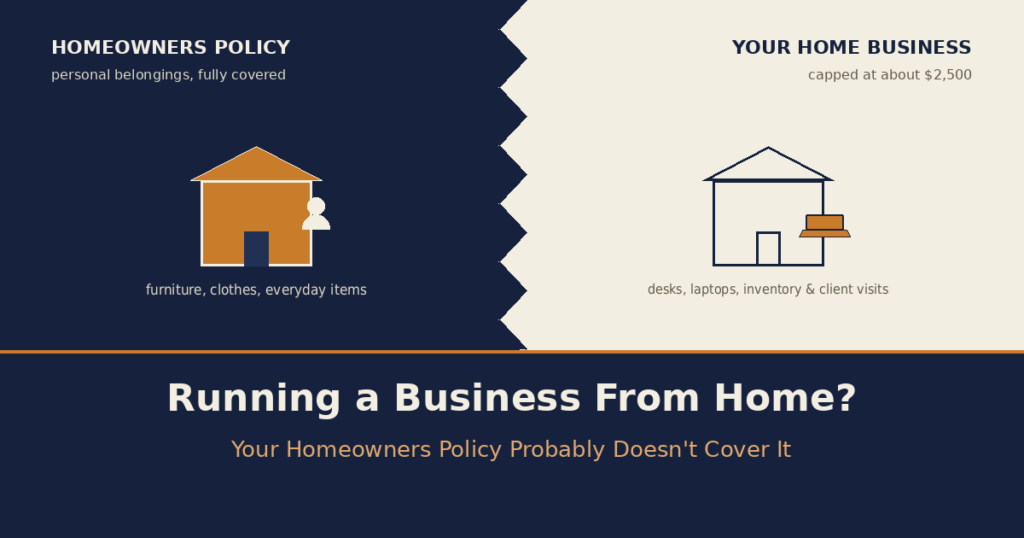
Standard homeowners policies include a modest built-in allowance for business property kept in the home, but it’s considerably smaller than most people expect. A commonly cited limit across multiple insurers is around $2,500 for business equipment on the premises, with an even lower limit, often just a few hundred dollars, for business property away from home. If your home office setup, a laptop, a monitor, specialized software, camera equipment, or inventory, adds up to more than that, and it often does quite quickly, the excess simply isn’t covered.
Insurers do offer an endorsement that raises this specific property limit, commonly up to around $10,000, for a relatively small additional premium. It’s worth knowing, though, that this endorsement typically addresses only the property side. It generally doesn’t touch the more serious gap: business liability.
The Liability Gap Is the Bigger Problem
Most homeowners policies contain a business liability exclusion, denying coverage for bodily injury or property damage claims connected to business activity conducted from the home. This exclusion tends to be broad, broad enough that a client tripping on your front steps, or a delivery driver slipping in your driveway while picking up a shipment for your business, can fall outside your policy’s protection entirely, even though the same injury happening to a purely personal guest would likely be covered without issue.
This gap doesn’t require in-person client visits to matter. Product liability, professional errors, and other business-related claims exist independent of foot traffic, meaning even a business run entirely online can carry real, uninsured liability exposure under a standard homeowners policy.
Three Ways to Actually Close the Gap
An in-home business endorsement adds a modest premium, commonly cited in the range of $20 to $50 a year on the low end, to raise both property and liability limits specifically for small-scale home business activity. This tends to suit lower-risk situations: tutoring, consulting, modest e-commerce side income, or similar small operations without employees or significant client traffic.
A Business Owner’s Policy, or BOP, is a separate commercial policy bundling property, general liability, and typically business interruption coverage. This is generally the right fit once a home business grows past a simple side activity: meaningful inventory, regular client visits, or any employees at all. Reported costs for a BOP vary considerably by business type and coverage level, commonly cited somewhere between $500 and $1,500 a year, though your specific cost depends on your actual risk profile.
Professional liability, or errors and omissions insurance, addresses a different kind of risk entirely: claims that your professional advice or service caused a client financial harm, rather than physical injury. This matters specifically for consultants, designers, and other service-based home businesses, and it’s typically not included in either a homeowners endorsement or a standard BOP, requiring its own separate policy.
The Employee Trigger Most Home Business Owners Miss
If a home-based business brings on any help, even a single part-time assistant, workers’ compensation requirements generally apply, the same as they would for a business operating out of commercial space. This obligation exists independent of your property and liability coverage, and it’s frequently the piece home business owners overlook entirely, having fixed their property and liability gaps and assumed that was the full picture.
Requirements and how workers’ comp coverage is obtained vary significantly by state, with some states running the program through a state fund rather than private insurers. Checking your specific state’s requirement the moment you bring on any help, even informally, is worth doing rather than assuming a homeowners endorsement or BOP already covers it.
A Practical Example
Imagine a graphic designer working from a home office, occasionally meeting clients there to review projects. A client trips on an uneven front step during one of these visits and is injured. Because this injury is connected to business activity, the homeowners policy’s liability exclusion applies, and the claim is likely denied outright, regardless of how minor or routine the visit seemed.
Now imagine the same designer carries an in-home business endorsement extending liability coverage to exactly this kind of scenario. The same injury would likely be covered under that endorsement, protecting the designer from a direct, personal liability claim over an incident connected to running their business from home.
Common Mistakes to Avoid
- Assuming no foot traffic means no liability exposure. Product and professional liability risks exist independent of whether clients ever set foot in your home.
- Fixing the property gap without addressing liability. An endorsement that only raises your business property limit leaves the more serious liability exclusion untouched.
- Not revisiting coverage as the business grows. A simple endorsement that worked for a small side income may no longer be adequate once the business adds inventory, employees, or regular client visits.
- Forgetting about workers’ compensation the moment you hire help. This is a separate legal obligation, not something a homeowners endorsement or standard BOP automatically resolves.
Final Thoughts
A homeowners policy was never built with business activity in mind, and the gaps it leaves, tight property limits and a broad liability exclusion, can leave a home-based business owner seriously exposed. The fix is usually inexpensive relative to the risk: an endorsement for smaller operations, a full Business Owner’s Policy as the business grows, and separate professional liability or workers’ compensation coverage as specific needs arise. Reviewing your actual business activity against what your current policy excludes is worth doing before a claim reveals the gap for you.
Disclaimer: This article is for general informational purposes only and does not constitute financial, legal, or insurance advice. Coverage limits, endorsement availability, costs, and state requirements vary by insurer and location, and can change over time. Contact your insurance provider or a licensed insurance professional for advice about your specific home-based business.
Sources
- IRMI (International Risk Management Institute) — “Insuring the Home-Based Business,” irmi.com
- LegalClarity — “What Does Home Business Insurance Endorsement Cover?,” legalclarity.org
- PolicyBenchmark — “BOP Insurance Guide 2026,” policybenchmark.com