This guide covers prescription drug coverage under US health insurance plans. Specific tier structures and costs vary by plan and insurer, so check your plan’s actual formulary and Summary of Benefits for figures that apply to you.
Two people can walk out of the same pharmacy with the same medication and pay wildly different amounts, and the reason usually has nothing to do with where they filled it. It comes down to which tier their specific insurance plan assigns that drug to, a system most people only encounter for the first time when a routine prescription suddenly costs far more than expected.
What a Formulary Actually Is
A formulary is your health plan’s list of covered prescription drugs. Insurers and pharmacy benefit managers build these lists specifically to include a broad range of clinically appropriate medications while steering cost-sharing toward the options that offer the most value for a given condition. If a medication isn’t on your plan’s formulary at all, it typically isn’t covered, and you’d generally pay the full retail price unless you successfully request an exception.
Within the formulary, drugs get sorted into tiers, and each tier carries its own copay or coinsurance level. This tier structure, not the drug’s actual retail price alone, is what determines what you personally pay at the counter.
How the Tiers Typically Work
Plans vary in exactly how many tiers they use, commonly somewhere between three and five, but the underlying logic is consistent across nearly all of them: lower tiers cost less, higher tiers cost more.
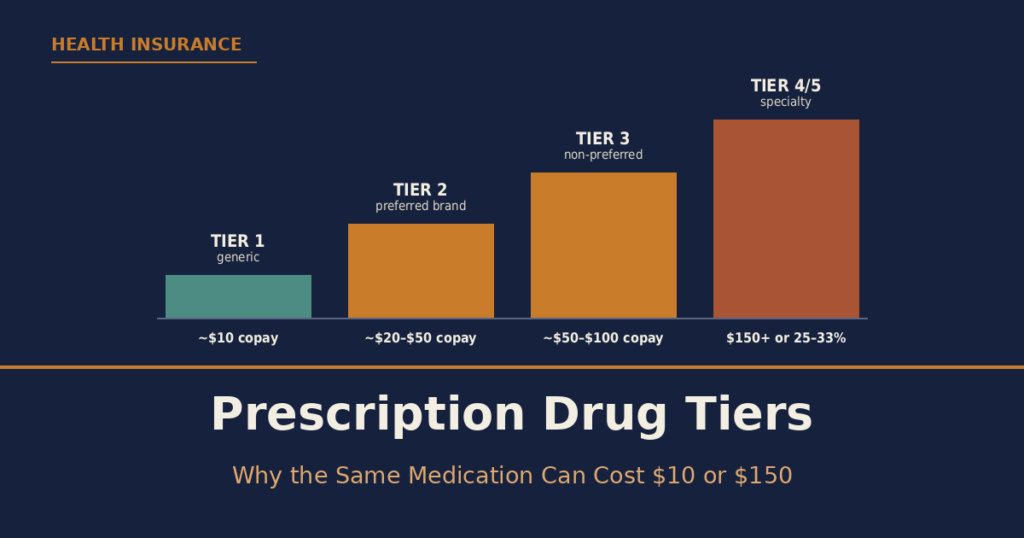
Tier 1 typically includes preferred, low-cost generic drugs, generally the cheapest tier, sometimes costing as little as a few dollars for a month’s supply.
Tier 2 generally includes other generics or preferred brand-name drugs, priced a step above Tier 1.
Tier 3 commonly includes preferred brand-name drugs and some higher-cost generics, with a more noticeable copay increase.
Tier 4, where it exists, generally includes non-preferred brand-name drugs and some of the highest-cost generics, along with newly approved medications that haven’t yet been reviewed for a lower tier.
Tier 5, on plans that use it, is typically reserved for specialty medications: high-cost drugs treating complex or rare conditions like cancer, rheumatoid arthritis, or multiple sclerosis. These are commonly priced not as a flat copay but as coinsurance, often in the range of 25% to 33% of the drug’s cost, which can add up to a substantial amount for genuinely expensive treatments.
The Detail That Actually Surprises People
Here’s what makes formularies genuinely confusing rather than just a matter of memorizing the tier structure: the same drug can sit on completely different tiers depending on which specific plan you’re enrolled in. A brand-name medication placed on Tier 3 under one insurer’s formulary might sit on Tier 4 under a different insurer, or even a different plan from the same insurer, meaningfully changing what you’d pay for the identical prescription.
This is exactly why comparing plans based only on the monthly premium can be misleading if you take regular medications. Checking a plan’s specific formulary for your actual prescriptions, not just assuming similar-sounding plans treat drugs the same way, is worth doing before you enroll, not after your first pharmacy visit under a new plan.
What to Do If Your Medication Lands on a High Tier
If you discover your prescription sits on an expensive tier, you generally have a few real options worth pursuing before simply accepting the cost.
Ask about a lower-tier alternative. Your doctor may be able to prescribe a different medication in the same therapeutic class that treats your condition just as effectively but sits on a cheaper tier.
Request a tier exception. Most plans allow you to formally request that a specific medication be covered at a lower tier’s cost-sharing level. This generally requires your doctor to certify that the lower-tier alternatives in the same drug class aren’t appropriate for your specific situation. Exceptions aren’t guaranteed, but they’re a legitimate, worthwhile step for an expensive medication with no comparable substitute.
Check for a generic equivalent. If you’re taking a brand-name drug, asking whether a generic version exists and would work for your condition is one of the more straightforward ways to move to a meaningfully cheaper tier.
Look into manufacturer copay assistance. For many specialty and brand-name drugs, the manufacturer offers its own copay assistance program, which can substantially offset what you’d otherwise pay out of pocket, independent of your plan’s tier structure.
Specialty Drugs and Medicare Part D’s Recent Change
For Medicare Part D enrollees specifically, a significant change took effect in 2025 and continues into 2026: an annual out-of-pocket cap on covered Part D drug costs, established under the Inflation Reduction Act and adjusted annually, landing at approximately $2,000 for 2026. Once your covered out-of-pocket spending reaches that cap for the year, your plan covers 100% of your remaining covered drug costs for the rest of the plan year. For someone on an expensive Tier 5 specialty medication, this cap represents a meaningful change from the cost exposure Medicare beneficiaries faced in prior years, when spending could continue well beyond that point.
Outside of Medicare, employer and ACA marketplace plans don’t have this specific federal cap on drug costs alone, though your plan’s overall annual out-of-pocket maximum still applies once you’ve spent enough across all covered services, prescriptions included.
A Practical Example
Imagine someone prescribed a brand-name medication for a chronic condition, discovering it sits on their plan’s Tier 4, with a copay considerably higher than they expected. Their doctor confirms no generic version exists, but mentions a similar medication in the same drug class that’s covered at Tier 2 instead.
Switching to that alternative, after confirming with their doctor that it would work equally well for their condition, immediately reduces their monthly cost. In a different scenario, where no lower-tier alternative exists, requesting a formal tier exception, with the doctor’s certification that this specific medication is medically necessary, would be the next reasonable step before simply accepting the higher cost indefinitely.
Common Mistakes to Avoid
- Choosing a health plan based only on premium, without checking your specific medications’ tier placement. A cheaper premium can be offset entirely by an expensive tier assignment for a drug you take regularly.
- Assuming your medication’s tier stays the same year to year. Formularies get updated regularly, and a drug that was Tier 2 last year could shift to a different tier at renewal.
- Not asking about a tier exception for an expensive, medically necessary drug. It’s not automatic, but it’s a legitimate request worth making rather than assuming the higher cost is final.
- Overlooking manufacturer copay assistance programs. These exist for many brand-name and specialty drugs and can meaningfully reduce your actual out-of-pocket cost.
Final Thoughts
Formulary tiers explain why two people on seemingly similar insurance plans can pay very different amounts for the same prescription, and why comparing plans by premium alone can miss a real cost sitting in the fine print. Checking your specific medications against a plan’s actual formulary before enrolling, and knowing that tier exceptions and generic alternatives are real options rather than long shots, puts you in a much stronger position when a prescription’s cost catches you off guard.
Disclaimer: This article is for general informational purposes only and does not constitute medical, legal, or insurance advice. Formulary structures, tier assignments, and costs vary by plan, insurer, and year, and can change at any time. Review your specific plan’s formulary and Summary of Benefits, and contact your insurer or a licensed professional for advice about your situation.
Sources
- GoodRx — “What Is a Formulary? Definition, Tiers, and Costs,” goodrx.com
- Humana — “Understanding Drug Tiers,” humana.com
- UnitedHealthcare — “What is a tiered formulary and what does it mean for me?,” uhc.com
- MedicareFAQ — “Medicare Part D Drug Tiers 2026,” medicarefaq.com