This guide covers car insurance in the United States. Specific deadlines and requirements are set at the state level and vary considerably, so confirm the exact rules for your new state directly with its DMV.
Car insurance is one of those moving tasks that’s easy to push toward the bottom of a long to-do list. It shouldn’t be. Your policy doesn’t automatically adjust to a new state on its own, and the clock on updating it typically starts the moment you actually move, not whenever you get around to it.
Your Policy Follows You, But Only Temporarily
If you’re traveling out of state, your car insurance generally follows you, and your liability coverage automatically adjusts to meet the state you’re visiting’s minimum requirements if your own coverage happens to fall short. This is designed for travel, not relocation.
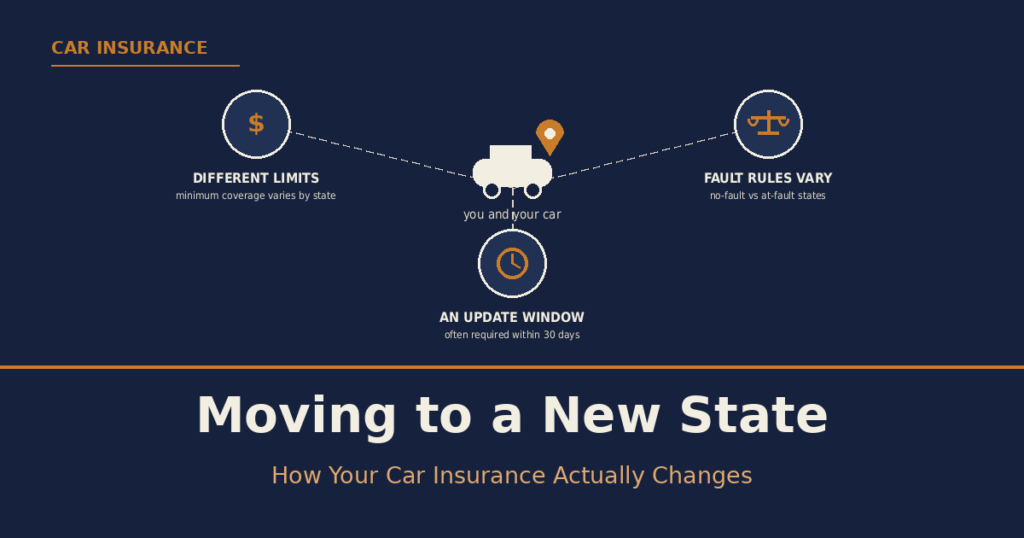
Once you actually move and establish residency in a new state, that automatic protection stops applying. States require you to register your vehicle and update your insurance once your new state becomes your legal home, and most give you a grace period to handle it, commonly cited across the industry as somewhere in the range of 30 to 90 days, though the exact window varies by state. A handful of states, including Massachusetts, Michigan, and New Mexico, require registration essentially immediately upon establishing residency, without the longer grace period more common elsewhere.
Why You Might Need an Entirely New Policy
Moving across state lines sometimes means more than just updating your address. If your current insurer isn’t licensed to sell policies in your new state, you’ll need to switch carriers entirely, regardless of how long you’ve been a customer or how clean your driving record is. Even when your insurer does operate in your new state, they’ll typically need to rewrite your policy to reflect that state’s specific coverage requirements, rating factors, and rules, rather than simply updating your address on the existing policy.
A cross-state move is generally treated as a qualifying life event, which means you can shop for and switch to a new policy right away rather than waiting for your current policy’s renewal date.
What Actually Needs to Change in Your Coverage
Every state sets its own minimum liability requirements, and they vary enough that a policy perfectly adequate in one state can fall short of another’s legal minimum. Beyond liability limits, a few other state-specific details are worth checking directly with your insurer.
Personal injury protection, or PIP, requirements differ significantly between no-fault and at-fault states, and moving between the two types can mean a meaningful change in how your policy is structured. Uninsured and underinsured motorist coverage requirements vary by state as well. Some states, including Florida, Michigan, and New York, have particularly distinctive coverage structures that differ noticeably from the more common at-fault liability model used elsewhere, so a move to or from one of these states deserves specific attention rather than an assumption that your existing coverage transfers cleanly.
The Fraud Risk of Not Updating Your Address
Here’s a mistake worth taking seriously: keeping your policy registered at your old address to hold onto a lower premium, rather than updating it to reflect where you actually live and garage your car. Insurers consider this material misrepresentation, and discovering it, commonly during a claim, can result in a denied claim or a canceled policy, regardless of how long the arrangement went unnoticed.
The math rarely favors the risk. Whatever you might save in premium by misrepresenting your address is generally far smaller than the cost of a denied claim after an accident. Active-duty military members are a recognized exception, generally permitted to maintain their home-state registration while stationed elsewhere, but this exception doesn’t extend to ordinary civilian moves made purely to chase a lower rate.
A Practical Timeline for the Move Itself
Most guidance on this topic converges on a similar sequence. Start shopping for quotes a few weeks before your move, since many insurers let you set up a new policy in advance and time its start date to match your actual move-in day, avoiding any coverage gap. Contact your current insurer directly to share your move date and new address, and ask specifically whether they can continue covering you in the new state or whether you’ll need a new policy elsewhere. Once you’ve arrived, confirm your new state’s specific deadline for registration and license transfer, and complete both promptly rather than assuming the grace period gives you more room than it actually does.
A Practical Example
Imagine someone moving from an at-fault state with relatively low liability minimums to a no-fault state with a PIP requirement and a different minimum liability structure entirely. If they simply update their mailing address without addressing these structural differences, they could end up both under-covered relative to their new state’s requirements and missing PIP coverage their new state expects them to carry.
Now imagine the same move handled properly: the mover contacts their insurer ahead of time, confirms whether the insurer operates in the new state, and works through the specific coverage differences, PIP, liability limits, uninsured motorist requirements, before their move-in date. Their new policy takes effect exactly when their old address stops applying, with no gap and no mismatch between what they’re carrying and what their new state actually requires.
Common Mistakes to Avoid
- Waiting until the grace period is nearly over to update anything. Starting the process before your move, rather than scrambling afterward, avoids both coverage gaps and rushed decisions.
- Assuming your existing coverage automatically meets your new state’s minimums. Liability limits, PIP requirements, and uninsured motorist rules all vary by state, and assuming continuity is worth confirming, not assuming.
- Keeping your old address on file to preserve a lower rate. This is treated as misrepresentation and can jeopardize an otherwise valid claim.
- Not checking whether your current insurer even operates in your new state. Discovering this late can leave you scrambling for a new policy right as your grace period closes in.
Final Thoughts
Moving to a new state changes more about your car insurance than just the mailing address on file. Coverage requirements, available insurers, and even the underlying legal framework, no-fault versus at-fault, can all shift with a state line. Starting the process early, confirming your new state’s specific requirements directly, and avoiding the temptation to keep an old address on file are what keep this part of a move from turning into a real problem later.
Disclaimer: This article is for general informational purposes only and does not constitute financial, legal, or insurance advice. Grace periods, coverage requirements, and registration deadlines vary by state and change over time. Confirm current requirements with your new state’s Department of Motor Vehicles and your insurance provider before and after your move.
Sources
- Progressive — “Do I Have to Change My Car Insurance When Moving?,” progressive.com
- ValuePenguin — “How to Transfer Car Insurance and Registration after Moving,” valuepenguin.com
- MoneyGeek — “Out-of-State Car Insurance: What You Need to Know,” moneygeek.com