
This guide covers the transition from ACA Marketplace coverage to Medicare in the United States. Specific premiums and penalty amounts shown are for 2026 and adjust annually, so confirm current figures at Medicare.gov before making enrollment decisions.
Turning 65 usually gets planned around retirement dates and Social Security timing. The Medicare enrollment deadline attached to that same birthday gets far less attention, and missing it is one of the more expensive, permanent mistakes someone can make in an otherwise well-planned retirement. If you’re currently on an ACA Marketplace plan, this deadline applies to you whether or not you feel ready to think about Medicare yet.
The Window You’re Actually Working With
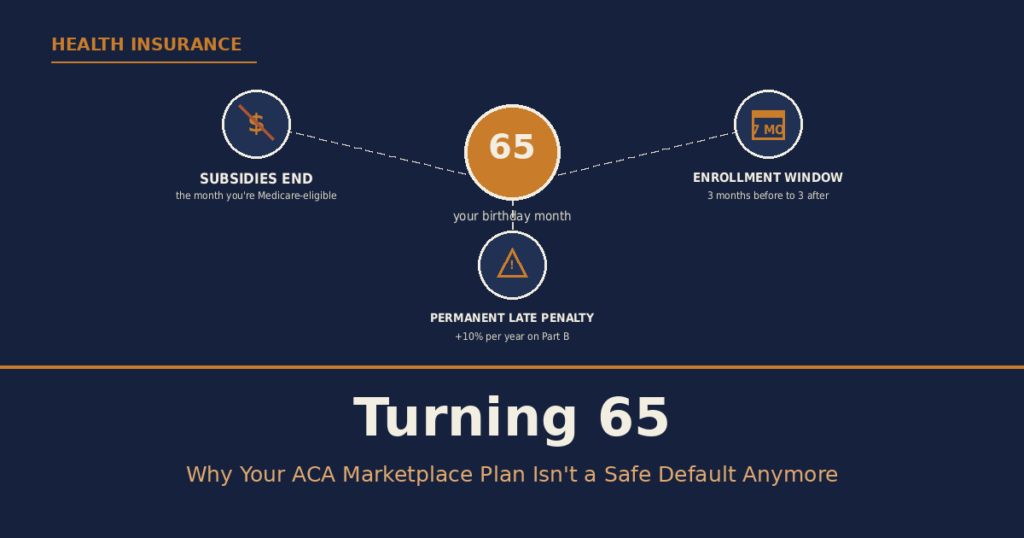
Your Medicare Initial Enrollment Period, commonly called the IEP, is a seven-month window built around your 65th birthday: it opens three months before your birthday month, includes your birthday month, and closes three months after. The clock starts on this schedule regardless of whether you take any action, and regardless of whether you’re happy with your current Marketplace plan.
Enrolling during the three months before your birthday month generally gets your Medicare coverage started on the first day of your birthday month itself, avoiding any gap. Enroll later in the window, and your coverage start date can be delayed by a month or more.
Why Your ACA Subsidy Disappears the Moment You’re Medicare-Eligible
Here’s the detail that catches a lot of early retirees off guard: ACA premium tax credits stop the month you become Medicare-eligible, regardless of whether you’ve actually enrolled in Medicare yet. Continuing your Marketplace plan past that point generally means paying its full, unsubsidized cost, since the subsidy itself is tied to Medicare eligibility, not to your enrollment status.
This creates a real trap for people who’ve carefully managed their income to qualify for a strong ACA subsidy in the years leading up to 65. That subsidy strategy has a hard expiration date attached to your birthday, whether or not it feels convenient.
The Penalty for Missing Your Window Is Permanent
If you don’t enroll in Medicare Part B during your IEP, and you don’t qualify for an exception, you generally face a Part B late enrollment penalty: an extra 10% added to your standard monthly premium for every full 12-month period you were eligible but didn’t enroll. This penalty isn’t temporary. It’s added to your premium for as long as you have Part B, which for most people means the rest of their life.
Part D, prescription drug coverage, carries its own separate penalty structure, calculated differently and triggered by a different clock: generally, going 63 or more days without creditable drug coverage after your IEP ends triggers a Part D penalty of roughly 1% of the national base premium for each month you went without coverage, also generally permanent.
The One Legitimate Way to Delay Without a Penalty
There’s a real exception here, but it’s narrower than a lot of people assume. If you or your spouse are still actively working at 65 and covered by a current employer’s group health plan, and that employer has 20 or more employees, you can generally delay Medicare Part B enrollment without penalty. Once that active employer coverage ends, you get an 8-month Special Enrollment Period to enroll in Part B penalty-free.
The critical detail: this exception requires active, current employer coverage from an employer of that size. COBRA continuation coverage, retiree health benefits, and an ACA Marketplace plan all fall outside this definition, even though people sometimes assume any of these counts as “still having coverage.” If you’re on COBRA or a Marketplace plan at 65, rather than actively working with employer coverage, the standard IEP deadline and penalty structure applies to you.
Employer size matters too. If your employer has fewer than 20 employees, Medicare generally becomes your primary coverage at 65 regardless of whether you keep working, and delaying enrollment in that situation can leave you exposed to medical bills your employer plan may refuse to cover as a secondary payer.
What Happens If You Miss the Window Entirely
Missing your IEP without qualifying for the employer-coverage exception means waiting for the General Enrollment Period, which runs January 1 through March 31 each year, with coverage typically starting later, often several months after you enroll. Beyond the coverage gap this creates, you’ll generally also face the Part B late enrollment penalty for the months or years you went without coverage after first becoming eligible.
A Practical Example
Imagine someone on an ACA Marketplace plan, receiving a meaningful subsidy, who turns 65 in June. Their IEP runs from March through September of that year. If they don’t act during this window, and they’re not covered by a qualifying employer plan, two things happen at once: their ACA subsidy disappears the month they turn 65 regardless of what they do next, and if they delay Medicare Part B enrollment past September, they begin accumulating a permanent late penalty on top of eventually needing to wait for a General Enrollment Period to sign up at all.
Now imagine a similar person who enrolls during the three months before their birthday month instead. Their Medicare coverage begins smoothly on their birthday month, with no gap and no penalty, and they can decide separately whether to pursue a Medigap supplement or a Medicare Advantage plan alongside their new Original Medicare coverage.
Common Mistakes to Avoid
- Assuming Medicare enrollment is automatic. Unless you’re already receiving Social Security benefits, no one enrolls you automatically. You need to actively sign up through the Social Security Administration during your IEP.
- Assuming COBRA or retiree coverage delays your deadline. Neither qualifies as active employer coverage under the delay exception, and relying on either past your IEP risks a permanent penalty.
- Skipping Part D because you don’t currently take medications. The late enrollment penalty applies regardless of whether you’re using the coverage yet, and it’s calculated from when your IEP ended.
- Not checking your specific employer’s size before assuming you can delay. The under-20-employee threshold is a hard line that determines whether Medicare becomes your primary coverage at 65, working or not.
Final Thoughts
Your ACA Marketplace plan can feel like a stable, familiar option to simply keep as you approach 65, but the subsidy underneath it disappears on a fixed date tied to your birthday, and Medicare’s own enrollment deadlines carry permanent penalties that don’t offer much room for second-guessing later. Marking your specific seven-month window, confirming whether you genuinely qualify for the active-employer delay exception, and enrolling during the window’s early months if you don’t, are the steps that keep this transition from becoming an expensive mistake.
Disclaimer: This article is for general informational purposes only and does not constitute financial, legal, or insurance advice. Medicare enrollment rules, premiums, and penalty calculations are set by CMS and adjust annually. Confirm current details at Medicare.gov or with the Social Security Administration before making enrollment decisions.
Sources
- Medicare.gov — Initial Enrollment Period, Special Enrollment Period, and General Enrollment Period rules
- Centers for Medicare & Medicaid Services (CMS) — 2026 Medicare Parts A & B Premiums and Deductibles announcement
- Social Security Administration — Medicare enrollment guidance, ssa.gov