This guide covers personal auto insurance for rideshare and delivery drivers in the United States. Specific coverage amounts and state requirements vary, and rideshare insurance products change frequently, so confirm current details with your insurer and the platform you drive for.
Turning on the Uber or Lyft app feels like flipping a simple switch. Insurance-wise, it changes your risk profile in a way most drivers don’t fully register until something goes wrong. Between what your personal policy excludes and what the rideshare company actually covers, there’s a real gap, and it happens to fall during the exact window many drivers spend the most time in: waiting for a ride request.
Why Your Personal Policy Stops Covering You
Standard personal auto policies contain what’s commonly called a livery or business-use exclusion, and driving passengers for a fee falls squarely into that excluded category. The moment you turn on a rideshare app and begin working, most personal insurers consider that a business activity outside what your policy was priced and written to cover, even if you’re using the same car you drive every day for errands.
This isn’t a minor technicality. If you’re in an accident while driving for a rideshare platform and your personal insurer determines the app was active, your personal policy can deny the claim entirely, leaving you to rely solely on whatever coverage the rideshare company itself provides during that specific moment.
The Three Periods, and Where the Real Gap Sits
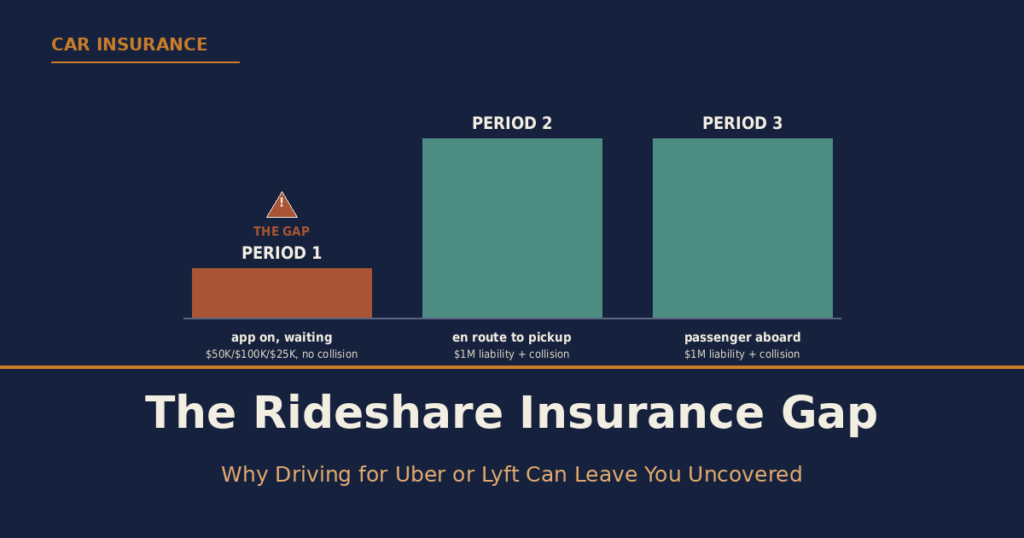
Uber and Lyft both structure their insurance coverage around three defined periods, and coverage strength varies dramatically between them.
Period 1 begins the moment you turn the app on and starts looking for a ride request. This is where the real gap lives. During this period, rideshare companies typically provide only limited contingent liability coverage, commonly described as being in the range of $50,000 per person and $100,000 per accident for bodily injury, with $25,000 for property damage, and this coverage generally only applies if your personal insurance doesn’t. Critically, there’s typically no collision coverage at all during this period, meaning damage to your own vehicle from an accident while you’re simply waiting for a ride request may not be covered by either your personal policy or the rideshare company.
Period 2 begins once you accept a ride request and are en route to pick up the passenger. Coverage increases substantially here, commonly to $1 million in third-party liability, along with contingent collision and comprehensive coverage, subject to a deductible that’s typically in the range of $1,000 to $2,500.
Period 3 covers the actual trip, from when the passenger enters your vehicle until they’re dropped off. Coverage here is generally similar to Period 2, commonly including the same $1 million liability limit along with uninsured and underinsured motorist coverage.
The pattern across all these figures: you’re most exposed during Period 1, precisely because that’s when both your personal policy and the rideshare company’s coverage are weakest.
How Rideshare Endorsements Close the Gap
Recognizing this gap, many insurers now offer a rideshare endorsement, sometimes called a TNC (transportation network company) endorsement, that extends your existing personal policy’s coverage into Period 1. Rather than requiring a full separate commercial policy, this endorsement adds rideshare-specific protection to the policy you already have, commonly for an additional cost in the range of roughly $6 to $40 a month, though pricing varies by insurer, state, and your specific coverage limits.
Some endorsements go further than just filling the Period 1 gap. A few insurers also offer deductible gap coverage, which reimburses you for the difference between the rideshare company’s collision deductible during Periods 2 and 3 and the lower deductible on your personal policy, reducing your out-of-pocket cost if you do need to file a claim during an active trip.
Not every state has the same level of rideshare endorsement availability. In some states, options are more limited, and drivers may need a genuine commercial policy rather than a personal-policy endorsement to be properly covered. Checking what’s actually available from insurers in your specific state, rather than assuming every product is sold everywhere, is worth doing directly.
Delivery Driving Carries a Similar, Related Gap
Drivers doing food or package delivery, rather than passenger rideshare, face a closely related exposure. Personal auto policies generally exclude delivery driving for payment the same way they exclude rideshare driving, and delivery platforms structure their own coverage with similar period-based limitations. If you drive for a delivery platform, confirming whether your existing rideshare endorsement extends to delivery work, or whether you need a separate product, is worth a direct conversation with your insurer.
A Practical Example
Imagine a driver who logs into a rideshare app and, while waiting for a request, is involved in an accident they’re found at fault for, causing damage to their own vehicle and a stopped car ahead of them. Without a rideshare endorsement, their personal insurer may deny the claim entirely, citing the livery exclusion, while the rideshare company’s Period 1 coverage may not include the collision protection needed to repair the driver’s own car at all.
Now imagine the same driver carries a rideshare endorsement on their personal policy. That endorsement extends their existing liability and collision coverage into Period 1, meaning the same accident is handled much like an ordinary claim would be under their personal policy, rather than falling into the gap between two separate, limited sources of coverage.
Common Mistakes to Avoid
- Assuming your personal policy covers you the moment you’re logged into the app. The livery exclusion applies as soon as you’re working, not just once a passenger is in the car.
- Assuming the rideshare company’s insurance covers everything. Their coverage is real, but it’s structured in tiers, and Period 1 in particular leaves real gaps, especially for damage to your own vehicle.
- Not disclosing rideshare or delivery driving to your personal insurer. Undisclosed business use discovered after a claim can complicate or void coverage well beyond just the specific incident in question.
- Assuming every state offers the same rideshare insurance options. Availability varies, and some states require a genuine commercial policy rather than a personal-policy add-on.
Final Thoughts
The gap in rideshare insurance isn’t a rare edge case. It sits squarely in the period many drivers spend waiting for their next fare, precisely when both their personal policy and the platform’s own coverage are at their weakest. A rideshare endorsement, confirmed directly with your insurer and matched to your specific state’s available products, is the most direct way to close that gap before an accident forces the question.
Disclaimer: This article is for general informational purposes only and does not constitute financial, legal, or insurance advice. Rideshare and delivery platform coverage, state requirements, and available insurance products change frequently and vary by state and insurer. Confirm current details with your insurance provider and the specific platform you drive for.
Sources
- Insurance Information Institute (III) — rideshare and personal auto exclusion guidance, iii.org
- The Rideshare Guy — “Rideshare Insurance for Uber and Lyft Drivers,” therideshareguy.com
- Coverage Classroom — “Rideshare Insurance: Uber Lyft Coverage Gap,” coverageclassroom.com