This guide covers short-term, limited-duration health insurance in the United States. This is an unusually unsettled regulatory area right now, with federal duration rules and enforcement status in flux and state rules varying enormously, so confirm the current status directly with your state’s Department of Insurance or a carrier before enrolling.
Short-term health insurance exists for a specific, narrow purpose: bridging a temporary gap in coverage. It’s not designed as a substitute for comprehensive health insurance, and understanding exactly what it excludes matters just as much as understanding what it costs, especially given how differently these plans are regulated depending on where you live.
What Short-Term Health Insurance Actually Is
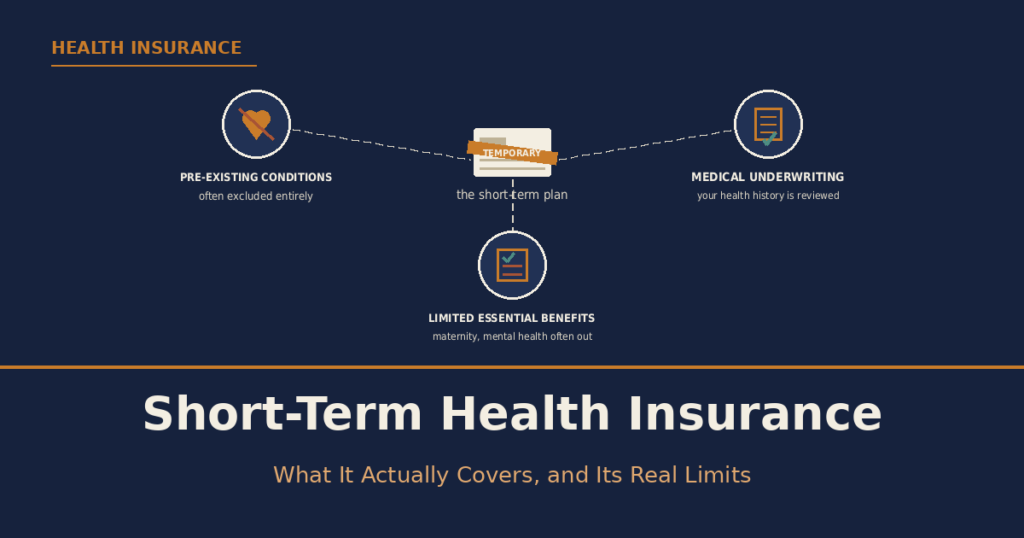
Short-term, limited-duration insurance, often abbreviated STLDI, sits entirely outside the ACA’s individual market framework. Because of that, it isn’t required to follow the ACA’s essential health benefit rules, doesn’t have to cover pre-existing conditions, and isn’t subject to the same annual out-of-pocket maximum that ACA-compliant plans must follow.
That structural difference is also what makes these plans considerably cheaper than ACA marketplace coverage, commonly reported at somewhere in the range of 40% to 80% less depending on the specific plans being compared. The lower price reflects genuinely less comprehensive protection, not simply a better deal on the same coverage.
How Long You Can Actually Keep One Is Genuinely Unsettled Right Now
This is the part of short-term insurance that’s hardest to pin down with confidence, and it’s worth understanding why. A federal rule finalized in 2024 limited these plans to a 3-month initial term with one 1-month renewal, a 4-month maximum total duration. However, federal regulators announced non-enforcement of that rule in mid-2025, and a new federal rule was, as of this writing, expected sometime around August 2026, without a confirmed final version yet in place.
In practice, this means duration limits currently depend heavily on your state. Some states, including Texas and Indiana, permit short-term plans lasting up to 36 months under their own state law, a limit that predates and diverges sharply from the paused federal 4-month rule. Other states, including California, New York, and Massachusetts, either ban short-term plans entirely or impose their own stricter limits, regardless of what federal rules currently allow.
Given how much this has shifted, and how much it may shift again once a new federal rule is finalized, confirming the current duration limit in your specific state, directly with a licensed carrier or your state’s Department of Insurance, is essential before you rely on any duration figure, including the ones in this article.
What These Plans Typically Don’t Cover
Regardless of how long a plan lasts, short-term coverage commonly excludes several categories that ACA-compliant plans are required to include.
Pre-existing conditions. This is the most consequential exclusion. Insurers can review your medical history going back a defined look-back period, commonly 12 to 24 months depending on the carrier, and deny claims related to any condition treated or diagnosed during that window, even a condition you weren’t fully aware of at the time you applied.
Preventive care. Routine screenings and annual physicals, covered at no cost under ACA-compliant plans, generally aren’t guaranteed under short-term coverage.
Maternity care. Pregnancy-related coverage is almost universally excluded from short-term plans.
Mental health treatment. Coverage here is typically limited or excluded entirely, unlike ACA-compliant plans, which are required to cover mental health as an essential benefit.
Prescription drugs. Many short-term plans exclude prescription coverage entirely, though some offer a limited add-on formulary for an additional cost.
Instead of the ACA’s required annual out-of-pocket maximum, short-term plans typically apply their own overall benefit cap, commonly in the range of $1 million to $2 million, a structure fundamentally different from how ACA-compliant plans limit your exposure.
Enrollment Works Differently Too
Unlike ACA marketplace plans, which generally require enrolling during a specific open enrollment window or a qualifying life event, short-term plans can typically be purchased at any time during the year. That flexibility is part of their appeal for a genuine short-term gap, but it comes with a trade-off worth knowing: the end of a short-term plan is not considered a qualifying life event, meaning it doesn’t by itself open a special enrollment period for ACA marketplace coverage. Planning your transition back to comprehensive coverage in advance, rather than assuming you can switch seamlessly when the short-term plan ends, matters for exactly this reason.
Who These Plans Actually Suit
Short-term coverage tends to fit a narrow set of situations well: someone between jobs with a defined, short coverage gap, someone who missed ACA open enrollment and doesn’t have a qualifying life event, or a generally healthy person who mainly wants protection against a catastrophic, unexpected event during a brief window.
It fits poorly for anyone with an ongoing health condition, anyone likely to need mental health treatment or prescription medication regularly, and anyone considering pregnancy during the coverage period. For these situations, comprehensive coverage, whether through the ACA marketplace, COBRA, or Medicaid if eligible, is almost always the better-protected option, even at a higher premium.
A Practical Example
Imagine someone between jobs for what they expect to be a two-month gap, in good health, with no ongoing conditions. A short-term plan, in a state that permits one of sufficient length, can provide meaningful protection against a major unexpected medical event during that window, at a lower cost than COBRA or an unsubsidized marketplace plan would run for the same short period.
Now imagine a different person with a managed chronic condition, facing the same two-month employment gap. A short-term plan could deny claims connected to that condition entirely, treating it as pre-existing, leaving this person effectively uninsured for the exact care they’re most likely to need. For this person, COBRA continuation or marketplace coverage, despite the higher premium, protects against the risk that actually matters to their situation.
Common Mistakes to Avoid
- Assuming short-term coverage works the same everywhere. Duration limits and availability vary enormously by state right now, and the federal baseline itself is currently unenforced pending a new rule.
- Not reading the pre-existing condition look-back period carefully. A seemingly unrelated visit years ago can affect coverage for a related issue later, depending on how the carrier defines the condition.
- Assuming the plan’s end automatically qualifies you for marketplace special enrollment. It doesn’t, so plan your next coverage step before the short-term plan expires, not after.
- Choosing short-term coverage with an existing health condition to save money. The savings can be real, but so is the risk of a denied claim for the exact care you’re most likely to need.
Final Thoughts
Short-term health insurance can genuinely help bridge a defined, temporary coverage gap for someone in good health, at a meaningfully lower cost than comprehensive coverage. It is not a substitute for ACA-compliant insurance, particularly for anyone with an ongoing health condition, and current rules governing how long you can keep one vary sharply by state during this unusually unsettled regulatory period. Confirming your state’s current rules, and being honest about your own health situation, are the two things that determine whether this coverage genuinely serves you or leaves you exposed exactly when you need protection most.
Disclaimer: This article is for general informational purposes only and does not constitute financial, legal, or insurance advice. Federal and state duration limits, coverage requirements, and availability for short-term health insurance are subject to active regulatory change. Confirm current rules with your state’s Department of Insurance or a licensed insurance professional before enrolling.
Sources
- HealthPlansCompared — “How Long Can You Keep a Short-Term Health Plan? 2026 Rules by State,” healthplanscompared.com
- HSA for America — “Short-Term Health Insurance Guide 2026,” hsaforamerica.com
- CoveredUSA — “Health Insurance With Pre-Existing Conditions: Your Rights in 2026,” coveredusa.org