This guide covers car insurance in the United States. Whether and how credit factors into your rate depends entirely on your state, and these rules do change through legislation, so confirm the current status where you live.
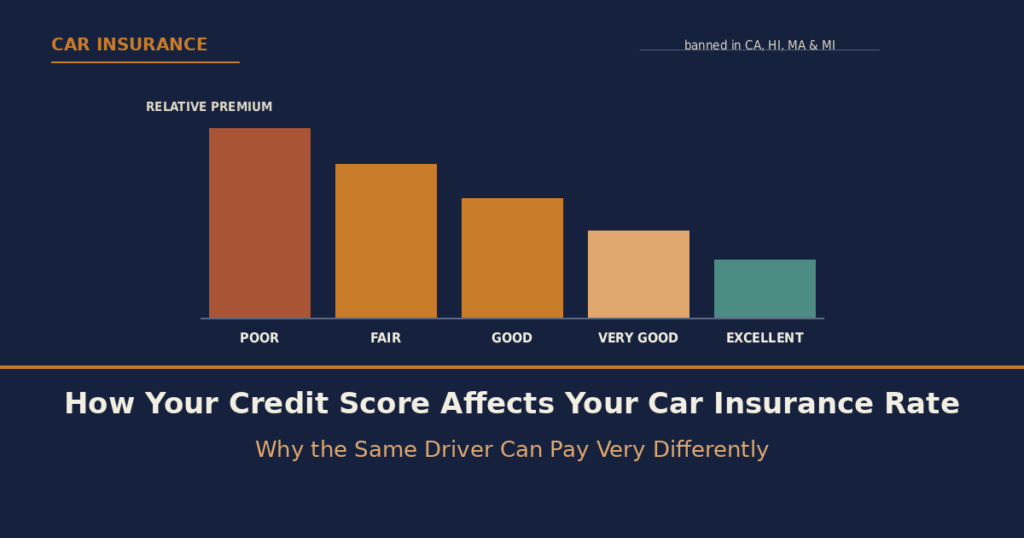
Most drivers know their credit score affects loan approval and interest rates. Fewer realize it also shapes what they pay for car insurance, often by more than almost any other single factor insurers consider. In most states, this is a completely legal and common practice. In a handful of others, it’s banned outright.
Why Insurers Use Credit at All
Insurers don’t look at your ordinary FICO score. They generate a separate credit-based insurance score, weighted differently, built specifically to predict the likelihood of filing a claim rather than the likelihood of defaulting on a loan. Payment history and outstanding debt levels typically carry the heaviest weight in this calculation.
The industry’s rationale is statistical: actuarial studies have consistently found a correlation between lower credit-based insurance scores and a higher likelihood of filing claims. Insurers price policies based on that pattern, the same way they price based on driving record or vehicle type. Critics of the practice argue this effectively penalizes people for financial hardship that has nothing to do with how they actually drive, and that argument is exactly what’s driving current legislative pushback in several states.
The Four States That Ban It Outright
California, Hawaii, Massachusetts, and Michigan currently prohibit insurers from using credit-based scoring to set auto insurance rates. If you live in one of these states, your credit history shouldn’t factor into your premium at all, regardless of which insurer you choose.
These bans have different origins. California’s dates back to Proposition 103 in 1988, which restricts auto rating factors mainly to driving record, annual mileage, and years of driving experience. Hawaii and Massachusetts adopted their own prohibitions separately. Michigan eliminated credit-based scoring as part of a broader no-fault insurance reform effort in 2020.
States With Partial Restrictions
A second group of states doesn’t ban credit-based scoring outright but limits how insurers can use it. Maryland allows credit to factor into your initial rate but restricts insurers from using it to deny coverage or raise your premium at renewal. Oregon permits credit-based pricing on new policies but prohibits using it as grounds to cancel or refuse to renew existing coverage. Several other states impose narrower restrictions on specific uses, such as limiting credit’s role in tiering decisions without banning it from the rating process entirely.
Because these partial rules vary considerably in what they actually restrict, checking your own state’s specific regulation, rather than assuming a “restriction” means the same thing everywhere, is worth doing if this affects you.
This Is an Active, Shifting Legal Area
Credit-based insurance scoring remains genuinely contested territory. Washington’s insurance commissioner issued an emergency rule banning the practice in 2021, only for a court to strike it down on procedural grounds the following year; as of 2026, credit-based scoring is again permitted there, though state lawmakers continue debating further restrictions. Separately, several other states have introduced their own legislation in 2026 aimed at banning or limiting the practice, reflecting the same debate playing out in statehouses around the country.
This history is worth keeping in mind: today’s rule in your state isn’t necessarily tomorrow’s. If this issue matters to you, checking your state insurance department’s current guidance, rather than relying on an older article or a rule that used to apply, is the safer approach.
How Much of a Difference Does It Actually Make?
In the roughly 46 states where credit-based scoring is permitted without a full ban, multiple analyses describe it as one of the more influential rating factors, in some cases affecting price more than a driver’s actual accident history. Exactly how large that gap is varies enormously depending on the source, the specific insurer, and the credit tiers being compared, with different published analyses citing meaningfully different percentage gaps between drivers with poor and excellent credit. Given how much these figures diverge, treating any single percentage as your own likely rate difference isn’t reliable. Getting quotes from multiple insurers is the only way to see how a specific company weighs credit in your situation, since insurers don’t all apply it with equal weight.
A Practical Example
Imagine two drivers with identical driving records, vehicles, and coverage levels, one with strong credit and one with poor credit, both shopping for insurance in a state that permits credit-based scoring. Despite driving records that look the same on paper, the driver with poor credit is likely to receive a meaningfully higher quote from most insurers, purely because of how their credit-based insurance score is calculated.
Now imagine those same two drivers shopping in California instead. Because credit-based scoring is banned there, their quotes would be based on driving record, mileage, and other permitted factors only, with credit history excluded from the calculation entirely, regardless of which insurer they compare.
What You Can Actually Do About It
If you live in a state where credit-based scoring is permitted, a few things are worth knowing. Getting an insurance quote typically triggers only a soft credit inquiry, which doesn’t affect your ordinary credit score the way a hard inquiry from a loan application would. Insurers also commonly re-check credit at renewal, meaning improving your credit over time can genuinely lower your rate at a future renewal, not just at initial signup.
Shopping around matters more here than with some other rating factors, since insurers don’t weight credit identically. A handful of insurers reportedly avoid using credit-based scoring altogether, or use it only lightly, which can make a meaningful difference if your credit is a weak point in your overall profile. Comparing quotes from several companies, rather than assuming your current insurer’s rate reflects the best available price, is the most direct way to find out.
Common Mistakes to Avoid
- Assuming your regular credit score and your credit-based insurance score are the same thing. They’re calculated differently and weighted differently, even though both draw on similar underlying data.
- Not shopping around if your credit is a weak point. Since insurers weigh credit differently, a company that penalizes it less heavily could offer a meaningfully better rate for the same coverage.
- Assuming a state’s current rule is permanent. This area of law has shifted before, in more than one state, and continues to see active legislative attention.
- Ignoring the renewal opportunity. If your credit improves after you first buy a policy, your rate may not automatically reflect that until your insurer re-checks it at renewal, so it’s worth asking directly.
Final Thoughts
Whether your credit history affects your car insurance rate depends almost entirely on where you live, and within states that allow it, how much it matters varies by insurer. If you’re in California, Hawaii, Massachusetts, or Michigan, this isn’t a factor at all. Everywhere else, understanding that credit-based insurance scoring works differently from your ordinary credit score, and shopping around given how differently insurers weigh it, are the two things most likely to actually affect what you pay.
Disclaimer: This article is for general informational purposes only and does not constitute financial or insurance advice. State laws governing credit-based insurance scoring change through legislation and regulatory action, and insurer practices vary. Confirm the current rules in your state with your state’s Department of Insurance, and contact insurers directly for quotes specific to your situation.
Sources
- ValuePenguin — “How Does Your Credit Score Affect Auto Insurance Rates?,” valuepenguin.com
- Compare.com — “Does Credit Score Affect Car Insurance? Rates & State Laws,” compare.com
- CNBC — “Home, car insurance rates based on credit history face state scrutiny,” cnbc.com
- National Association of Insurance Commissioners (NAIC) — content.naic.org