
This guide covers prior authorization in US health insurance. Rules vary by plan type and state, and this is an active reform area, so confirm current specifics with your insurer or state insurance department.
Prior authorization is the process where your insurer has to approve certain treatments, procedures, or medications before agreeing to pay for them. For a lot of patients, it’s also the single most frustrating part of dealing with health insurance: a delay, sometimes a denial, standing between a doctor’s recommendation and actually receiving care. A major federal rule took effect in 2026 specifically targeting these delays, and understanding what it does, and doesn’t, change is worth knowing if you’re navigating this process.
What Prior Authorization Actually Is
Prior authorization, sometimes called precertification or pre-approval, requires your doctor to get sign-off from your insurer before certain services are covered: some surgeries, advanced imaging, specialty medications, and other higher-cost or higher-scrutiny treatments. Insurers use it to manage cost and confirm medical necessity before care is delivered, rather than reviewing the bill after the fact.
The problem, widely documented by physician groups, is how often this process delays care that’s ultimately deemed appropriate anyway. Physician surveys have consistently found that a large share of doctors believe prior authorization delays necessary care, and that the process contributes to patients abandoning treatment altogether due to the wait.
What Actually Changed in 2026
A CMS rule finalized in January 2024, known as the Interoperability and Prior Authorization Final Rule, took effect January 1, 2026. It applies to Medicare Advantage plans, state Medicaid managed care programs, and Children’s Health Insurance Program managed care plans, with sources also describing its reach extending to ACA marketplace plans, though the exact timeline that applies to marketplace plans specifically has been described somewhat differently across sources, so confirming your own marketplace plan’s specific standard directly is worth doing if this matters to you.
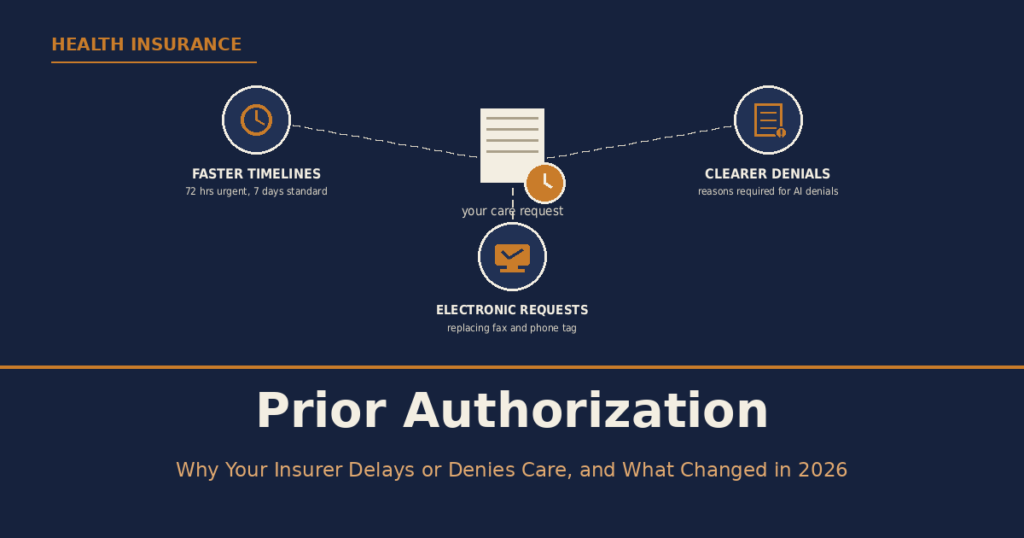
For the plan types clearly covered, the rule sets firm new maximums: standard, non-urgent prior authorization decisions must be issued within seven calendar days, down from a previous standard that could stretch to two weeks or longer. Urgent requests must be decided within 72 hours.
Beyond speed, the rule requires insurers to provide a specific reason for every denial, rather than a generic “not medically necessary” form response, and to publicly report prior authorization performance metrics starting in 2026, including approval and denial rates, average turnaround times, and appeal outcomes.
The Industry’s Own Voluntary Commitments
Separately from the CMS rule, a group of health insurance industry leaders pledged in mid-2025 to further streamline prior authorization voluntarily, beginning in 2026. These commitments include reducing the overall volume of services subject to prior authorization, honoring another plan’s prior authorization approvals during a 90-day transition period when a patient switches insurers, and providing clearer explanations of determinations. Later commitments in this pledge include working toward real-time approvals for most requests and standardizing electronic submission systems.
Because these are voluntary industry commitments rather than binding federal law, actual implementation varies by insurer, and it’s reasonable to treat them as a stated direction rather than a guaranteed standard for every plan.
States Have Been Moving on This Too
Separate from federal action, a large number of states have passed their own prior authorization reform legislation in recent years, with reported figures ranging from roughly 18 to 30 states having taken some form of legislative action since 2024 depending on how the count is measured. Because these state-level rules generally apply to fully insured plans regulated at the state level, and because their scope and specific timelines vary, a prior authorization request in one state can face a different mandated turnaround than the same request in another. Checking your specific state’s rules, particularly if your plan is state-regulated rather than a self-funded employer plan, adds another layer worth confirming.
What to Actually Do If You’re Facing a Prior Authorization Delay or Denial
Understand Why You Were Denied
Under the new rules, insurers are required to provide a specific reason for denial, including the clinical criteria or guideline used in the decision. Request this in writing if it isn’t automatically provided. Insurers commonly rely on proprietary clinical guideline systems to evaluate requests, and knowing exactly which criteria your case didn’t meet is what actually makes an appeal possible to build.
Use the Appeal Process
Every denial comes with an internal appeal right, typically with a specific deadline, commonly somewhere in the range of 30 to 60 days, that starts the moment you receive the denial. If your internal appeal is denied, an external review by an independent third party is generally available afterward, typically decided within 45 days for a standard review or 72 hours for an expedited one.
Some analyses of prior authorization appeals have found that a substantial share of denials get overturned when patients or providers actually appeal them, while relatively few patients pursue an appeal in the first place. Even without pinning down an exact figure, the pattern is worth taking seriously: a denial is often not the final word, and it’s worth pursuing if your doctor still believes the treatment is appropriate.
Ask About a Peer-to-Peer Review
Many insurers offer your treating physician the option to speak directly with the insurer’s reviewing physician to discuss the clinical reasoning behind a request. This step, often available within a matter of business days after a denial, can sometimes resolve a dispute faster than a formal written appeal.
A Practical Example
Imagine a patient whose doctor requests prior authorization for an MRI to evaluate a persistent symptom. Under the new standard timeline, the insurer must respond within seven calendar days for a standard request, a meaningful improvement from the two-week or longer waits that were common before 2026.
If the request is denied, the insurer must now provide a specific clinical reason, rather than a vague boilerplate response, giving the doctor an actual basis to challenge the decision if they disagree. The patient can then pursue an internal appeal, and if needed, an external review, with defined deadlines governing each step, rather than facing an open-ended process with no clear timeline for resolution.
Common Mistakes to Avoid
- Not appealing a denial. Analyses suggest a meaningful share of denials get reversed on appeal, yet relatively few patients pursue this option.
- Accepting a vague denial reason. You’re now entitled to the specific clinical criteria used, and having that detail is what makes building an effective appeal possible.
- Missing appeal deadlines. Internal and external appeal windows are time-limited, and missing them can close off your options.
- Assuming your specific plan is covered by the new federal timelines. The rule’s core protections clearly apply to Medicare Advantage, Medicaid managed care, and CHIP; if you’re on an employer or marketplace plan, confirm your plan’s specific standard rather than assuming the same timeline automatically applies.
Final Thoughts
Prior authorization remains a genuine source of delay in American healthcare, but 2026 marked the most significant regulatory pushback on that delay in years: firm turnaround deadlines, mandatory specific denial reasons, and public reporting requirements for the plan types the federal rule covers. Whether your own plan is bound by these exact standards depends on its type, so it’s worth confirming directly, and it’s worth remembering that a denial is frequently not the end of the process if your doctor still believes the requested care is appropriate.
Disclaimer: This article is for general informational purposes only and does not constitute medical, legal, or insurance advice. Prior authorization rules, timelines, and appeal rights vary by plan type and state, and this is an active area of regulatory and legislative change. Contact your insurer, your state’s insurance department, or a licensed professional for advice about your specific situation.
Sources
- CMS — Interoperability and Prior Authorization Final Rule (CMS-0057-F)
- Forbes — “Prior Authorization Reform Is Here — And It Could Change How Millions Get Care,” forbes.com
- Health Affairs Forefront — “Prior Authorization Reform Heats Up,” healthaffairs.org
- Becker’s Payer Issues — “What’s the latest on prior authorization reform?,” beckerspayer.com