This guide covers car insurance in the United States. Total loss thresholds and formulas are set at the state level and vary by insurer, so confirm the specifics for your state and policy.
Hearing that your car has been “totaled” raises an immediate question most people haven’t thought through in advance: what does the insurance company actually pay, and is it enough to replace what you lost? The answer surprises a lot of people, especially those still financing the vehicle, because the payout is rarely the number they expect.
What “Totaled” Actually Means
Insurers declare a car a total loss when the cost to repair it exceeds a certain threshold relative to its value, or when the car would remain unsafe to drive even after repairs. Most states set this threshold somewhere around 70% to 75% of the vehicle’s value, though the exact percentage and method vary by state and by insurer’s specific total loss formula.
This is a financial and safety determination, not necessarily a reflection of how severe the damage looks. A car with extensive but repairable body damage might not be totaled, while a car with damage that looks more modest but affects the frame or safety systems might be.
The Number That Actually Determines Your Payout
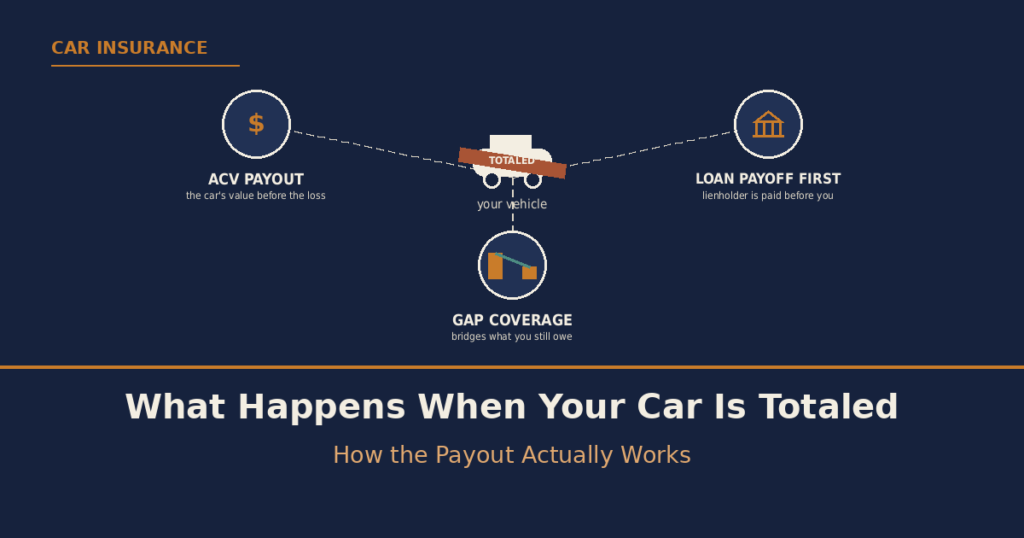
Here’s the detail that catches the most people off guard: your payout is based on your car’s actual cash value, or ACV, immediately before the accident. It is not based on what you originally paid for the car, what you still owe on a loan, or what it would cost to buy a brand-new equivalent today.
ACV starts from the vehicle’s replacement cost, essentially what a similar car would sell for, and then subtracts depreciation: the value lost to age, mileage, wear, and market conditions. Since virtually every car depreciates from the moment it’s driven off the lot, your ACV payout will almost always be less than what you originally paid, even for a relatively new vehicle.
Insurers typically determine this figure using valuation tools and data from sources like Kelley Blue Book, NADA, and comparable sales of similar vehicles in your area, accounting for your specific car’s make, model, age, mileage, and condition. Your deductible is then subtracted from that ACV figure to arrive at your final settlement.
Why This Can Leave You Owing Money
If you’re still financing or leasing your vehicle, this valuation method creates a real risk worth understanding before it happens to you. Because cars depreciate, especially quickly in the first few years, and loan balances decrease more slowly, it’s common for what you owe on a loan to exceed your car’s actual cash value at some point during the loan term.
If your car is totaled while that gap exists, your insurer’s ACV payout goes toward paying off your loan, but if the payout is less than your remaining balance, you’re personally responsible for the difference. You’d be left making payments on a loan for a car you no longer have.
This is exactly the risk gap insurance is designed to close. Gap insurance covers the difference between your ACV payout and your remaining loan or lease balance, and it’s frequently required by lenders on new financed vehicles specifically because this scenario is common enough to matter.
What About New Car Replacement Coverage?
A separate, optional add-on called new car replacement coverage addresses a related but different gap. Rather than paying your depreciated ACV, this endorsement pays for a brand-new vehicle of the same make and model if your car is totaled, minus your deductible. For a car just a couple of years old, the difference between its depreciated ACV and the cost of buying the same model new today can be substantial.
This coverage is typically only available for newer vehicles and usually needs to be added when you first purchase or lease the car, so it’s worth asking about at that point if replacing a totaled vehicle with a new equivalent matters to you.
How the Process Actually Unfolds
After an accident, an adjuster assesses the damage and compares the estimated repair cost against your state’s or insurer’s total loss threshold. If the vehicle is declared a total loss, the insurer calculates its pre-accident actual cash value, subtracts your deductible, and sends you a settlement offer.
This process commonly takes a few weeks from the point the damage assessment is complete, though the exact timeline varies by insurer and by how much of a backlog they’re managing at the time. Total loss claims have become somewhat more common in recent years, and processing times have lengthened accordingly at some insurers, so patience, and periodic follow-up, is often part of the process.
Importantly, the settlement offer isn’t necessarily final. If you believe the ACV figure your insurer calculated is too low, based on comparable vehicle sales or documented upgrades and condition your insurer’s estimate didn’t account for, you generally have the right to negotiate, backed by your own research into comparable vehicle values in your area.
A Practical Example
Imagine a driver two years into a car loan, still owing $14,500, when their car is totaled in an accident that wasn’t their fault. Their insurer determines the car’s actual cash value was $12,000 at the time of the accident. After the settlement, the driver still owes $2,500 on a loan for a car they can no longer drive, an amount gap insurance would have covered had they carried it.
Now imagine a different driver in a similar accident, but with gap insurance in place. Their insurer pays the same $12,000 ACV toward the loan, and their gap policy covers the remaining $2,500 difference, leaving them with no remaining loan balance despite the same underlying math.
The accident, the car’s value, and the loan balance were identical in both scenarios. The presence or absence of gap coverage was what determined whether one driver walked away debt-free.
Common Mistakes to Avoid
- Assuming the payout will cover your loan balance. ACV and loan balance are two entirely separate numbers, and there’s no guarantee they’re close to each other, especially in a loan’s early years.
- Accepting the first settlement offer without checking it against comparable vehicle values. Insurers use valuation tools, but errors and omissions happen, and you’re generally entitled to push back with your own documentation.
- Not knowing whether you have gap insurance. If you’re financing a relatively new vehicle, checking whether this coverage is already part of your policy, or whether you should add it, is worth doing well before you’d ever need it.
- Confusing new car replacement coverage with standard comprehensive and collision. It’s a separate, optional add-on, not something included automatically with full coverage.
Final Thoughts
A totaled car payout is based on what your vehicle was actually worth right before the accident, not what you paid for it and not what you still owe. That distinction can leave financed drivers with a real, unexpected gap unless they’ve specifically protected against it. Understanding how ACV works, and whether gap or new car replacement coverage makes sense for your specific vehicle and loan situation, is worth doing well ahead of an accident rather than learning it in the middle of one.
Disclaimer: This article is for general informational purposes only and does not constitute financial, legal, or insurance advice. Total loss thresholds, valuation methods, and available coverage options vary by state and insurer, and can change over time. Review your policy documents and contact your insurance provider for details about your specific situation.
Sources
- Kelley Blue Book — “Totaled Car: Everything You Need to Know,” kbb.com
- U.S. News & World Report — “How Does an Insurance Company Determine Car Value?,” usnews.com
- Nolo — “The Insurance Company Says My Car Is a Total Loss. What Now?,” nolo.com
- MoneyGeek — “Total Loss Car Insurance: What Happens & Next Steps,” moneygeek.com