This guide covers ACA Marketplace health insurance in the United States. This is a fast-moving legislative topic, and Congress may still act to change these rules, so check HealthCare.gov or your state’s marketplace for the most current status before making coverage decisions.
If you buy health insurance through the ACA Marketplace and your premium jumped sharply heading into 2026, there’s a specific, dateable reason. Enhanced premium subsidies that had been in place since 2021 expired at the end of 2025, and a previously eliminated income cutoff, known as the subsidy cliff, came back. Understanding exactly what changed, and where you stand relative to that cutoff, matters more this year than it has in years.
What the Enhanced Subsidies Used to Do
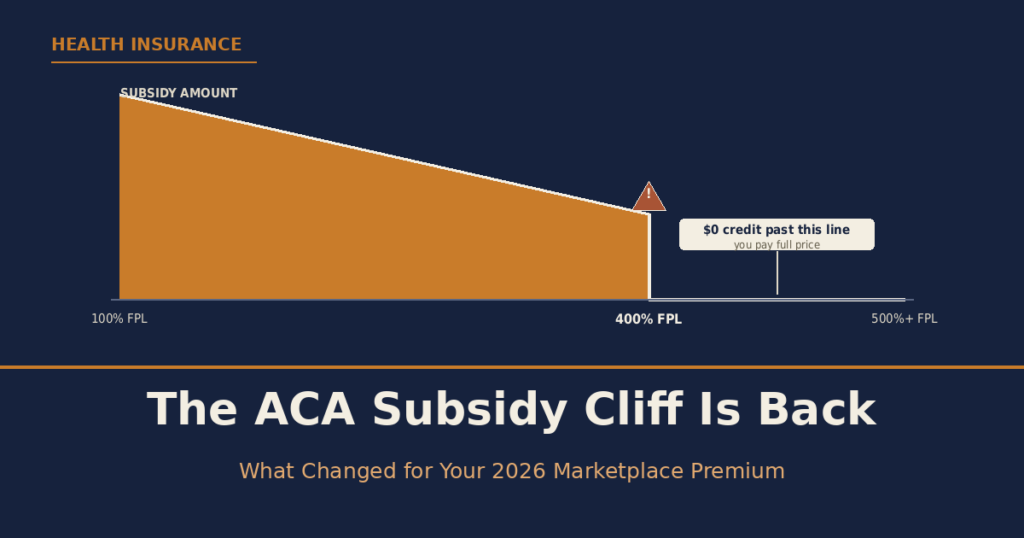
Since 2014, the ACA has offered premium tax credits to help eligible households afford Marketplace coverage. Originally, that help was limited to households earning between 100% and 400% of the federal poverty level, and hitting that 400% mark meant losing the subsidy entirely, all at once. That hard cutoff is what’s meant by the “subsidy cliff.”
Starting in 2021, temporary enhancements eliminated that cliff. Households above 400% of the poverty level became newly eligible for help too, with their expected contribution toward a benchmark plan capped at 8.5% of income rather than facing zero support. These enhancements were extended through 2025, and during that stretch, ACA Marketplace enrollment grew dramatically, from around 12 million people in 2021 to a record 24 million or more by 2025.
What Actually Changed for 2026
The enhanced subsidies expired at the end of 2025, and Congress did not pass legislation to extend them before that deadline. As a result, the original, pre-2021 subsidy structure is back in effect for 2026: premium tax credits are available only to households between 100% and 400% of the federal poverty level, and the cliff at 400% has returned.
For 2026, that 400% threshold works out to approximately $62,600 for a single person, roughly $84,600 for a two-person household, and around $128,600 for a family of four, based on the poverty guidelines used for 2026 coverage. Cross that line by even a small amount, and your household’s eligibility for any premium tax credit drops to zero, not a reduced amount.
This is a legislative outcome, not a permanent feature of the law. The underlying premium tax credit itself doesn’t expire and continues to exist going forward. What lapsed was specifically the temporary provision that expanded eligibility and increased the subsidy amount. Some members of Congress have pushed to extend or restore the enhancements, while others have opposed doing so without other changes attached, and the outcome of that debate could still affect future plan years.
Who This Actually Affects Most
Not every Marketplace enrollee feels this the same way. Data from KFF indicates that consumers with incomes above the subsidy cliff made up a relatively small share of 2025 enrollment overall, but accounted for a disproportionate share of people who dropped or reduced coverage heading into 2026, once the enhanced subsidies ended.
Older enrollees face a particularly steep impact. Because ACA premiums are allowed to vary more by age than by most other factors, someone in their late 50s or 60s pays substantially more for the same plan than a younger enrollee, which means losing a subsidy hits that age group’s monthly premium far harder in dollar terms.
Households with incomes below 400% of the poverty level generally continue to receive some premium tax credit under the restored original structure, though at a less generous level than what the enhanced subsidies had provided. Households below 100% of the poverty level don’t qualify for Marketplace premium tax credits at all; in the roughly 41 states plus Washington, D.C. that expanded Medicaid, many of these households qualify for Medicaid coverage instead, up to around 138% of the poverty level.
The Repayment Risk Worth Understanding
Here’s a detail that catches people off guard even when they’re aware of the cliff itself: premium tax credits are generally paid in advance, based on your estimated income for the year. If your actual income for 2026 ends up higher than what you originally reported, and that puts you over the 400% threshold, you may be required to repay the subsidy amount you received when you file your 2026 tax return.
This makes reporting income changes to your Marketplace promptly more important in 2026 than it was during the enhanced-subsidy years, when the cliff didn’t exist and a modest income increase couldn’t produce this kind of full repayment obligation. If your income looks like it’s approaching that threshold partway through the year, updating your Marketplace application as soon as you know matters, since it affects both your ongoing monthly premium and your eventual tax filing.
A Practical Example
Imagine a household of four with an income right around $125,000, comfortably under the roughly $128,600 threshold for 2026. This household remains eligible for a premium tax credit, calculated under the restored original ACA formula, even though that credit is less generous than what the temporary enhancements would have provided in prior years.
Now imagine a similar household with income around $130,000, just over the threshold. Despite the income difference being relatively small, this household’s premium tax credit eligibility doesn’t shrink gradually. It disappears entirely, and they’re responsible for the full, unsubsidized cost of their Marketplace plan.
This is exactly the “cliff” framing: the loss isn’t proportional to how far over the line you are. It’s a full drop-off right at the threshold.
What to Actually Do If You’re Near the Line
If your household income is close to the 400% threshold, a few legitimate strategies can help manage where you land. Contributions to a traditional IRA or an HSA, if you’re eligible, reduce your modified adjusted gross income, which is the figure used to determine subsidy eligibility. Timing certain income, where you have some control over it, such as deferring a bonus or a discretionary capital gain into a different year, can also affect which side of the threshold you land on for a given plan year.
None of these strategies are guaranteed to work for every household’s situation, and some involve real financial trade-offs beyond just the subsidy question. A conversation with a tax professional or a licensed Marketplace navigator, particularly if your income sits close to the cliff, is worth having before you assume either outcome.
Common Mistakes to Avoid
- Not reporting an income increase promptly. Waiting until tax time to discover you’ve crossed the threshold can mean a repayment obligation you didn’t see coming.
- Assuming the subsidy phases out gradually. It doesn’t. Crossing 400% eliminates the credit entirely, not partially.
- Ignoring Medicaid eligibility if your income is genuinely low. If your household falls under 100% of the poverty level, or under your state’s Medicaid expansion threshold, that coverage path may be available and worth checking directly.
- Assuming this year’s rules are permanent. This is an active legislative area, and future plan years could look different depending on what Congress does.
Final Thoughts
The return of the ACA subsidy cliff in 2026 changes the math meaningfully for anyone whose household income sits anywhere near 400% of the federal poverty level, and it reintroduces a real repayment risk for anyone whose income ends up higher than expected. Checking your current eligibility directly on HealthCare.gov or your state’s Marketplace, reporting income changes promptly, and talking to a tax professional if you’re close to the threshold are the most useful steps available given where this policy currently stands.
Disclaimer: This article is for general informational purposes only and does not constitute financial, legal, or tax advice. ACA subsidy rules, income thresholds, and eligibility criteria are subject to ongoing legislative change. Consult HealthCare.gov, your state’s Marketplace, or a licensed tax professional for advice about your specific situation.
Sources
- Congressional Research Service (CRS) — “Enhanced Premium Tax Credit and 2026 Exchange Premiums: Frequently Asked Questions,” congress.gov
- KFF — “What We Know So Far About 2026 ACA Marketplace Enrollment, Premiums, and Deductibles,” kff.org
- CNBC — “ACA subsidy cliff may mean ‘astronomical tax bills’ for many,” cnbc.com
- ASTHO — “ACA Enhanced Premium Tax Credits: Legislative Developments in 2025 and 2026,” astho.org