This guide covers business insurance in the United States. Coverage terms, costs, and legal exposure vary by state and industry, so review specific policy terms with a licensed commercial insurance broker.
A lot of business owners hear about employment practices liability insurance for the first time from an HR peer who just went through a claim, or from a close call of their own. The reaction is usually the same: their general liability policy, the one they assumed covered everything, doesn’t cover this at all. Good management and fair treatment reduce the odds of a claim. They don’t eliminate the cost of defending one, and that cost alone can be enough to hurt a small business badly.
What EPLI Actually Covers
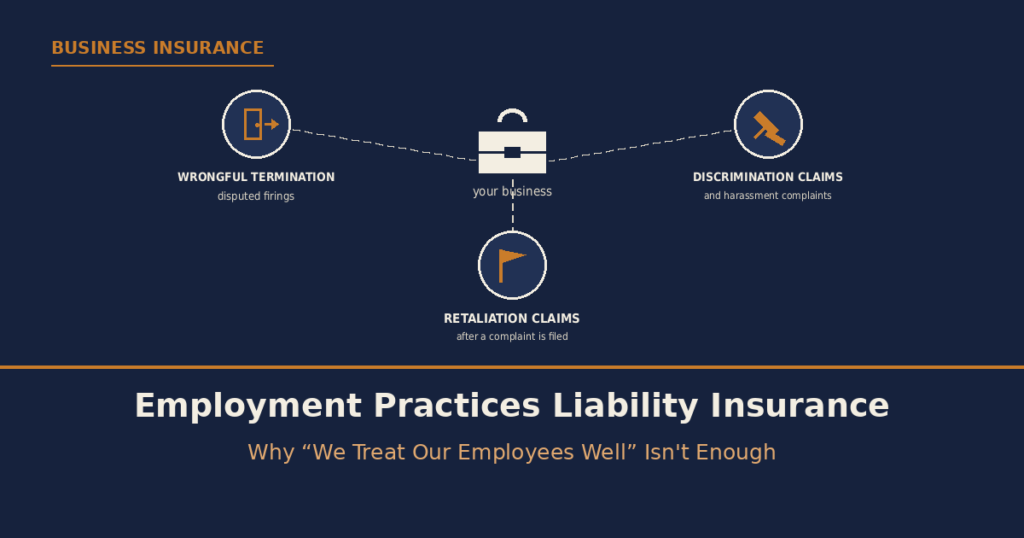
Employment practices liability insurance, commonly shortened to EPLI, covers claims alleging wrongful acts in the employment relationship: discrimination, harassment, retaliation, and wrongful termination. It responds to lawsuits brought by employees, former employees, and in some cases job applicants who believe they were treated unfairly in hiring, employment, or termination decisions.
The specific claim types EPLI typically addresses include discrimination based on protected characteristics like age, race, sex, religion, or disability; sexual or other workplace harassment; retaliation against an employee for reporting misconduct or filing a complaint; wrongful termination; and failure to hire based on a discriminatory reason.
The Feature That Makes This Coverage Genuinely Valuable
EPLI’s most important feature isn’t what it pays after a case is decided. It’s the duty to defend. The policy pays your legal defense costs, attorney fees, investigation expenses, court costs, from the moment a claim is filed, regardless of whether the allegations ultimately have merit.
This matters because legal defense costs alone can reach well into five or six figures, even for a claim that’s eventually dismissed or found to have no merit. Without EPLI, a business absorbs those costs entirely out of pocket, win or lose. If a claim does result in a settlement or judgment, the policy can also cover that payment, up to your policy’s limit.
Why Your Other Policies Don’t Cover This
It’s a common and understandable assumption that general liability insurance, which covers a broad range of third-party claims, would extend to employment disputes too. It doesn’t. General liability is built around bodily injury and property damage claims. Employment-related claims fall into an entirely different risk category, which is exactly why EPLI exists as separate, standalone coverage.
EPLI generally isn’t included in a standard Business Owner’s Policy either. Some carriers offer it as an add-on endorsement to a BOP, but the coverage limits and terms in that form are typically narrower than a standalone EPLI policy. If you’re relying on a bundled policy for this protection, confirming the actual limit and scope with your broker is worth doing directly rather than assuming it matches a standalone policy’s coverage.
EPLI is also worth distinguishing from a similarly named but different coverage: employee benefits liability, which covers administrative errors in managing benefit plans, like incorrectly enrolling an employee in the wrong health plan. The two get confused because they both involve employees, but they respond to fundamentally different situations.
Who Actually Needs This
Any business with employees carries some exposure to employment practices claims, regardless of how carefully it manages its workforce. Businesses without a dedicated HR department or in-house legal counsel, which describes most small businesses, tend to be particularly exposed, since they generally have fewer internal safeguards and less specialized guidance in place when a personnel dispute escalates.
Certain business types face somewhat elevated exposure due to the nature of their work: businesses with frequent client contact and smaller, close-knit teams, companies with significant hiring and turnover, and industries with a history of higher claim frequency. That said, the underlying exposure exists for essentially any employer, not just these categories specifically.
What It Actually Costs
Cost figures across several independent industry sources converge reasonably closely. Multiple sources report an average small business premium in the range of roughly $220 to $260 per month, translating to a median annual cost somewhere around $2,650 to $2,700. The broader range across different business sizes and risk profiles runs considerably wider, from around $750 up to well over $10,000 annually, depending heavily on employee count, industry, claims history, and the specific coverage limit and deductible you choose.
Employee count is generally described as the single biggest driver of premium, followed by industry type and claims history. A common average deductible cited across sources is around $10,000, though this varies by policy and can be adjusted, with a higher deductible generally lowering the premium.
Given how much your specific cost depends on your business’s particular risk profile, treating any of these figures as a rough planning reference rather than a personal quote, and getting current quotes directly, is the more reliable approach.
A Practical Example
Imagine a small business terminates an underperforming employee after documented performance issues. The former employee later files a claim alleging the termination was actually based on age discrimination, an allegation the business believes is untrue and unsupported.
Without EPLI, the business would need to fund its own legal defense entirely, potentially into the tens of thousands of dollars, even if the claim is eventually dismissed for lack of merit. With EPLI in place, the policy’s duty to defend covers those legal costs from the point the claim is filed, regardless of how the case ultimately resolves. If the case did result in a settlement, the policy would also apply toward that cost, up to the policy’s limit.
The business’s actual conduct in this scenario doesn’t change. What changes is who bears the cost of defending it, and how much financial disruption that defense causes along the way.
Common Mistakes to Avoid
- Assuming fair treatment eliminates the need for coverage. Claims can be filed regardless of merit, and legal defense costs accrue either way.
- Assuming a Business Owner’s Policy already includes this. It generally doesn’t, and where an EPLI endorsement exists, its limits are typically narrower than a standalone policy.
- Choosing a deductible without considering your business’s actual cash flow. A lower premium with a high deductible only helps if you can genuinely absorb that deductible when a claim arrives.
- Not reviewing coverage as headcount grows. A business that started with a handful of employees and has since scaled up carries meaningfully more exposure than its original policy may have been priced for.
What to Actually Do Next
Talk to a licensed commercial insurance broker about your specific employee count, industry, and any past claims history, since these are the factors that most directly shape both your premium and the coverage limit that makes sense for your business. It’s also worth asking whether EPLI can be bundled with related management liability coverage, like directors and officers insurance, since combining these is common and can sometimes improve overall pricing.
Final Thoughts
Employment practices liability insurance addresses a risk that exists the moment a business has employees, independent of how well that business actually treats its workforce. The defense-cost protection alone, regardless of a claim’s merit, is often what makes this coverage worth carrying, since legal defense costs can be substantial even for claims that go nowhere. Confirming you’re not relying on a policy that doesn’t actually include this protection is worth a direct conversation with your broker.
Disclaimer: This article is for general informational purposes only and does not constitute financial, legal, or insurance advice. Coverage terms, costs, and legal exposure vary by state, industry, and individual business, and can change over time. Contact a licensed commercial insurance broker or an employment attorney for advice about your specific business.
Sources
- Insureon — “Employment Practices Liability Insurance (EPLI),” insureon.com
- TechInsurance — “Employment Practices Liability Insurance (EPLI) Cost,” techinsurance.com
- Vouch — “Employment Practices Liability Insurance (EPLI): A 2026 Guide,” vouch.us
- U.S. Equal Employment Opportunity Commission (EEOC) — eeoc.gov