This guide covers car insurance in the United States. Notification requirements, discounts, and typical cost increases vary by state and insurer, so confirm specifics with your own carrier.
The learner’s permit arrives, and not long after, so does a very different insurance bill. Teen drivers are consistently the most expensive drivers to insure, and the reasons behind that, along with the choices that actually affect the final cost, are worth understanding before the premium increase catches you off guard.
Why Teen Drivers Cost So Much More to Insure
The pricing isn’t arbitrary. Teen drivers, particularly those between 16 and 19, are involved in crashes at a meaningfully higher rate per mile driven than older, more experienced drivers, across virtually every crash severity category. That risk translates directly into claim frequency and claim size, which is what insurers are pricing when they calculate a teen surcharge.
This isn’t a judgment on any individual teen’s driving ability. It reflects inexperience as a category: less time reading traffic patterns, slower hazard recognition, and a statistically higher likelihood of the kind of driving errors that lead to claims. Rates gradually decline as teens age and build a clean driving record, and by the mid-20s, premiums are typically much closer to standard adult rates.
Do You Actually Have to Add Your Teen to Your Policy?
Most insurers don’t require a teen to be added the moment they get a learner’s permit, though many do apply added cost once a teen holds a full license and drives regularly. Requirements vary by insurer, so confirming your specific carrier’s policy is worth doing directly rather than assuming.
That said, insurance professionals generally advise notifying your insurer as soon as your teen has a permit, even if it isn’t strictly required yet. Driving uninsured, or with a driver your insurer doesn’t know about, is a real risk if an accident happens before you’ve made the notification, potentially leaving a claim disputed or denied at the worst possible time.
Adding Your Teen to Your Policy vs. a Separate Policy
Teens under 18 generally can’t purchase their own auto insurance policy without a parent or guardian involved, since they can’t independently enter into the contract. But even where a separate policy is technically possible for an older teen, it’s consistently the more expensive route.
Across multiple industry analyses, adding a teen to an existing family policy comes out meaningfully cheaper than insuring that same teen on a standalone policy, commonly by a wide margin. The exact dollar figures vary considerably by source, state, coverage level, and the teen’s age and gender, so treat any specific number you see elsewhere as an estimate rather than a personal quote. What’s consistent across sources is the direction: keeping a teen on the family policy is almost always the lower-cost path.
What Actually Moves the Price
A handful of specific factors influence how much adding a teen actually costs.
Age. The youngest teen drivers, 16 and 17, see the steepest cost increases. That cost gradually declines through the late teens and early 20s as a driving record builds.
Gender. Male teen drivers typically cost more to insure than female teen drivers, reflecting differences in claim statistics by group, though this gap narrows with age.
Vehicle. A sportier or higher-value vehicle costs meaningfully more to insure than a practical, high-safety-rated one. Putting a teen driver on an older, safer, less powerful car is one of the more direct ways to control the added cost.
Driving designation. Some insurers let you designate a teen as the primary driver of a specific vehicle rather than an all-purpose additional driver on every car in the household, which can affect pricing depending on the company’s specific rating rules.
Discounts Worth Asking About
Several discounts specifically target teen drivers, though availability and size vary by insurer.
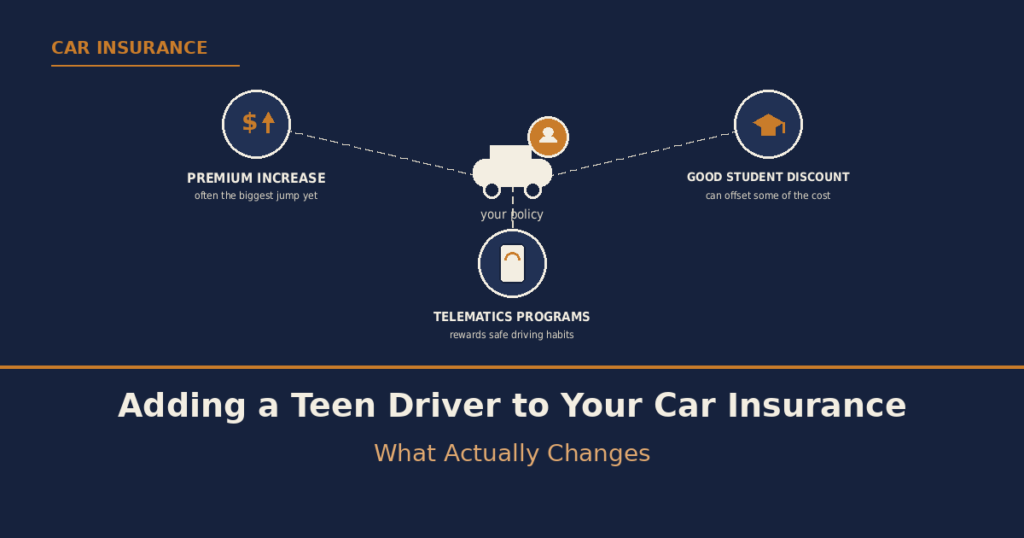
Good student discounts reward a strong GPA, based on the reasoning that academic responsibility correlates with more responsible driving. Driver’s education or defensive driving course completion is commonly discounted, and some states actually require insurers to offer this discount by law. Telematics or usage-based programs that track actual driving behavior can reduce costs for teens who drive safely, monitored through an app or plug-in device. Away-at-school discounts apply if a teen attends college a meaningful distance from home, commonly around 100 miles or more, without a car on campus, since insurers treat this as substantially reduced driving exposure.
Stacking several of these discounts together can meaningfully reduce the overall surcharge, though the combined effect varies by insurer and by which discounts your teen actually qualifies for.
A Practical Example
Imagine a family adding their 16-year-old to their existing auto policy, choosing to have them primarily drive an older, safe, moderately priced sedan rather than a newer sports car. The teen completes a state-approved driver’s education course and maintains a strong GPA, qualifying for both a good student discount and a driver’s education discount.
Compare that to a different family whose teen drives the newest, more powerful vehicle in the household, with neither discount applied. Even with similar base rates from the same insurer, the total added cost between these two households could differ substantially, purely based on vehicle choice and discount eligibility, on top of the base teen-driver surcharge every insurer applies to some degree.
Common Mistakes to Avoid
- Waiting to notify your insurer until after your teen is fully licensed. Getting ahead of it, even at the learner’s permit stage, keeps your coverage and claims history clean if something happens early on.
- Not asking about every available discount. Good student, driver’s education, telematics, and away-at-school discounts aren’t always applied automatically, and some require you to specifically request them.
- Assuming your current insurer offers the best teen rates. Rates for teen drivers vary considerably between companies, and shopping around periodically, even every couple of years, can reveal meaningful savings a single insurer won’t offer on its own.
- Underestimating liability coverage needs with a new, higher-risk driver on the policy. Some agents recommend increasing liability limits specifically when a teen driver joins the household, given the statistically higher accident risk during these years.
Final Thoughts
Adding a teen driver to your policy is expensive almost everywhere, for reasons rooted in real crash statistics rather than arbitrary pricing. Keeping them on your existing family policy rather than a standalone one, choosing a safer and less powerful vehicle for them to drive, and stacking every discount they qualify for are the levers most within your control. None of them make the cost disappear, but together they can meaningfully narrow the gap between what you’d pay without any planning and what you’ll actually owe.
Disclaimer: This article is for general informational purposes only and does not constitute financial, legal, or insurance advice. Notification requirements, discount availability, and cost increases vary by state, insurer, and individual circumstances, and can change over time. Contact your insurance provider for details specific to your policy and state.
Sources
- Insure.com — “Do you have to add a teenage driver to your car insurance policy?,” insure.com
- State Farm — “Car Insurance for Teens,” statefarm.com
- AAA Club Alliance — “Adding Teens to Your Car Insurance: Costs, Coverage, and Savings,” cluballiance.aaa.com
- MoneyGeek — “Adding Your Child to Car Insurance,” moneygeek.com