
This guide covers life insurance in the United States. Rider availability, definitions, waiting periods, and costs vary significantly by insurer, so confirm the specific terms of any rider directly with the carrier before relying on it.
A base life insurance policy does one thing: it pays a death benefit when you die. Riders are optional add-ons that extend what the policy does beyond that single event, sometimes for a genuine gap in protection, sometimes for a cost that doesn’t clearly pay for itself. Knowing which riders address a real risk in your specific situation, rather than adding every option available, is what makes this part of buying a policy worth thinking through carefully.
What a Rider Actually Is
A rider modifies your base policy, either by adding a new benefit, changing how the death benefit can be used, or extending coverage to someone beyond the primary insured. Some riders come standard on many modern policies at no additional cost. Others are priced separately and add to your premium, sometimes by a small amount, sometimes meaningfully.
Because rider availability, definitions, and pricing vary considerably between insurers, the same rider name can mean somewhat different things depending on which company’s policy you’re looking at. Reading the actual rider language, not just its name, matters more here than with most parts of a policy.
The Riders Most Commonly Included at No Extra Cost
Accelerated Death Benefit
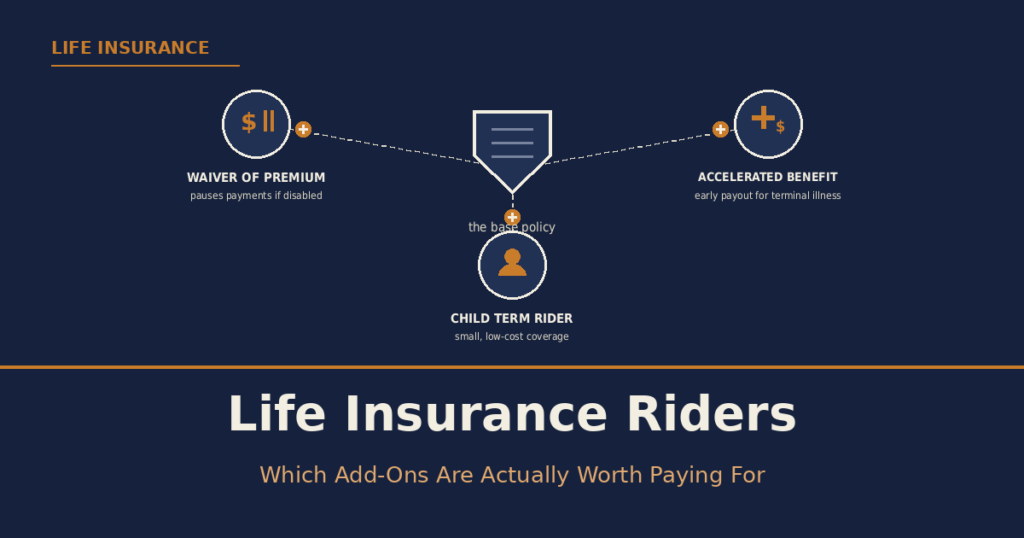
This rider lets you access part of your death benefit while you’re still alive if you’re diagnosed with a qualifying terminal illness, commonly defined as a prognosis of a limited time left to live, though the exact definition varies by policy. Many carriers now include a basic version of this rider automatically on both term and permanent policies, and some have expanded it in recent years to also cover certain chronic or critical illnesses, like a major heart attack, stroke, or invasive cancer diagnosis.
The trade-off is straightforward: whatever amount you access while alive reduces the death benefit your beneficiaries eventually receive. Some insurers also apply administrative fees, commonly in a range of roughly 2% to 4% of the accelerated amount, or interest charges on the advance. For a permanent policy with cash value, accelerating the benefit can also reduce the cash value available for future loans or withdrawals.
Since this rider is now included on many policies as a standard feature rather than an added cost, it’s worth confirming your specific policy already includes it before assuming you need to pay extra for it elsewhere.
Riders That Typically Add to Your Premium
Waiver of Premium
If a qualifying disability leaves you unable to work, this rider allows your premiums to be waived, keeping your policy active without requiring payments you can’t afford. Coverage generally requires meeting the policy’s specific disability definition and satisfying a waiting period, often around six months, before the waiver actually kicks in.
This rider tends to matter most for people whose income depends heavily on their own ability to work, particularly in physically demanding or higher-risk occupations, or for anyone who is their household’s sole income earner. Losing a policy to a lapse during a period of disability, precisely when the coverage might matter most, is the exact scenario this rider protects against.
Child Term Rider
This adds a relatively small amount of term coverage for your children under your own policy, typically at a low added cost. It’s generally not meant as meaningful financial protection on its own, more a way to ensure a modest benefit is available to cover final expenses if the unthinkable happens, and some versions let a child convert the coverage to their own permanent policy later without new underwriting.
Guaranteed Insurability Rider
This allows you to purchase additional coverage at set future points, or after specific life events like marriage or the birth of a child, without new medical underwriting. It suits younger, currently healthy buyers who want to lock in the ability to increase coverage later even if a future health issue would otherwise complicate qualifying for more.
Accidental Death Rider
This pays an additional benefit if death results from a covered accident, on top of the base death benefit. It’s typically inexpensive, but it’s also narrow in what it actually protects against, since most deaths aren’t classified as accidental under the rider’s terms.
Return of Premium Rider
This refunds the premiums you paid if you outlive your term policy, rather than the coverage simply expiring with nothing returned. It sounds appealing, but it meaningfully increases your premium, often substantially more than the accelerated death benefit or waiver of premium riders. Whether that trade-off is worth it depends on how you’d otherwise use the money you’d spend on the higher premium; investing the difference elsewhere may outperform waiting for a premium refund, though that comparison depends on your own financial situation and risk tolerance.
Weighing Whether a Specific Rider Is Worth It
A rider is generally worth adding when it addresses a real, specific gap for your situation, not simply because it’s available. A single person with no dependents may find little value in a child term rider. Someone in a physically demanding job with no other income protection may find real value in a waiver of premium rider. A family relying heavily on one income, with young children and a large mortgage, may reasonably prioritize guaranteed insurability to preserve the ability to increase coverage later.
A Practical Example
Imagine two people, each buying similar $1 million term policies at similar base premiums.
The first buys the base policy alone. Years later, a disability leaves them unable to work for an extended period. Without a waiver of premium rider, they’re responsible for continuing to pay premiums during a period when their income has stopped, and missing payments risks losing the policy entirely, right as their family’s need for it may be greatest.
The second added a waiver of premium rider and a basic child term rider when they bought their policy, for a modest increase to their monthly premium. When they face a similar disability years later, the waiver of premium rider keeps their policy active without requiring payments they can’t currently afford, and their children retain a small amount of coverage throughout.
The added cost was real in both cases, small as it was. Only one of these two outcomes reflects it having done its job.
Common Mistakes to Avoid
- Adding every available rider without evaluating your actual risk. Riders add cost, and not every one addresses a gap that applies to your specific situation.
- Assuming a rider is included when it’s actually priced separately, or vice versa. Confirm directly with the insurer which riders come standard on your specific policy and which are add-ons.
- Not reading the rider’s specific definitions. Terms like “terminal illness” or “total disability” carry precise, sometimes narrow definitions that determine whether you’d actually qualify when it matters.
- Overlooking fees or interest tied to accelerated benefit riders. Accessing the benefit early is not the same as receiving your full death benefit for free; understand the reduction and any associated costs before relying on it as a financial plan.
Final Thoughts
Riders let you shape a policy around risks a standard death benefit doesn’t address on its own: disability, terminal illness, a child’s future insurability, or outliving a term policy. Some come free with many modern policies. Others add real cost, and are only worth that cost when they match a genuine gap in your own situation. Comparing rider terms across a few insurers, rather than accepting whatever a single carrier includes by default, is worth the extra time before finalizing a policy.
Disclaimer: This article is for general informational purposes only and does not constitute financial, legal, or insurance advice. Rider availability, definitions, waiting periods, fees, and costs vary by insurer and policy, and can change over time. Consult a licensed insurance agent for advice about your specific situation.
Sources
- United Policyholders — “Four life insurance riders to consider – and two to avoid,” uphelp.org
- NerdWallet — “Life Insurance Riders: What You Need to Know,” nerdwallet.com
- Aflac — “Understanding the Life Insurance Waiver of Premium Rider,” aflac.com