This guide covers car insurance in the United States. Program details, discount structures, and data practices vary significantly by insurer, so review a specific program’s terms directly before enrolling.
Car insurance has traditionally priced you based on broad categories: your age, your ZIP code, your credit-based insurance score, your claims history. Usage-based insurance, often called telematics, adds a more direct input into that pricing: data about how you actually drive. It can mean real savings for some drivers. It also means handing your insurer a more detailed picture of your driving than they’ve ever had access to before, which is worth understanding clearly before you opt in.
How It Actually Works
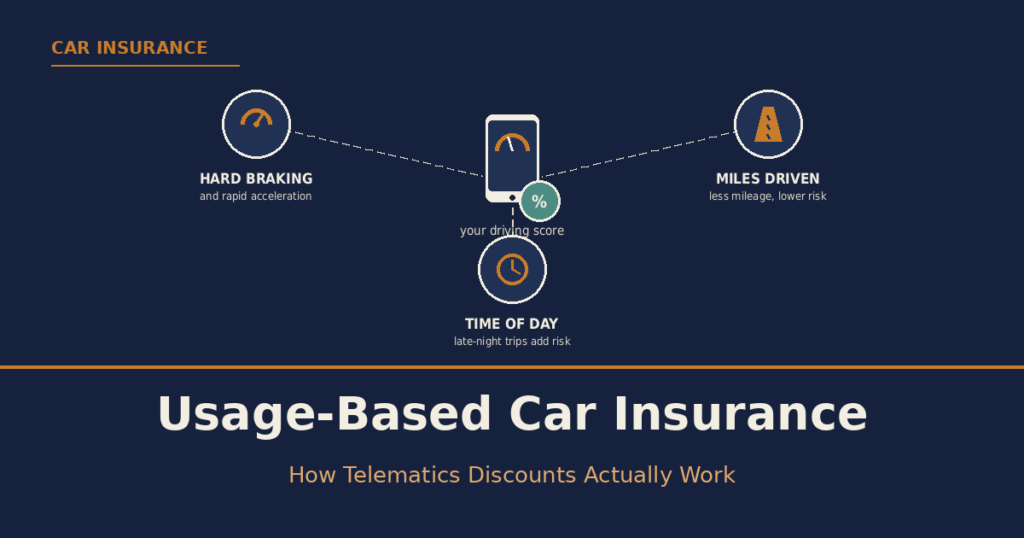
You enroll in an insurer’s program, then share driving data through one of a few methods: a smartphone app, a small plug-in device connected to your car, or, increasingly, built-in telematics already present in newer vehicles. The system records selected driving characteristics over a monitoring period, and the insurer uses that data to build a driving profile or score.
That score can influence your discount, or in some program structures, your actual renewal rate going forward, not just an initial sign-up bonus. Program design varies meaningfully by insurer, so the specific mechanics, and what happens to your rate over time, are worth confirming directly rather than assuming all programs work the same way.
Two Different Models, Not One Product
Usage-based insurance isn’t a single thing. It generally splits into two distinct approaches.
Behavior-based programs keep your traditional policy structure in place and add a safe-driver discount tied to how you drive: smooth acceleration and braking, avoiding hard stops, limiting heavy late-night driving. Your base rate structure stays largely the same, with the telematics data layered on top as a discount opportunity.
Pay-per-mile, or mileage-based, programs work differently. You pay a small base rate plus a per-mile charge tied to your actual mileage. This model suits low-mileage drivers specifically, since your premium scales down directly with how little you drive, rather than being based on an estimated annual mileage figure.
Some insurers offer both models as separate products, so it’s worth confirming which structure a specific program actually uses before enrolling, since the two work quite differently.
What Discounts Actually Look Like
Discount ranges vary considerably by insurer and by how well your recorded driving habits align with what the program rewards. Based on a Consumer Reports analysis of major carriers, advertised maximum discounts have included figures like up to 40% from Allstate and Nationwide, up to 30% from Liberty Mutual, State Farm, Travelers, and USAA, up to 25% from GEICO, up to 20% from American Family, and up to 15% from Farmers, with some insurers also offering a smaller discount, often 5% to 10%, simply for enrolling before any driving data is even collected.
These are advertised maximums, not typical or guaranteed outcomes. Your actual discount depends on your specific driving data measured against that insurer’s program, and it commonly takes a few months of data collection before the full telematics-based discount kicks in.
Fewer People Actually Use These Programs Than You’d Expect
Despite how often telematics gets marketed, actual enrollment remains modest. The same Consumer Reports research, based on a large 2024 survey of American policyholders, found that only about 28% of respondents even knew whether their insurer offered a telematics program, and only around 14% had actually used telematics with their current insurer.
That gap between marketing visibility and actual usage is worth keeping in mind. A large discount is only real if you actually qualify for it, and plenty of policyholders either don’t know the option exists or decide, after learning the details, that it isn’t the right fit for their driving pattern.
The Privacy Trade-Off Is Real, Not a Footnote
Enrolling in a usage-based program means sharing detailed data about your driving, and depending on the program and collection method, that can include location, time of day, trip frequency, and specific driving behaviors like hard braking or phone use while driving.
App-based programs tend to collect the broadest range of data, since they can combine GPS location, phone sensor data, and route information. Plug-in devices and built-in vehicle systems often collect a narrower set of driving-specific data, though this varies by program.
Before enrolling, it’s worth reading the program’s specific privacy terms: what’s collected, how long it’s retained, whether it can be shared with third parties, and whether it affects only your discount or your broader renewal pricing. Discounts aren’t guaranteed with most behavior-based programs, meaning the realistic worst case for many is a smaller discount than advertised rather than a rate increase, but confirming that a specific program is genuinely discount-only, rather than one that could raise your rate based on the data, is worth doing before you enroll.
Who Tends to Benefit Most
Usage-based insurance tends to work best for drivers with smooth, consistent driving habits, predictable schedules, and lower-risk driving hours, since these patterns align well with what most programs measure and reward. Low-mileage drivers, including remote workers, retirees, and households with a secondary vehicle that’s rarely used, are often the strongest fit for pay-per-mile programs specifically.
Drivers who cover long distances regularly, or whose driving style includes frequent hard braking or acceleration even if generally safe, may find these programs offer little benefit, or in some cases work against them, depending on how the specific program scores that behavior.
A Practical Example
Imagine two drivers considering the same insurer’s telematics program.
The first drives a short, consistent daytime commute, rarely brakes hard, and puts on well below average annual mileage. For this driver, a behavior-based or pay-per-mile program is likely to reflect genuinely lower risk, and the resulting discount is likely to meaningfully outweigh the privacy trade-off of sharing driving data.
The second drives long highway distances for work, often at night, with a driving style that includes more aggressive braking during unpredictable traffic. For this driver, the same program might produce a smaller discount than advertised, or in a behavior-scored model, could reflect a risk profile the insurer doesn’t reward, making the traditional pricing model, based on broader rating factors rather than individual trip data, potentially the better fit.
Common Mistakes to Avoid
- Assuming the advertised maximum discount is what you’ll actually receive. It’s a ceiling, not a typical outcome, and your actual result depends on your specific driving data.
- Enrolling without reading the program’s specific privacy terms. Data collection scope, retention, and third-party sharing vary meaningfully by program.
- Not confirming whether the program is discount-only or affects your broader rate. This distinction matters more than the advertised percentage itself.
- Assuming all usage-based programs work the same way. Behavior-based and pay-per-mile are genuinely different products, sometimes offered by the same insurer.
Final Thoughts
Usage-based insurance can offer real savings for drivers whose actual habits are lower-risk than what traditional rating factors alone would suggest. It also asks you to trade a meaningful amount of driving data for that opportunity, and the size of both the discount and the privacy trade-off vary considerably by program and insurer. Reading a specific program’s actual terms, rather than reacting to an advertised maximum discount, is what makes this a genuinely informed decision rather than a bet on marketing.
Disclaimer: This article is for general informational purposes only and does not constitute financial, legal, or insurance advice. Program structures, discount amounts, data collection practices, and pricing rules vary by insurer and program, and can change over time. Review a specific program’s terms directly and contact your insurance provider for details about your situation.
Sources
- Consumer Reports — “Usage-Based Car Insurance Can Save You Money, but It Puts Your Data Privacy at Risk,” consumerreports.org
- Yahoo Finance — “What is usage-based insurance?,” finance.yahoo.com
- National Association of Insurance Commissioners (NAIC) — naic.org