
This guide covers rental car insurance in the United States. Coverage details depend on your specific auto policy, credit card, and the rental company involved, so confirm the specifics with each before you decline or accept coverage at the counter.
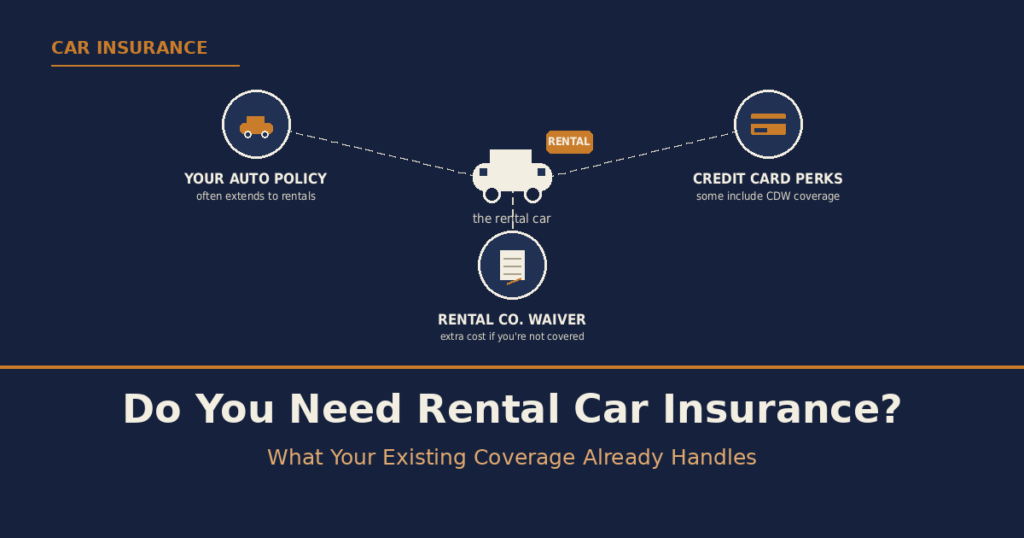
The rental counter question is familiar to almost every traveler: do you want to add insurance? It’s easy to either wave it off out of habit or add every option out of caution. Neither response is really informed, since the honest answer depends on what you already have covering you. Three sources potentially protect you already: your personal auto policy, your credit card, and the rental company’s own optional coverage. Understanding how they actually overlap is what makes the counter decision genuinely informed.
What Your Personal Auto Policy Already Covers
If you carry a personal auto insurance policy, it commonly extends to a rental car used for personal, non-business travel. Whatever coverage you carry on your own vehicle, liability, collision, comprehensive, generally applies at the same limits and the same deductible when you’re driving a rental.
That extension has real limits worth knowing before you assume you’re fully covered.
Business use often isn’t included. Personal auto policies typically limit coverage to personal use. A rental used for work travel, sales calls, or other business purposes may fall outside what your personal policy extends to cover, even for an otherwise ordinary rental.
Your coverage level carries over, gaps included. If your personal policy only includes liability coverage, that’s all that extends to the rental. Without collision or comprehensive on your own car, you likely don’t have it on the rental either.
Loss-of-use charges can be a gap. If the rental car is damaged and out of service for repairs, the rental company may bill you for the income they lost while it was unavailable. Many personal auto policies don’t cover this specific charge, which is one of the more common ways renters get an unexpected bill even with coverage otherwise in place.
What Your Credit Card Actually Adds
Many credit cards include some form of rental car coverage as a built-in benefit, but the details vary enormously by card issuer, and even by specific card within the same issuer’s lineup.
Primary vs. secondary matters a lot. Secondary coverage, the more common type, only pays after your personal auto insurance has been applied first. That means a claim still touches your personal policy, and could still affect your claims history, before the card coverage picks up the remainder. Primary coverage, offered by some premium cards, pays directly without involving your personal insurance first, which can help you avoid both your deductible and any impact on your personal policy’s claims record.
Activation has specific requirements. You typically need to pay for the entire rental with the eligible card, and specifically decline the rental company’s own collision damage waiver, for the card’s coverage to apply at all.
Coverage usually excludes liability. Credit card rental coverage typically addresses damage to the rental vehicle itself, not liability for injuries or damage you cause to other people or their property. That gap matters, since liability exposure is often the more financially serious risk.
Certain vehicles and situations get excluded. Luxury vehicles, trucks, and extended rental periods are commonly excluded or limited under credit card coverage. International rentals may or may not be covered depending on the card and the country, so checking your specific card’s benefits guide before an international trip is worth the ten minutes it takes.
What the Rental Company Actually Offers
At the counter, rental companies typically offer several distinct products, and it’s worth knowing they’re not all the same thing.
A collision damage waiver, sometimes called a loss damage waiver, releases you from responsibility for damage to the rental vehicle, including theft and vandalism. Supplemental liability coverage adds protection for injuries or damage you cause to others beyond what your personal policy or the rental company’s built-in minimum provides. Personal accident insurance covers medical costs for you and your passengers if you’re injured in an accident.
Rental companies generally carry state-minimum liability coverage on their vehicles in most states, though the details of what’s included, and how it interacts with your own coverage, vary by state and by company.
A Practical Example
Imagine a driver with a personal auto policy that includes full collision and comprehensive coverage, renting a car for a weekend personal trip and paying with a credit card that offers secondary rental coverage.
If the rental car is damaged in an accident, this driver’s personal auto policy responds first, subject to their existing deductible. Their credit card’s secondary coverage can then help cover that deductible and any remaining gap, once the personal policy claim is filed and processed. In this scenario, declining the rental company’s collision damage waiver is a reasonable choice, since two layers of coverage already apply.
Now imagine a different renter with no personal auto policy at all, renting a car for a business trip, paying with a card that only offers coverage for personal travel. Here, the personal auto extension doesn’t exist to begin with, the credit card coverage likely doesn’t apply because the trip is for business, and this renter is genuinely exposed without purchasing coverage from the rental company directly.
The same “do you want insurance” question at the counter has a completely different right answer for these two renters.
Common Mistakes to Avoid
- Assuming credit card coverage applies without checking the specifics. Card benefits change, vary by card tier, and often exclude vehicle types or trip types you might not expect.
- Forgetting to decline the rental company’s waiver when required. Some credit card coverage only activates if you specifically decline the counter’s own collision damage waiver, and forgetting this step can void the benefit.
- Not checking whether your trip counts as business use. This is one of the most common gaps, since personal auto and many credit card benefits explicitly exclude business travel.
- Overlooking liability entirely. Credit card coverage often skips liability, so if you’re not carrying it elsewhere, an accident that injures someone else could leave you personally exposed regardless of the rental car itself being covered.
Final Thoughts
There’s no universal answer to the rental counter question, only an answer that depends on what you’re actually bringing with you: your personal auto policy’s specifics, your credit card’s benefits, and the nature of your trip. Checking both before you travel, rather than deciding on the spot at the counter, is the only reliable way to know whether the rental company’s coverage is a genuine need or a redundant expense.
Disclaimer: This article is for general informational purposes only and does not constitute financial, legal, or insurance advice. Coverage terms vary by insurer, credit card issuer, rental company, and state, and can change over time. Review your policy documents and credit card benefits guide, and contact your insurer or card issuer directly, before deciding on rental car coverage for a specific trip.
Sources
- State Farm — “Rental Car Insurance: Is It Necessary?,” statefarm.com
- Progressive — “Rental Car Insurance: Do You Need It?,” progressive.com
- Liberty Mutual — “Rental car insurance, should you get it?,” libertymutual.com
- Allstate — “Do You Need Rental Car Insurance?,” allstate.com
- Capital One — “Credit Card Rental Car Insurance: How It Works,” capitalone.com