
This guide covers life insurance in the United States. Underwriting categories, coverage limits, and pricing vary by insurer, so confirm specifics directly with any carrier you’re considering.
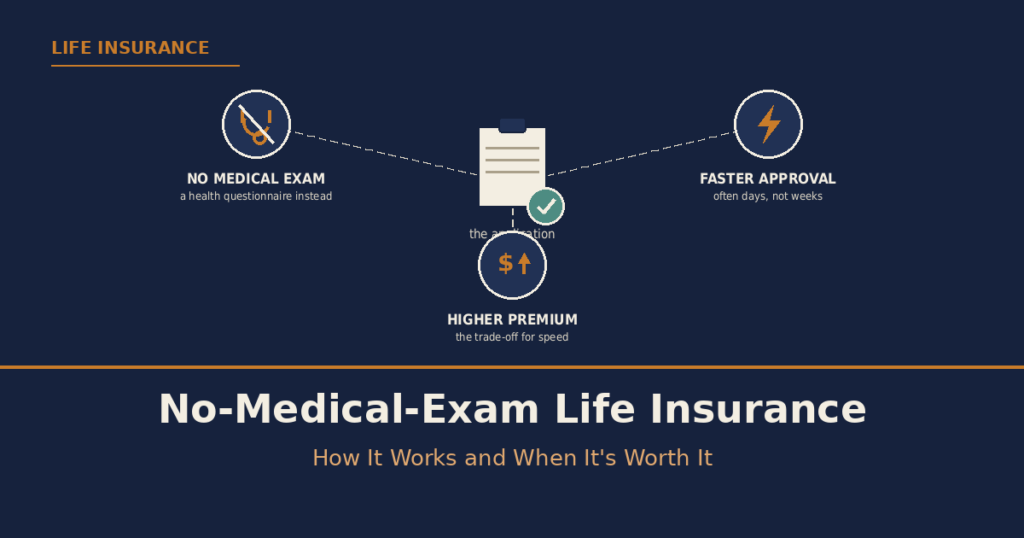
Scheduling a paramedical exam, then waiting weeks for blood work and a decision, is exactly the kind of friction that keeps people from buying life insurance in the first place. No-medical-exam policies exist to remove that friction. They’re not a single product, though. They’re a spectrum, and understanding where a given policy falls on it matters more than the “no exam” label alone.
Three Different Things Get Called “No-Exam”
The phrase covers three genuinely different underwriting approaches, and they don’t offer the same coverage, speed, or price.
Accelerated Underwriting
This is the closest to traditional underwriting, just without the physical exam. Instead of bloodwork, insurers pull prescription history, motor vehicle records, credit-based insurance scores, and sometimes electronic health records, then run that data through an algorithm to assess your risk.
Coverage limits here are the highest among no-exam options, commonly ranging up to $2 million or more depending on the carrier, with decisions often arriving within minutes to 48 hours for healthy applicants. Pricing is frequently comparable to a fully underwritten policy, since the insurer is still gathering substantial data, just electronically rather than through a physical exam.
The catch: if your data profile raises questions the algorithm can’t resolve, you may still get routed to a traditional exam rather than approved through the accelerated path.
Simplified Issue
This tier trades a physical exam for a short health questionnaire, typically somewhere between 5 and 15 yes-or-no questions, alongside a check of third-party data sources. No bloodwork, no physical, but also less information for the insurer to work with.
Coverage is more limited than accelerated underwriting, generally topping out somewhere in the range of $500,000 depending on the insurer. Because the insurer has less data than a fully underwritten application would provide, simplified issue policies tend to cost more than an equivalent accelerated or fully underwritten policy.
Guaranteed Issue
This is the most permissive tier: no health questions, no exam, and approval isn’t contingent on your health at all. It exists mainly for people in poor health seeking a smaller policy, often for final expenses, who wouldn’t qualify through the other paths.
Coverage amounts here are the smallest of the three, and premiums are the highest relative to the coverage provided. Guaranteed issue policies also typically include a graded death benefit for the first two to three years. If the insured dies from natural causes during that window, beneficiaries generally receive a refund of premiums paid plus interest rather than the full death benefit, with the full benefit only applying to deaths after the graded period ends, or in cases of accidental death from the start.
What You Give Up by Skipping the Exam
The trade-off isn’t really about convenience versus cost, since accelerated underwriting can be priced competitively with fully underwritten policies. The real trade-off is about information and eligibility.
A traditional exam gives the insurer more complete medical information, which can sometimes work in your favor, placing a genuinely healthy applicant into a lower-risk, lower-premium category that a data-only review might not fully capture. Certain health conditions can also disqualify you from the faster underwriting tiers even when you’d have qualified for standard rates through a traditional exam. Common disqualifiers for accelerated underwriting include recent cancer treatment, certain cognitive disorders, heart disease, and some autoimmune conditions, though this varies by insurer.
If you’re declined or routed away from a no-exam tier, that generally doesn’t mean you’re uninsurable. It usually just means the application moves to full underwriting with a traditional exam instead.
A Practical Example
Imagine two applicants, both 35 and in good health, each seeking $500,000 in 20-year term coverage.
The first applies through an accelerated underwriting carrier. The insurer reviews their prescription history and driving record, finds nothing concerning, and approves them within a day at a rate close to what a fully underwritten policy would have cost. They never see a nurse or provide a blood sample.
The second has a more complex health history involving a recent, still-being-monitored medical condition. The accelerated underwriting algorithm can’t resolve the uncertainty from data alone, so their application gets routed to full underwriting instead, requiring a traditional exam before a final decision and rate are issued.
Both outcomes are normal. Accelerated underwriting works well for straightforwardly healthy applicants, but it isn’t guaranteed to be the final word for everyone who applies through it.
Who No-Exam Coverage Actually Suits
Accelerated underwriting tends to suit healthy applicants who want meaningful coverage quickly, without the multi-week wait a traditional exam and lab review can involve. Simplified issue can work for people with minor, well-controlled health conditions who don’t need extremely high coverage limits. Guaranteed issue exists specifically for people in poor health who need a smaller policy and can’t qualify elsewhere, with the graded death benefit as a real limitation to understand going in.
Common Mistakes to Avoid
- Assuming all no-exam policies cost more. Accelerated underwriting can be priced comparably to fully underwritten coverage, so it’s worth comparing quotes rather than assuming skipping the exam always means paying a premium.
- Choosing guaranteed issue without understanding the graded death benefit. If your beneficiaries would need the full benefit immediately, this waiting period is a real limitation worth knowing about in advance.
- Not shopping multiple carriers. Underwriting criteria for what qualifies as “healthy enough” for accelerated underwriting vary meaningfully between insurers, so a decline at one carrier doesn’t mean the same result everywhere.
- Assuming a routing to full underwriting means a decline. It usually just means more information is needed, not that coverage is unavailable.
Final Thoughts
“No-exam” isn’t one product; it’s three different tiers with real differences in coverage limits, cost, and eligibility. Accelerated underwriting offers the closest experience to traditional coverage, often at a comparable price, for applicants in good health. Simplified issue and guaranteed issue exist further down that spectrum for people who need faster approval or have health conditions that would complicate a traditional application. Knowing which tier you’re actually looking at, rather than reacting to the “no exam” label alone, is what makes comparing policies genuinely useful.
Disclaimer: This article is for general informational purposes only and does not constitute financial or insurance advice. Underwriting categories, coverage limits, pricing, and eligibility criteria vary by insurer and change over time. Consult a licensed insurance agent for advice about your specific situation.
Sources
- U.S. News & World Report — “Best No-Exam Life Insurance Companies of 2026,” usnews.com
- Forbes Advisor — “Best No-Exam Life Insurance Companies of 2026,” forbes.com
- National Association of Insurance Commissioners (NAIC) — Consumer Guide to Life Insurance, naic.org