This guide covers homeowners insurance in the United States. Specific policy structures vary by insurer, so confirm which coverage basis applies to each part of your policy directly with your provider.
A house fire or a stolen laptop is stressful enough without discovering your payout is thousands of dollars short of what you actually need to replace what you lost. That gap usually comes down to one overlooked detail buried in your policy: whether your coverage is based on replacement cost or actual cash value. They sound similar. The dollar difference between them often isn’t.
The Core Difference
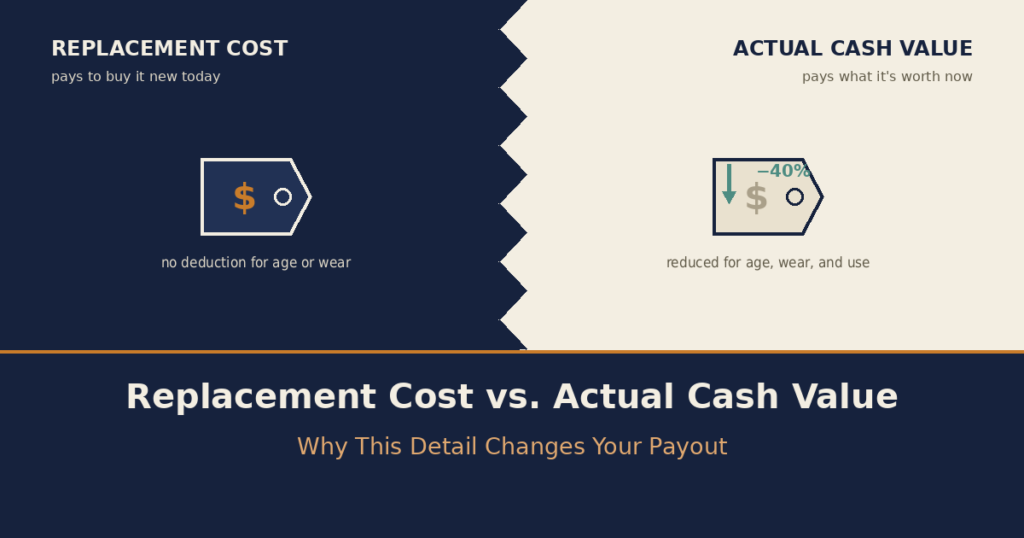
Replacement cost coverage pays what it actually costs to repair or replace your damaged property with something new, of similar kind and quality, at today’s prices. It doesn’t subtract anything for age or wear.
Actual cash value, often shortened to ACV, pays that same replacement cost minus depreciation. Depreciation accounts for age, wear, and condition, which means an older item is worth less under this method, even though replacing it new would cost the same as replacing a newer one.
The practical result: replacement cost gets you enough money to actually buy a new equivalent item. Actual cash value often doesn’t, and the gap grows the older the damaged item was.
A Practical Example
Imagine a roof that’s 10 years old gets destroyed in a storm, and replacing it today would cost $20,000.
Under replacement cost coverage, your insurer pays close to that full $20,000, minus your deductible. You come out with enough to actually replace the roof.
Under actual cash value coverage, your insurer subtracts a decade’s worth of depreciation from that $20,000 figure first. Depending on the depreciation schedule your insurer applies, the payout might land somewhere around $5,000, minus your deductible. You’d likely need to cover several thousand dollars out of pocket to fully replace the same roof.
Same damage, same replacement cost, but a meaningfully different check depending on which coverage basis your policy uses.
How This Applies to Different Parts of Your Policy
This distinction doesn’t apply uniformly across your entire policy, and that inconsistency catches people off guard.
Dwelling Coverage
Most homeowners policies cover the structure of your home itself, the dwelling, on a replacement cost basis by default. If your home is damaged or destroyed, your policy is generally designed to pay what it costs to rebuild it with similar materials and quality, without subtracting for the home’s age. Certain individual components, your roof being a common example, may be handled differently and covered at actual cash value even within an otherwise replacement-cost policy. Check your specific policy language rather than assuming your entire dwelling coverage works the same way in every scenario.
Personal Property Coverage
Your belongings, furniture, electronics, clothing, and everything else inside your home, work differently. Many policies default to actual cash value for personal property unless you specifically add replacement cost coverage, usually for an additional premium. This is the area where the ACV-versus-RCV decision most directly affects what you’d actually receive after a claim involving your belongings.
Guaranteed and Extended Replacement Cost
Some insurers offer an enhanced version of replacement cost coverage worth knowing about, particularly if construction costs in your area have risen sharply.
Extended replacement cost adds a buffer above your policy’s stated dwelling coverage limit, often capped around 20% over that amount, in case rebuilding costs exceed what you originally insured for. Guaranteed replacement cost goes further, covering the full cost of rebuilding even if it exceeds your policy limit by more than that buffer, though this option isn’t available from every insurer and often costs more.
If construction costs have risen significantly since you last reviewed your policy, either option is worth asking your insurer about directly.
Why Some Policies Still Use Actual Cash Value
If replacement cost coverage generally provides better protection, it’s fair to ask why actual cash value exists at all. The answer is cost. ACV policies typically carry lower premiums, which can make coverage more affordable for policyholders willing to accept a smaller payout in exchange for a lower monthly cost.
For some homeowners, particularly those with older belongings they wouldn’t necessarily replace with brand-new equivalents anyway, that trade-off might be reasonable. For others, especially those who’d be genuinely unable to cover the gap out of pocket after a major loss, the added cost of replacement cost coverage is generally worth it.
Common Mistakes to Avoid
- Assuming your entire policy uses the same coverage basis. Dwelling coverage and personal property coverage are frequently handled differently, and specific components like roofs sometimes differ from the rest of the dwelling.
- Not reviewing your coverage as prices rise. If your dwelling coverage limit hasn’t kept pace with local construction costs, even replacement cost coverage might fall short without an extended or guaranteed rider.
- Confusing market value with replacement cost. Your home’s market value reflects what it would sell for, including the land. Replacement cost reflects what it would cost to rebuild the structure alone, and the two numbers are often quite different.
- Not asking whether you can upgrade personal property to replacement cost. Many insurers allow this for an added premium, and it’s a straightforward conversation to have at renewal.
Final Thoughts
The difference between replacement cost and actual cash value rarely matters until you’re filing a claim, and by then it’s too late to change your policy for that specific loss. Confirming which basis applies to your dwelling coverage, and separately to your personal property, is a simple conversation with your insurer that can prevent a serious financial gap after a real loss.
Disclaimer: This article is for general informational purposes only and does not constitute financial, legal, or insurance advice. Coverage structures, depreciation methods, and available options vary by insurer and policy, and can change over time. Review your policy documents carefully and contact your insurance provider or a licensed insurance professional for advice about your specific situation.
Sources
- National Association of Insurance Commissioners (NAIC) — “What’s the Difference Between Actual Cash Value Coverage and Replacement Cost Coverage?,” content.naic.org
- Progressive — “Replacement Cost vs. Actual Cash Value,” progressive.com
- U.S. News & World Report — “Actual Cash Value vs. Replacement Cost,” usnews.com
- Allstate — “Actual Cash Value vs Replacement Cost,” allstate.com